Zwei Kolleginnen und Kollegen im Büro besprechen am Dashboard-Monitor PPWR- und DPP-Daten
27.10.2026

How to reuse PPWR data for DPP and PCF

Contacting the same suppliers three times? There’s no need. This blog article shows you how PPWR, DPP, and PCF can all be served from a single database.

In brief

  • The data you collect for the PPWR is needed in two other places: for the Digital Product Passport and for the Product Carbon Footprint.
  • Because PPWR, DPP, and PCF draw on the same data, duplicate data collection is a real risk. This happens above all when the data is stored in isolation and other teams don’t know it exists.
  • Capturing the data once in a structured way in a single system, rather than gathering it anew for every requirement, saves you additional work in the long run.

The PPWR has introduced the first binding EU-level packaging obligations for companies since August 2026, with more to follow in stages through 2030. For many procurement and packaging managers, one idea seems obvious: gather the necessary data once for the PPWR and consider the matter settled. But this exact material data is needed again elsewhere: for the Digital Product Passport and for the Product Carbon Footprint. If you don’t plan for this, you’ll end up searching for the same information a second time when the next requirement comes along.

What PPWR data you need to collect now

Some of the obligations already apply; most of the rest will follow in stages over the coming years. In force since August 2026:

  • Declaration of conformity and technical documentation for every packaging item
  • Manufacturer identification, for example via type, batch, or serial number
  • Information on material composition
  • Restrictions on certain hazardous substances, such as PFAS

Further PPWR requirements will only take effect in the coming years: The design-for-recycling criteria will be defined by 2028 and become binding from 2030, as will the minimum recycled content requirements for plastic packaging. QR code-based labeling will be phased in: From February 12, 2027, individual EU member states may require it for certain types of packaging. From August 12, 2028, harmonized EU-wide labeling with information on material composition, sorting instructions, and recycled content becomes mandatory. From February 12, 2029, an additional label for reusable packaging will be added.

Looking for an end-to-end PPWR solution?

You’ve found it with VERSO! We guide you through the PPWR from start to finish – fully automated.

Where else do you need PPWR data?

You will most likely need the material composition you document for the PPWR two more times.

For the Digital Product Passport:

According to a signal from the EU Commission, the Digital Product Passport (DPP) – a digital data set covering a product’s origin, materials, and recyclability, anchored in the EU Ecodesign for Sustainable Products Regulation (ESPR) – is set to apply to packaging from 2028; the final legal act is still pending. The PPWR already stipulates today: If another EU legal act requires a DPP for the packaged product, the packaging may carry only a single data carrier. By collecting material data in a structured way for PPWR labeling now, you’re already laying the technical and content foundation for a future packaging DPP.

For the Product Carbon Footprint:

The Product Carbon Footprint (PCF), meaning an individual product’s carbon footprint across its life cycle, requires the same material composition and the same weight data as its calculation basis. If you have already captured this data properly for the PPWR, you can skip a separate data collection step here.

Finally calculate PCFs automatically and at scale

With the VERSO Climate Hub, PCF calculations are no longer a tedious, piecemeal task. Thanks to automation and AI support, the software lets you calculate thousands of PCFs in one go – fully standards-compliant and transparent, of course.

Looking at the specific data points makes the overlap clear:

Overlap of data points across the PPWR, the Digital Product Passport (DPP) and the Product Carbon Footprint (PCF)
Data point Relevance for PPWR Relevance for DPP Relevance for PCF
Material composition Mandatory Core information Basis for emissions calculation
Weight/quantity per material Mandatory Mandatory Basis for mass balance
Recycled content Mandatory from 2030 Mandatory Partly relevant for emission factors
Producer identification Mandatory Mandatory (economic operator) Not relevant
Disposal and sorting information Mandatory from 2028 Mandatory Indirect, via recyclability
Raw material origin / supplier information on upstream materials Partly relevant Partly relevant, especially for critical raw materials Basis for upstream emissions data
Substances of concern (SVHC/REACH) Mandatory Mandatory Not relevant

How can you use these overlaps to save time and costs?

By collecting the data centrally in one solution that serves PPWR, DPP, and PCF alike, rather than in isolation across different tools.

If the material data ends up in an Excel list that only the PPWR project team knows about, you’ll request the same information from your suppliers again for the next requirement, whether DPP or PCF. If instead it’s stored where the relevant teams can access it as well, that second request is no longer needed.

Do you really need a software solution for this?

For the PPWR obligations currently in force, manual data collection is still sufficient for some companies. That is changing from two directions at once. First, the effort for the PPWR alone is growing: With the requirements added between 2027 and 2030, the number of data points per packaging item increases, as do the maintenance effort with every redesign and the number of SKUs that need to be kept up to date. Second, the same database pays off again as soon as you reuse it for DPP and PCF. A software solution therefore pays for itself twice: through the growing PPWR requirements themselves, and through reusing the data for other requirements.

What does this mean for procurement in practice?

Collecting data for the PPWR usually falls to procurement. Here are our tips for procurement teams:

  • Store data centrally: Supplier, material, and product data belong in one place rather than in several isolated tools. Managing supplier data in one place is a core function of the Supply Chain Hub anyway. This means the material data for the PPWR is right where other teams can find it from the start.
  • Use a shared questionnaire: Request the information for PPWR, DPP, and PCF in a single supplier request instead of reaching out again with every new requirement. Standardized fields and units ensure the responses can be reused directly.
  • Involve teams early: Clarify early on which teams calculate the DPP and PCF and need access to the same data.
  • Request evidence at the same time: Have data sheets, supplier declarations, and certificates submitted together with the information, and store them alongside the data. If you also anchor data delivery in framework agreements, you’ll have to follow up less later on.
  • Define maintenance from the start: Determine who updates the data in the event of a redesign or a change of supplier. Otherwise, the information will become outdated before the next requirement arrives.
  • Start with the biggest lever: Begin with the packaging and suppliers with the highest volume. This way, you build a reliable database early on, even with a small team.


Want to know how to effectively connect your PPWR data collection with DPP and PCF? Get in touch, and we’ll show you how to put it all into practice with VERSO.

Key questions about reusing data for PPWR, DPP, and PCF

What do PPWR, DPP, and PCF have in common?

All three draw on the same data points, such as material composition and recycled content. Legally, the Digital Product Passport (DPP) is an ESPR instrument; according to an EU signal, it is planned for packaging from 2028, but the final legal act is still pending. The PPWR already stipulates today that packaging and DPP must share a single data carrier. By collecting PPWR data in a structured way now, you’re also prepared for PCF and a future DPP.

Do I need to collect data separately for PPWR, DPP, and PCF?

Not necessarily. There are many overlaps between the requirements, and for this data, a single collection is sufficient.

Which other requirements draw on the same product data?

DPP and PCF are the most obvious examples, but not the only ones. Supply chain due diligence obligations, ecodesign requirements for other product groups, and internal sustainability reports also often ask for the same material composition or supplier information. Capturing the data once in a structured way further reduces the effort for each of these requests.

What’s the best way for a team to start with structured data collection?

The first step is taking stock: What material data is already available, where is it stored, and who in the company is already accessing it today? Building on this, you can develop a shared supplier request that covers several requirements at once, instead of launching a separate request for every new requirement.

Who in the company should have access to the central database?

At a minimum, the teams responsible for PPWR compliance, DPP, and PCF – typically procurement, packaging development, and sustainability. The sooner these teams know they’re using the same database, the less often they’ll request the same information from suppliers multiple times.

Is centralized data collection worthwhile even with only a few packaging types or SKUs?

Yes, even if the effect is smaller with only a few SKUs. The effort for a one-time, structured collection hardly differs from an isolated collection, but the benefit when the data is used a second and third time does.

* This information is summarized editorial content and should not be construed as legal advice. VERSO accepts no liability.

Subscribe to our newsletter!

Sign up to receive regular updates on: Current ESG topics and legislative changes Best practices in ESG and sustainable supply chains VERSO news Sustainability events and more

Current ESG topics and regulatory changes
Best practices in ESG and sustainable supply chains
VERSO news
Sustainability events and much more
Ausreden für Dekarbonisierung: Beispielbild für eine Dekarbonisierungsmaßnahme, die Nutzung von Windenergie.
23.10.2026

Climate Bullsh*t Bingo: 9 excuses in mid-sized companies for not decarbonizing and what’s behind them

No priority, no resources, no influence on Scope 3? We’ve collected nine typical objections to decarbonization at mid-sized companies and show why the request for climate data will come anyway.

9 excuses for not decarbonizing and what’s behind them

No priority, no resources, no clear requirements: we hear objections to a decarbonization strategy from mid-sized companies all the time, and most of them are understandable. Still, they don’t change one thing. Customers, tenders, and banks are increasingly asking for climate data. Companies that start their carbon footprint early can then give reliable answers.

In our LinkedIn series “Climate Bullsh*t Bingo,” we took on nine statements we keep hearing in conversations about carbon footprints and climate targets. Here, we bring them together and go a bit deeper than a post allows.

While sorting them, we noticed that the objections boil down to three basic attitudes. The first is “later”: the topic matters, but now isn’t the time. The second is “not us”: the topic mainly concerns others. And the third is “there’s an easier way”: there’s a route that promises less effort. We go through the nine objections in this order.

The 9 objections against decarbonization at a glance

Objection Kernel of truth Why it doesn’t hold up First step
Not a priority Other issues are more urgent Energy costs, customer requests, and regulation won’t wait Identify the biggest emission and cost drivers
We’re waiting for clear requirements Regulation keeps changing Requirements come via customers, banks, and tenders Set up a carbon footprint regardless of obligations
Nobody cares anyway Many aren’t asking openly yet When the request comes, an estimate won’t do Build a data foundation before anyone asks
Lack of resources Climate management seems like a major project Nobody expects everything at once Start with the carbon footprint, prioritize the biggest levers
The others aren’t doing it either Competitors seem passive A lot happens out of sight, and a head start is an advantage Use your own data as a sales argument
Hardly any emissions as a service provider Scope 1 and 2 are often small Scope 3 is usually the largest block, even for service providers Account for travel, IT, and purchased services
No influence on Scope 3 No direct control Procurement, suppliers, and product design have a direct impact Identify the most relevant commodity groups and suppliers
Only costs, no benefits Decarbonization costs money Climate data reveals inefficiencies and savings potential PCF oder Bilanz als Analyseinstrument nutzen
We offset everything anyway Climate protection projects are worthwhile Offsetting doesn’t replace reduction Reduction pathway first, then offsetting for the rest

1. “It’s not a priority right now”: When should companies start decarbonizing?

In short: sooner than it usually feels. The issues tied to climate data don’t follow your internal priority list. Energy costs, customer requirements, and regulation are coming either way.

The objection is understandable. Order volumes, skilled labor shortages, supply bottlenecks: at mid-sized companies, there’s rarely a moment when nothing urgent is on the table. Next to all that, a carbon footprint can easily look like a requirement with no obvious benefit.

The problem is that the topic doesn’t go away when you put it off. It comes back later, usually under more time pressure and at a higher cost. One example is your own progress over time. If a customer wants to know how much you’ve reduced your emissions in recent years, you need comparative figures from exactly those years. Companies that start their carbon accounting late can’t prove progress, even if it happened.

Prioritizing is still the right call, as long as it’s based on numbers. An initial carbon footprint shows where the relevant emissions, costs, and risks lie. From there, you can decide which few measures deliver most of the impact and which can wait. These often include measures that make a noticeable difference in the short term, for example on energy costs.

2. “We’re still waiting for clear requirements”: Do you need a decarbonization strategy without a legal obligation?

In short: yes, if customers, banks, or tenders ask for climate data. And they increasingly do, regardless of what lawmakers currently require.

There’s a real reason behind this objection. Sustainability regulation is in flux: thresholds for reporting obligations have been raised, deadlines postponed, and reporting content scaled back. If you base your planning on the law, you’re planning against a moving target.

But the law has long since stopped being the only source of requirements. A large share comes through the supply chain. Corporations that have set climate targets also need to reduce emissions from the goods and services they buy. To do that, they need data from their suppliers, which they request through supplier questionnaires, framework agreements, or tenders. Banks, in turn, assess climate risks in their loan portfolios and ask for emissions data during financing discussions.

This shifts the question. Instead of “What do lawmakers require?” it becomes: What information do our customers and lenders need, and does a solid data foundation give us an advantage?

That’s why it makes sense to set up a carbon footprint without waiting for the final legal situation. Methodologically, it follows the GHG Protocol, which is the established standard regardless of individual laws. It becomes more accurate with every update: primary data replaces estimates, and assumptions are checked against real values. Along the way, it also shows where energy, materials, or process steps in your own operations cost more than they need to.

3. “Nobody cares anyway”: Who asks for climate data?

In short: large customers, tendering organizations, and banks, increasingly with concrete requirements for quality and comparability. If you only start when the request arrives, you usually have too little time for reliable figures.

For many companies, the statement is actually true at the moment. Not every customer is openly asking for emissions data yet, and the topic barely plays a role in day-to-day business.

That typically changes with a single request. An important customer needs your components’ product carbon footprint for its own Scope 3 reporting. A public tender calls for a climate target and proof of emissions. Before renewing a credit line, the bank sends an ESG questionnaire.

At this point, a quick Excel estimate rarely suffices. What’s needed are traceable values, a clear methodology, and data for all relevant sites. Building that within a few weeks is expensive, stressful, and error-prone. If in doubt, the contract goes to a competitor who was able to respond faster.

Preparation here mainly means building the data foundation before anyone asks: Which data is where, who’s responsible, and how does it all come together? Once these questions are settled, you can respond to requests calmly and with reliable figures.

4. “We don’t have the resources”: How much effort does a carbon footprint take?

In short: far less than it feels like, as long as you don’t tackle everything at once. Most of the effort comes from poor processes that start from scratch every year.

Climate management can quickly look like a huge extra project. Corporate footprint, product carbon footprints, maybe a life cycle assessment, plus climate targets, measures, and reporting. If you plan all of that at the same time, you really won’t have the capacity.

But nobody expects that either. A sensible starting point is a company-level carbon footprint, the corporate carbon footprint. It shows where the largest emissions lie and therefore where resources are actually worth investing. Instead of tackling ten things at once, you focus on the biggest levers.

You don’t have to cover every detail yourself. Methodological expertise, for example on assigning emission factors or defining Scope 3 boundaries, can be brought in selectively from external consultants. Internally, what you mainly need are clear responsibilities and a process that can be repeated every year.

That’s exactly where most of the effort arises. When Excel files are passed around by email, consumption data is painstakingly pieced together, and emission factors are assigned manually, every footprint takes a lot of time all over again. With clear processes and software such as the VERSO Climate Hub, this can be standardized so the footprint doesn’t turn into a major project again every year.

5. “The others aren’t doing it either”: Is climate action a competitive advantage?

In short: yes, especially when it isn’t yet standard in your industry. At the same time, competitors are often doing more than is visible from the outside.

At first glance, the statement sounds reassuring. If nobody in the market is moving, there seems to be no reason to rush ahead.

Whether it’s true, however, is hard to judge from the outside. A decarbonization strategy rarely features on the homepage, internal climate targets aren’t necessarily announced publicly, and a PCF often only becomes an issue when a customer specifically asks for it. Assuming competitors are doing nothing because you can’t see anything often means underestimating the situation.

And if the others really are doing nothing, that’s your opportunity. As long as reliable CO₂ data, a transparent climate target, or PCFs for the most important products aren’t a given in an industry, good preparation lets you build a head start. It becomes visible the moment an important customer requests climate data, a tender calls for concrete targets, or the bank asks about them. That’s when it becomes clear who’s prepared.

Companies that start early can set themselves apart with their data instead of playing catch-up later. Reliable figures and a clear strategy are strong arguments in sales conversations, in tenders, and with investors.

6. As a service provider, we hardly have any emissions”: Do service providers need a carbon footprint?

In short: yes. Service providers often have low direct emissions, but as with most companies, the largest share of their carbon footprint lies in Scope 3, meaning purchased services, business travel, and IT.

The objection usually comes from companies without a plant and without production. And for part of the footprint, it’s true. The GHG Protocol, the common standard for carbon accounting, distinguishes between three scopes: Scope 1 covers direct emissions, for example from your own heating systems or company vehicles. Scope 2 covers emissions from purchased electricity and heat. Scope 3 covers all other indirect emissions along the value chain. For service providers, Scope 1 and 2 are often genuinely small.

But that says little about the overall footprint. For most companies, whether in industry, retail, or services, Scope 3 accounts for by far the largest share of emissions.

Where service providers’ Scope 3 emissions lie depends on the business model:

  • A consulting firm with a lot of travel often has its largest emissions in flights and train journeys to clients, not in the office.
  • A software company generates a large share of its emissions through the cloud infrastructure it purchases, and less at its own site.
  • A financial services provider often has its largest emissions in the companies it finances or invests in.

Companies that only account for Scope 1 and 2 therefore usually see just a fraction of their carbon footprint, whether they’re service providers or manufacturers. A good starting point is the Scope 3 categories that are clearly relevant to your business model: business travel, employee commuting, purchased services and IT, and for financial companies, financed emissions.

7. “We have no influence on Scope 3”: How can Scope 3 emissions be reduced?

In short: through procurement, supplier selection, and product design. Companies don’t control Scope 3 emissions directly, but they influence them through many of their own decisions.

Scope 3 covers the indirect emissions that arise in the upstream and downstream value chain, meaning at suppliers, in logistics, or during the use of your own products. It’s true that you don’t cause these emissions yourself. That you can’t influence them is only half true.

That’s because many levers lie within your own company:

  • which materials are used
  • which suppliers and partners you work with
  • what requirements you place on suppliers
  • how products are designed and how many emissions are already embedded in them

Quick wins are rare in Scope 3, and little can be steered at the push of a button. In practice, “We have no influence on that” therefore often means: The topic is complex, and we don’t have a good approach for it yet.

A good approach is to make the topic smaller and more concrete. A hotspot analysis shows which commodity groups and suppliers account for the largest share of your Scope 3 emissions. For these, it pays to improve data, sharpen requirements, and look at alternatives. Because Scope 3 makes up the largest part of the carbon footprint at many companies, this is also where the greatest reduction potential lies. Our practical guide to sustainable supply chains shows how to involve suppliers in a structured way.

8. “It brings us no benefits, only costs”: Does decarbonization pay off economically?

In short: often yes, because the data collected for a carbon footprint also reveals costs and inefficiencies. Not every measure pays off immediately, but looking only at the investment falls short.

Decarbonization costs money, and there’s no sugarcoating that. Data collection, software, consulting, and measures all come with costs, and some investments only take effect over years.

If you only look at this side, however, you overlook what changes elsewhere. One example: A company calculates a product’s carbon footprint and takes a closer look at its materials and bill of materials. This reveals that less material could be used in some places. CO₂ was the trigger; the result is lower emissions and lower material costs.

Similar effects show up in many places:

  • Logistics data collected for the carbon footprint uncovers inefficient routes.
  • Material flow data makes offcuts and scrap visible, which easily get lost in cost accounting.
  • Supply chain analysis shows where dependencies on individual suppliers become an economic risk.
  • Reliable emissions data helps you answer tenders and custome

This turns the carbon footprint or PCF into an analysis tool for your own operations. The more worthwhile question is therefore: Which costs, risks, or inefficiencies become visible once we truly understand our emissions?r requests quickly and on a solid basis.

9. “We offset everything anyway”: Is offsetting enough for climate action?

In short: no. Offsetting balances out emissions on paper but doesn’t reduce them. It has its place at the end of a reduction pathway, for the remainder that can’t be avoided.

With offsetting, a company buys certificates from climate protection projects, for example in reforestation or renewable energy, and counts the associated savings against its own emissions. These projects can be worthwhile. But they don’t change anything about the emissions in your own company and supply chain, which continue to occur.

Regulation now also draws clear lines here. Since September 27, 2026, the EU Directive on Empowering Consumers for the Green Transition, EmpCo for short, has applied. It prohibits advertising a product as “climate neutral” or “carbon neutral” if this claim is based on offsetting.

Credible climate targets reverse the logic anyway. The Science Based Targets initiative (SBTi) requires deep emission reductions across all scopes. Offsetting is only intended for residual emissions that can’t be avoided, and even then through the permanent removal of CO₂ from the atmosphere rather than arbitrary offset certificates.

So the order is clear: reduce first, then offset the unavoidable remainder. If you want to safeguard climate claims in your communications, you’ll find more in our article on the fife biggest greenwashing- traps.

Conclusion: Why the request comes anyway

None of the nine objections are made up. Resources are scarce, laws keep changing, Scope 3 is hard to manage, and decarbonization costs money. People who say these things are usually describing quite honestly how the topic feels right now: big and hard to get a handle on.

On one point, however, the objections change nothing. At some point, someone will ask for the numbers, whether it’s an important customer, a tender, or the bank. That request doesn’t depend on whether the topic is an internal priority right now or what competitors are doing. If you’ve started by then, you can respond calmly and with reliable data.

Getting started doesn’t mean doing everything at once. Three steps are enough to begin:

  1. an initial carbon footprint that shows where your largest emissions lie
  2. prioritization of the few levers with the greatest impact
  3. a process that can be repeated every year without starting from zero again

You wanna start now? Feel free to contact us!

Frequently asked questions about decarbonization at mid-sized companies

What does Scope 3 include?

Scope 3 covers all indirect emissions along the value chain that don’t fall under Scope 2. The GHG Protocol distinguishes 15 categories, including purchased goods and services, transportation, business travel, employee commuting, the use of sold products, and their end-of-life treatment. Which categories are relevant depends heavily on the business model.

Where do you start with a decarbonization strategy?

With a company-level carbon footprint. It shows where the largest emissions arise. Building on this, you can set reduction targets, prioritize measures, and establish a process for measuring progress regularly.

Can companies still advertise products as “climate neutral”?

Not if the claim is based on offsetting. Since September 27, 2026, the EU’s EmpCo Directive has prohibited advertising products as climate neutral or carbon neutral if the emissions are merely offset through certificates. In general, environmental claims should only be made if they can be reliably substantiated.

What’s the difference between a CCF and a PCF?

The corporate carbon footprint (CCF) accounts for an entire company’s emissions over a year. The product carbon footprint (PCF) captures a single product’s emissions across its life cycle or a defined stage of it. The CCF is well suited as a starting point and for steering, while the PCF becomes especially relevant when customers request product-level values.

How often should a carbon footprint be updated?

Usually once a year. That’s the only way to demonstrate progress and evaluate measures. A consistent methodology is important so the values remain comparable over the years.

* This information is summarized editorial content and should not be construed as legal advice. VERSO accepts no liability.

Subscribe to our newsletter!

Sign up to receive regular updates on:

  • Current ESG topics and legislative changes
  • Best practices in ESG and sustainable supply chains
  • VERSO news
  • Sustainability events and more

Sign up now!

Graphic of a Product Life Cycle which ist monitored within a LCA, PCF and EPD
02.07.2026

LCA vs. PCF vs. EPD: What Are the Differences and When Do You Need Which Tool?

LCA vs. PCF vs. EPD: Anyone working with product environmental impact will quickly come across these three abbreviations. But what do they mean? When does each tool make sense? This article gives you an overview. Plus: What role does the CCF play?

LCA vs. PCF vs. EPD: an overview

Before we take a closer look at each tool for calculating and presenting product environmental impact, we want to give you a brief overview in table form. This way, you can see at a glance what to consider when comparing Product Carbon Footprint vs. Life Cycle Assessment vs. Environmental Product Declaration.

PCF LCA EPD
Written out Product Carbon Footprint Life Cycle Assessment Environmental Product Declaration
What does it measure? Greenhouse gas emissions from a product, expressed in CO₂e Multiple environmental impacts: climate, water, resources, acidification, land use, and more A product environmental profile, third-party verified and published
Standard ISO 14067 ISO 14040, ISO 14044 ISO 14025, EN 15804 (construction)
Verification Optional Optional Mandatory third-party verification
Impact scope Climate Multiple impact categories Multiple, depending on the product category

LCA vs. PCF vs. EPD: the tools briefly explained

Let’s now take a closer look at PCF, LCA, and EPD. PCF, LCA, and EPD all describe product environmental impacts, but in different ways. One measures only climate impact, another covers a whole set of impacts, and the third presents results in a publicly comparable format. If you mix them up, you may end up providing too much or too little. Here are the three in detail:

Product Carbon Footprint (PCF)

The Product Carbon Footprint (PCF) measures only a product’s greenhouse gas emissions, expressed in CO₂e. The established standard here is ISO 14067. A PCF is especially useful when customers ask for specific CO₂ values, CBAM data is required, or a climate hotspot needs to be identified. By the way: The PCF should not be confused with the Corporate Carbon Footprint, which refers to the entire company. However, the PCF can feed into the CCF.

Life Cycle Assessment (LCA)

When it comes to LCA vs. PCF, one thing is clear: the Life Cycle Assessment goes far beyond the PCF. It looks not only at climate impact in the form of emissions, but also at water consumption, resources, acidification, and land use. Common standards here include ISO 14040 and ISO 14044. When deciding between Product Carbon Footprint vs. Life Cycle Assessment, the LCA is especially useful when you want to make product decisions across several environmental impacts, for example in redesign or material selection.

Environmental Product Declaration (EPD)

When comparing LCA vs. PCF, the EPD also comes into play. An Environmental Product Declaration is a third-party verified, public document based on an LCA. The classic standard for this is ISO 14025, while construction products, for example, are also subject to EN 15804. An EPD is often necessary when you want to communicate environmental data externally — in tenders, for building certifications, or to customers who require verified comparability.

Put simply: The LCA is the comprehensive method for calculating product environmental impact. The PCF is the climate-related part within the LCA. And the EPD is the verified format for public communication.

And the CCF?

The Corporate Carbon Footprint (CCF) does not quite fit into the LCA vs. PCF vs. EPD comparison because it does not look at a single product, but at greenhouse gas emissions from an entire company. It is calculated across Scopes 1, 2, and 3 based on the GHG Protocol, from office heating to the supply chain. PCF and CCF complement each other: product data from the PCF can feed into the Scope 3 part within the CCF. You can learn how to calculate your Corporate Carbon Footprint in our blog post on the CCF.

CCF not yet calculated?

Here is your guide on how to it works!

LCA vs. PCF vs. EPD: Which one do you need when?

Whether a PCF is enough or whether you need an LCA or EPD depends on the reason behind the request: Who is asking, what are the data needed for, and what format must the results ultimately take? This is a good way to determine whether a PCF is sufficient, an LCA is necessary, or an EPD is required. Three questions usually lead you to the answer quickly:

1. Who is asking, and for what purpose?

If the request comes from a customer’s procurement team, it is usually about CO₂ data for that customer’s own Scope 3 inventory or supply chain reporting. A PCF is sufficient. If it is about a public tender or building certification, an EPD is usually required. If it is about internal product decisions, an LCA provides the more robust basis.

2. Is a CO₂-only view enough, or do several environmental impacts need to be considered?

For CBAM, decarbonization strategies, and most customer requests, the PCF is sufficient. Anyone comparing materials, rethinking packaging, or assessing circular solutions will not get far with climate data alone. In those cases, the LCA is the right tool.

3. Do the data need to be publicly comparable in a standardized format?

Not for internal management and most customer requests. But they do for tenders, building certifications, or market communication where products are directly compared. This is exactly where the EPD shows its strength: uniform product category rules make products within the same category truly comparable.

The starting point for all product requests: PCF

A PCF is always a solid foundation for all further calculations related to your products’ environmental impacts. In the PCF guide, you will learn the best way to approach this.

How are PCF, LCA, EPD, and CCF connected?

In brief:

  • LCA vs. PCF is actually the wrong framing, because the PCF is part of the LCA: the LCA covers several environmental impacts, while the PCF focuses on greenhouse gas emissions.
  • And the EPD is not a fully separate tool either. The EPD brings LCA results into a standardized, public format.
  • The CCF sits one level higher, at company level. PCF and EPD provide product data for its Scope 3 inventory.
LCA vs. PCF vs. EPD: How are the tools for calculating product environmental impact connected?

PCF, LCA, EPD, and CCF do not simply stand side by side; they build on each other. The LCA is the method behind the scenes: it assesses a product’s environmental impacts across its entire life cycle. The PCF is one impact category within the LCA, namely global warming potential, expressed in CO₂e. The EPD, in turn, presents LCA results in a standardized, third-party verified, and public format.

The CCF looks at a different level: not a single product, but company-wide emissions across Scopes 1, 2, and 3. This is where the connection to the product closes the loop, because product data from the PCF can feed into the Scope 3 part within the CCF.

One data foundation for PCF, LCA, EPD, and CCF

PCF, LCA, EPD, and CCF do not compete with each other; they answer different questions. Which tool you need depends on the occasion, and over time you will often need several of them: a PCF for a customer today, an LCA for a redesign tomorrow, and later an EPD for a tender. The better you understand the differences, the more precisely you can deliver what is needed without wasting effort.

What connects all four is the data behind them: they rely on largely the same product data or build on one another. Once you have reliably collected a product’s CO₂ value, you have already completed a large part of the work needed for the LCA, and those results in turn form the basis for an EPD. The real effort rarely lies in the individual proof point, but in building a robust, traceable data foundation. If the data is scattered or incomplete, every new request starts from scratch. If it is well-structured and available, the right proof point can be derived depending on the occasion.

This is exactly where the VERSO Climate Hub comes in: It brings product calculations, from PCF to LCA, together on one shared data foundation.

* This information is summarized editorial content and should not be construed as legal advice. VERSO accepts no liability.

Subscribe to our newsletter!

Sign up and receive regular news about:

  • Current ESG topics and legislative changes
  • Individual advice from the VERSO experts
  • News about VERSO
  • Sustainability Events and more
Kompass in der Natur, der sinnbildlich dafür steht, dass sich Unternehmen Klimaziele setzen, die zur Dekarbonsierung führen.
27.05.2026

SBTi Climate Targets: How to Get Validated – and What You Need to Know About the Update

Science-based climate targets are among the most credible signals a company can send to the outside world. Investors, customers, and procurement teams specifically check whether targets have been externally validated. Here’s what’s behind the Science Based Targets initiative (SBTi), how validation of SBTi climate targets works, and what’s changing with SBTi V2.

Climate targets under SBTi

Science-based climate targets are now among the most credible signals a company can send to the outside world. Investors, customers, and procurement teams specifically look at whether climate targets have been externally validated. The Science Based Targets initiative – SBTi for short – has established itself as the international reference standard. But what’s behind it, when is the effort worthwhile, how does validation work, and what does SBTi V2 mean for companies planning right now?

Climate targets: Why the framework matters

Many companies set climate targets. Not all of them hold up. Internally developed targets without external review often come across as arbitrary and are increasingly viewed with skepticism by stakeholders. Anyone aiming to communicate credibly needs more than a self-set CO₂ benchmark.

We’ve summarized how to set up climate targets and what really counts in a separate article.

What are SBTi climate targets?

The Science Based Targets initiative (SBTi) is an international standard that supports companies in setting science-based climate targets. Specifically: companies define emissions reduction targets compatible with the 1.5°C goal set out in the Paris Climate Agreement. SBTi then independently reviews and validates these targets, ensuring they are externally credible and comparable.

In short: SBTi makes sure that climate targets aren’t set arbitrarily but are genuinely sufficient to curb climate change. The initiative is also currently working on a new version of its Net-Zero Standard – SBTi V2 – which is expected to be finalized later this year. We’ll explain what that means for companies further down.

Are SBTi climate targets worth it for your company?

SBTi-validated climate targets offer real benefits – but getting there takes effort. Rather than listing pros and cons in the abstract, let’s get specific: when is the step worthwhile, and when is it not yet?

SBTi climate targets are worthwhile if …

  • you need external credibility with investors, customers, or in tender processes. SBTi serves as independent proof that climate targets have been set using sound methodology.
  • you already have a solid data foundation. Scope 1 and 2 should be cleanly recorded, with an initial approximation for Scope 3 in place. Without this, the process quickly becomes frustrating.
  • sustainability is strategically anchored and not treated solely as a reporting topic.
  • you are part of the supply chain serving large companies – many now actively require SBTi targets.
  • you deliberately want to put pressure on yourselves: SBTi forces real reductions, not symbolic measures or offsetting.

SBTi climate targets are not yet worthwhile if …

  • you completely lack a data foundation: no recorded emissions, no defined responsibilities, no established process. In that case, it’s worth building internal structure first – SBTi assumes the basics are in place.
  • you need quick external impact. SBTi takes time and isn’t a fast communication lever.
  • the resources for the process simply aren’t there. Beyond fees, there’s internal effort and often external support involved. If you’d like assistance here, feel free to reach out.
  • you need maximum flexibility. The methodology is strict and leaves little room for individualized approaches.

Corporate carbon footprint not yet calculated?

Our guide walks you through the process step by step and shows you what to watch out for.

Step by step to SBTi validation

You’ve made the decision? Then the formal part begins – and it’s more detailed than many initially expect.

Step 1: Submit climate targets (Submission)

All relevant documentation must be complete and properly prepared: the Target Submission Form, emissions data (CCF, PCF), methodological derivations, and company information. Internal alignment and reviews are part of this stage, before the formal submission to SBTi takes place.

Step 2: Have climate targets validated by SBTi

The initiative reviews whether the targets are genuinely 1.5°C-compatible. So-called Clarification Requests often come up – follow-up questions where data, assumptions, or boundaries need to be refined. This phase is about responding with technical accuracy, supplying additional data and target pathways where needed, and coordinating alignment between internal departments and SBTi.

Step 3: Implement climate targets

Target validated – now it’s about actually walking the reduction pathway.

SBTi validation is achievable. But it’s detail work. With good preparation, it runs significantly faster and more smoothly.

Climate targets under SBTi V2: What companies need to know now

SBTi continuously develops its Net-Zero Standard. The current version, on which targets are submitted and validated today, is to be replaced by SBTi V2 – a fundamentally revised standard that brings, among other things, stricter requirements for Scope 3, transition planning, and the handling of residual emissions.

Following two consultation drafts in 2025, the final standard is expected later this year. A transition phase is likely for companies: new targets can presumably still be submitted under the current version until the end of 2027 before V2 applies to new targets starting in 2028. Already validated targets will generally remain in place until the end of their respective target period.

In other words: no one needs to switch over immediately. But anyone planning now should know where things are heading.

What you can already do today:

Rethink Scope 3

Don’t just calculate it, but properly classify it: which categories truly drive emissions? Where is reliable data missing? Where are assumptions still being used today that are more rough than solid?

Move from target setting to steering

Going forward, how progress is measured will count for more. Are there clear KPIs along the reduction pathways? Are measures reviewed regularly, or were they planned once and then left aside?

Set up the transition plan early

Not as a reporting document, but as a steering instrument. Anyone who cleanly defines measures, timelines, and responsibilities now will be much better positioned later.

Actively involve the supply chain

For Scope 3, it’s no longer enough to request data from suppliers just once. The point is to identify which suppliers and product groups truly carry weight – and to work with them in a targeted way on better data quality and concrete reduction measures.

Clarify how to handle residual emissions

Carbon removals are becoming more important, but not as a substitute for reduction. Even today, a realistic assessment should be made of which emissions might remain in the long term.

Think about evidence early

V2 is clearly moving toward robust evidence. Data should be traceable, consistent, and connectable – progress must be demonstrable, not just roughly plausible.

Anyone who tackles these points now won’t have to start from scratch with SBTi V2 but can build on what’s already in place at the company.

The PCF is becoming more important for SBTi V2. Time to get started.

Clean Scope 3 data already matters for SBTi validation today. With the new version, the focus shifts even more toward supply chain emissions. Now is the time to turn your attention to the PCF. This guide walks you through the calculation step by step.

We’re happy to support you on the path to validated SBTi climate targets

SBTi targets require a robust data foundation: cleanly recorded emissions, clear reduction pathways, traceable progress measurement. If you’d like to approach this path in a structured way, we’ll guide you through it.

* This information is summarized editorial content and should not be construed as legal advice. VERSO accepts no liability.

Subscribe to our newsletter!

Sign up and receive regular news about:

  • Current ESG topics and legislative changes
  • Individual advice from the VERSO experts
  • News about VERSO
  • Sustainability Events and more

Bild von Windrädern in der Natur. Sie tragen u.a. dazu bei, die Emissionen von Unternehmen zu reduzieren und ihre Klimaziele zu erreichen.
08.04.2026

Setting Climate Targets for Companies: How to Develop Well-Founded Reduction Goals

In this article, you will learn how companies can set well-founded climate targets, why the base year of the carbon footprint is crucial, and how to develop a reliable emissions reduction pathway.

The carbon footprint is complete. For many companies, the next step seems obvious: setting climate targets.

In practice, however, this step is often more challenging than expected. Because between a completed carbon footprint and robust climate targets lies a key question: what is actually realistic, effective, and strategically meaningful for our company?

Many companies define CO₂ reduction targets before they fully understand their potential. This leads to targets that are either too cautious or unrealistic. Neither is helpful.

In this article, you will learn how companies can set well-founded climate targets, why the base year of the carbon footprint is crucial, and how to develop a reliable emissions reduction pathway.

Common mistakes when setting climate targets

When setting climate targets, many people initially think in terms of a target year and a percentage. This is exactly where the first mistake often begins. A target such as “40 percent fewer emissions by 2030” may sound concrete, but it is only robust if it is clear what it refers to and how it will be achieved.

In practice, three typical mistakes occur when defining targets:

1. Reducing climate targets to a single number1. Klimaziele auf eine Zahl reduzieren

Strong climate targets for companies consist of more than a target year and a reduction value. They also answer key questions:

  • What is the company’s starting point?
  • Which emissions are included?
  • How ambitious yet realistic is the target?
  • How can progress be measured later?

Only then does a target become a manageable foundation for climate management.

2. Defining reduction targets before understanding the potential

A carbon footprint is the foundation for any target setting. Without reliable emissions data, no well-founded climate targets can be developed.

However, the footprint alone is not sufficient. It shows where emissions occur, but not automatically where real reduction potential exists.

The biggest lever is not in the same place for every company. Depending on the business model, it may lie in energy supply, vehicle fleets, production processes, logistics, or the supply chain.

This is why it is important to clarify before defining targets which emission sources are most relevant, what potential arises from them, and what is realistically feasible from an operational perspective.

3. Focusing only on the target year instead of the reduction pathway

Many companies focus heavily on the target year. However, a target for 2030 or 2040 alone says little about how emissions will decrease along the way.

This is why a robust emissions reduction pathway is essential.

A reduction pathway describes how emissions should evolve over several years. It helps define interim targets, measure progress, and avoid pushing achievement to a distant endpoint.

A meaningful reduction pathway helps to

  • make development over time transparent
  • assess interim results more effectively
  • identify deviations earlier
  • manage climate targets more strategically

This turns a climate target from a future promise into a manageable development pathway.

What makes strong climate targets

Robust climate targets consist of more than a number and a target year. They are formulated in a way that provides guidance, is understandable internally, and can be managed reliably over time.

This requires more than ambition. Strong climate targets are primarily defined by clarity and measurability. Key elements include:

  • a clear base year
  • a defined target year
  • a specific reduction value
  • a clearly defined scope
  • a transparent data foundation
  • a realistic reduction pathway

Especially for CO₂ reduction targets, it is important not only to define the target itself, but also to make the underlying logic understandable. Only then can targets be communicated internally, embedded strategically, and monitored reliably.

The base year of the carbon footprint: what companies should consider

To set climate targets, companies need a clear reference point. This is where the base year of the carbon footprint becomes critical.

The base year is the year against which future reductions are measured. If a company aims to reduce emissions by 50 percent by 2030, it must be clear which year serves as the reference.

A suitable base year should:

  • be based on reliable data
  • be methodologically sound
  • be representative of the company
  • not be heavily distorted by one-off effects

This is more important than it may seem at first glance. An unsuitable base year can make target achievement appear artificially easier or unnecessarily difficult. For robust climate targets, this foundation is essential.

CO₂ reduction targets for companies: ambitious but realistic

In practice, companies often face a tension: climate targets should be ambitious but must remain grounded in reality.

A target that is too cautious fails to leverage existing potential. A target that is too ambitious quickly loses credibility if it is not viable internally. Strong target setting lies somewhere in between.

Key questions include:

  • What level of reduction is plausible based on emissions data?
  • Where are the biggest levers?
  • Which conditions limit implementation?
  • What developments are realistic in the short, medium, and long term?

For sustainability managers, striking this balance is critical. Climate targets should not only sound good, but also provide real guidance within the company.

Science-based climate targets for robustness and credibility

In principle, companies are free to choose how they define their climate targets. However, more and more companies are aligning with science-based standards. Science-based climate targets, such as those defined by the SBTi, are characterized by the following:

  • alignment with the 1.5°C pathway
  • clear and measurable structure (base year, target year, reduction percentage, clearly defined scope (1, 2, 3))
  • use of real emissions data
  • inclusion of Scope 3 (if relevant)
  • immediate implementation of measures
  • limited reliance on offsetting

Not every company needs to adopt science-based targets. However, it is often worthwhile to align with the core principles of such frameworks. For companies seeking particularly robust and credible targets, this can provide valuable guidance. Those interested in exploring this further should take a closer look at SBTi requirements.

Setting climate targets in companies: a five-step process to an effective reduction pathway

A practical process for defining targets typically looks like this:

Understand the carbon footprint

The carbon footprint shows where emissions occur and which areas are most relevant.

2. Assess hotspots and potential

Before defining targets, it is essential to understand where realistic reduction potential exists.

3. Define the base year and target framework

Determine which year serves as the reference and which emissions are included in the target.

4. Evaluate target options

Only at this stage should decisions be made about target ambition and time horizon.

5. Align targets internally

Climate targets should not be developed in isolation, but in alignment with strategy, data, and operational realities.

Conclusion: setting climate targets means making reduction manageable

Companies that want to set climate targets should not start with an isolated percentage. The key starting point is a robust carbon footprint, combined with a realistic understanding of internal potential.

A strong target system requires a well-defined base year, a transparent emissions reduction pathway, and a target definition that is ambitious yet achievable.

This turns CO₂ reduction targets into more than a communication statement. They become the foundation for effective, strategically managed climate action.

If you want to develop well-founded climate targets and take the next steps in a structured way, feel free to reach out. We support you with practical and expert guidance.

* This information is summarized editorial content and should not be construed as legal advice. VERSO accepts no liability.

Subscribe to our newsletter!

Sign up and receive regular news about:

  • Current ESG topics and legislative changes
  • Individual advice from the VERSO experts
  • News about VERSO
  • Sustainability Events and more
Product
18.11.2025

PCF Automation in 6 Steps

The calculation of a Product Carbon Footprint (PCF) is becoming increasingly important for many companies. Automation can be a real game changer here. These six steps show how to move effectively from a manual PCF assessment toward full process automation.

The calculation of product emissions — a Product Carbon Footprint (PCF) — is becoming increasingly important for many companies. With a wide product portfolio, this quickly turns into a major challenge.

Automation can be a real game changer here. To unlock automation potential within your organization, it helps to break the entire PCF process into small, understandable steps. These six steps show how to move effectively from a manual PCF process toward full process automation.

1. Clarify the basics: What is reported, to whom, and based on which standard?

Before you move into the practical phase, you should be able to answer a few key questions:

  • Who receives the PCF data — customers, authorities, or internal stakeholders?
  • How should the data be presented — as a report, a digital interface, or an audit result?
  • Which standards guide the reporting — GHG Protocol, ISO 14067, or other norms?

These questions define the methodological framework. They determine how deep the calculation needs to go (e.g., cradle-to-gate or cradle-to-grave) and which system boundaries apply.

2. Understand your role in the value chain

Your position within the value chain defines which data is relevant:

  • Companies delivering to a single customer often need standardized downstream data.
  • Companies at the end of the value chain must prepare information for final products and end customers.
  • Suppliers in between need both: incoming data collection and outgoing data transmission.

This classification helps identify the right interfaces and automate them later on.

3. No automation without data quality

Automation depends entirely on the data foundation. Companies need to ask:

  • Where do the data points come from — ERP systems, production data, supplier information?
  • How can they be structured in a product-level and usable format?
  • How can you ensure that the data is complete, consistent, and up to date?

Only when these questions are resolved is it worth moving toward technical automation. Otherwise, errors multiply instead of decreasing.

4. From databases to supplier data: Evaluate emissions correctly

A central step in calculating a Product Carbon Footprint is linking material data to emissions. There are two approaches:

  1. Emission factors from databases: easy to access, but based on averages.
  2. Factors based on data from your own supply chain: more complex, yet far more precise.

Many companies rely on databases in the short term. There are already many reliable sources with filtering options to find the most accurate factor possible. At VERSO, for example, we give you access to about 50 databases with over 200,000 emission factors.

In the long run, though, there is no alternative to supply chain data for real transparency and comparability. You should therefore request emission data or individual PCFs from your suppliers as soon as possible. You can also do this via the VERSO Supply Chain Hub. You then transfer the data directly into your PCF in the VERSO Climate Hub.

5. Automate step by step — instead of rushing ahead

Automation should definitely be the goal. However, many companies begin automating before the right foundations are in place. Often, materials are simply linked to emission factors — which may save time, but does not deliver reliable results.

A better approach: first build a solid methodological concept, structure processes in modules, and automate step by step. A modular system helps you start with a few well-defined processes. You can then transfer rules and calculation logic to additional products over time.

6. From partial to full automation

Once the methodology and data quality are right, automation can expand step by step:

  • Automated data transfers between internal systems (ERP) and PCF software
  • Intelligent and automated allocation of emission factors to materials
  • Fully automated calculation processes
  • Automated management and updates of emission factors
  • …

The goal: end-to-end, reliable PCF calculations — without manual intervention.
This frees teams to focus on what matters: reducing emissions, implementing measures, and improving products.

Conclusion: Automate with intention

PCF automation succeeds when methodology and data quality come first. Clear goals, roles, and standards, structured data sources, and gradual automation lead to robust results with less effort. A modular approach supports automation, transparency, and comparability — all the way to end-to-end PCF calculation without manual input.

We are happy to support you with software and consulting.

Guide: Calculate the PCF in 7 steps

Determine the emissions of your products in 7 steps: This guide takes you through the PCF calculation in an understandable way.

* This information is summarized editorial content and should not be construed as legal advice. VERSO accepts no liability.

Subscribe to our newsletter!

Sign up and receive regular news about:

  • Current ESG topics and legislative changes
  • Individual advice from the VERSO experts
  • News about VERSO
  • Sustainability Events and more

Sign up now!

Eine Hand mit Arbeitshandschuhen hält eine gerade produzierte Glasflasche – Symbolbild für den PCF
03.07.2025

Product Carbon Footprint (PCF): Definition, Importance & How It Works

If you take decarbonization, product responsibility and long-term viability seriously, the Product Carbon Footprint (PCF) is essential. This article explains what the PCF is, why it matters, how to calculate it – and why a product’s carbon footprint is the key starting point for effective climate management in your supply chain.

Key takeaways

  • The Product Carbon Footprint (PCF) captures the total greenhouse gas emissions of a product across its entire life cycle – from raw material extraction to disposal.
  • The PCF is becoming increasingly important for companies, driven by regulations like the CSRD, CBAM, Green Claims Directive, ESPR and sector-specific rules such as the EU Battery Regulation.
  • A reliable PCF enables:
    • Comparison and management of products based on climate impact
    • Identification of emission hotspots in the supply chain
    • Informed decision-making in procurement, product development, strategy and communication

What is the Product Carbon Footprint (PCF)?

The Product Carbon Footprint refers to the greenhouse gas emissions (measured in CO₂ equivalents) generated by a product throughout its entire life cycle.

It is also known as the product’s CO₂ balance or product-related carbon footprint. Several standards define the methodological requirements for calculating the PCF:

Independent Standards Industry-specific rules Product-specific rules
ISO 14067 TfS PCF Guideline Environmental Product Declarations (EPD) mit Product Environmental Footprint Category (PEFCR)
ISO 14040/44 Catena-X PCF Rulebook
GHG Protocol Product Standard PACT Pathfinder Framework
etc.

Various industries have developed their own sector-specific guidelines for calculating the PCF, some of which are internationally recognized. These include the PACT Pathfinder Framework, the TfS PCF Guideline or the Catena-X PCF Rulebook.

If you calculate your PCF according to ISO 14067, the scope of the assessment depends on the chosen system boundary:

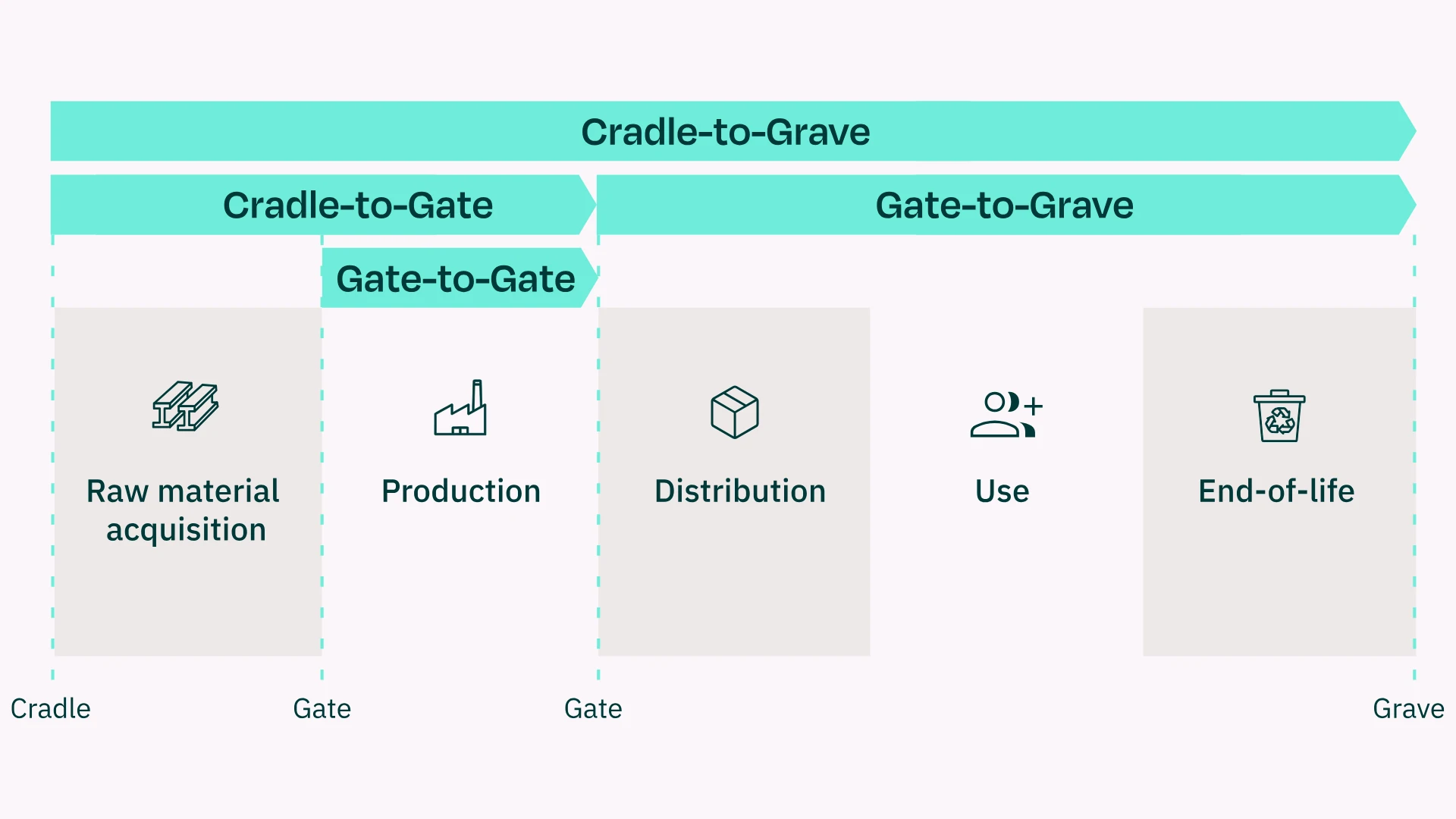
  • Cradle-to-Gate: From raw material extraction to the factory gate.
  • Gate-to-Gate: Covers only your own manufacturing process.
  • Cradle-to-Grave: Extends through use and end-of-life disposal.
  • Gate-to-Grave: From distribution to disposal.
  • Cradle-to-Cradle: In circular models – includes recycling.
Overview on PCF System Boundaries

Why is the PCF important for my company?

Regulatory requirements

The PCF plays a key role in ensuring compliance and meeting reporting obligations. Climate-related product data is required in many European regulatory contexts, including:

  • CSRD
  • CBAM
  • Green Claims Directive
  • Empowering Consumers for the Green Transition Directive (EmpCo Directive)
  • Environmental Product Declarations (EPDs) and the Construction Products Regulation (CPR)
  • Digital Product Passport / Ecodesign for Sustainable Products Regulation (ESPR)
  • Battery Regulation
  • Coming soon: EU Strategy for Sustainable and Circular Textiles

Market expectations and long-term business value

Even beyond regulatory requirements, the PCF is a valuable tool for any company pursuing a climate strategy.

  • Climate change is putting global supply chains at risk. To respond with more sustainable business practices and reduce emissions, companies first need to understand their own impact and identify hotspots. Low-emission products carry fewer risks.
  • In general, ESG data is becoming increasingly important in financing and procurement decisions.
  • Customers also expect honest and credible information about product sustainability.
  • The PCF brings climate action out of the abstract and into daily operations. With reliable PCF data, you can benchmark your value chain, compare products on the market, prioritize investments and base decisions on measurable impact.

The PCF as a steering tool

If your company is just starting out with climate management, it may be unclear where to focus first. You may already have ambitious climate goals—but still lack the data to confidently say how and whether those goals can be achieved.

This is exactly where the PCF comes in:

  • It provides reliable and transparent data
  • It pinpoints where emissions occur across a product’s production and use
  • It enables data-driven decisions in procurement and product development
  • It lays a solid foundation for your decarbonization strategy

The PCF as a strategic lever

A PCF is more than just a single emissions figure. It creates transparency at the product level—and becomes a strategic lever across multiple areas of the business:

  • Product development: The PCF helps identify emission-intensive components and evaluate alternatives. This allows you to systematically reduce the carbon footprint of individual products.
  • Procurement: Knowing where your emissions hotspots are enables you to take targeted action and make your supply chain more climate-friendly.
  • Sales and marketing: A traceable PCF can strengthen a product’s sustainability profile – provided the communication is honest and well-founded. It gives you a solid basis for credible green claims.
  • Strategy and planning: The PCF highlights where emission reduction potential lies within components and the value chain. It also shows which products are environmentally viable and how to systematically decarbonize your portfolio.

PCF, CCF and LCA: Differences and how they relate

When working on your company’s or products’ carbon footprint, you’ll often come across the abbreviations PCF, CCF and LCA. These three concepts are closely connected but differ in focus and scope:

Corporate Carbon Footprint (CCF) Product Carbon Footprint (PCF) Life Cycle Assessment (LCA)
Definition Total greenhouse gas emissions of a company Greenhouse gas emissions of a product across its entire life cycle  Comprehensive environmental footprint of a product across its entire life cycle 
System boundary All company activities (operations, vehicle fleet, supply chain, etc.)  The complete product life cycle (raw materials, production, use, disposal)  The complete product life cycle including upstream and downstream processes
Objective Overview of company emissions, management of climate targets and reduction measures Determining the climate impact of a product, basis for ecodesign and supply chain requirements Analysis and evaluation of all environmental impacts of a product (not just CO₂)
Relevance Basis for climate strategy, carbon footprint, CSRD reporting, climate targets Relevant for customer requirements, product development, ecodesign, supplier assessments Basis for EPDs, life cycle assessments, ecodesign standards and environmental labeling 
Data sources Energy data, business trips, vehicle fleet, procurement, production, suppliers, distribution Material and process data, supplier data, usage scenarios, end-of-life treatment  Extended product and process data, including water, energy, raw material and land use
Scopes Scope 1, 2 and 3 according to GHG Protocol Scopes not applicable; based on the product life cycle  Scopes not applicable; based on the product life cycle 
Addressees Executive management, investors, banks, regulatory authorities, general public  Customers, procurement, product development, suppliers, end consumers  Sustainability managers, LCA specialists, environmental officers, building and product certification bodies 

In short: The PCF focuses solely on the climate impact of a product within this broader framework. If you’re calculating emissions at the product level, you’ll often use the same methods, data and system boundaries as for an LCA – but the PCF narrows the analysis to greenhouse gas emissions only.

7 steps to your first Product Carbon Footprint

A reliable PCF lays the foundation for strategic decision-making, targeted decarbonization, compliance with CBAM and other regulations, and credible sustainability communication.

Our practical PCF guide shows you how to get started – step by step, with a clear structure.

You want to automate your PCF calculation? Learn how VERSO’s PCF Calculation software simplifies the process.

Guide: 7 steps to your Product Carbon Footprint

Determine the emissions of your products in 7 steps: This guide takes you through the PCF calculation in an understandable way.

*This information is summarized editorial content and should not be considered legal advice. VERSO assumes no liability.

Corporate Carbon Footprint (CCF) – smokestacks representing company greenhouse gas emissions
26.06.2025

How is the Corporate Carbon Footprint (CCF) Calculated?

What are your company’s CO₂ emissions – and how can they be reliably calculated? This article explains why the Corporate Carbon Footprint matters—and how to approach it step by step.

The Corporate Carbon Footprint (CCF) refers to the total greenhouse gas emissions a company causes, both directly and indirectly—from office heating to global supply chains. It is calculated based on Scopes 1, 2, and 3 as defined by the Greenhouse Gas Protocol. Scope 3 is particularly critical, as it often accounts for more than 70% of total emissions. Calculating the CCF is a prerequisite for setting effective climate targets, implementing reduction measures, and communicating sustainability efforts credibly. For many companies, it is increasingly becoming a requirement—whether driven by legislation, market expectations, or customer demands.

Content:

Why the Corporate Carbon Footprint matters now

The pressure on companies to understand and reduce their emissions is increasing. Not only due to legal requirements such as the EU Climate Law, CBAM, or the CSRD: More and more companies are being asked to provide climate-related data – whether in tenders, across supply chains, or as part of voluntary sustainability reporting.

Especially for mid-sized businesses, the Corporate Carbon Footprint is becoming a key competitive factor. Those who know their carbon footprint can take targeted action, reduce risks, and position themselves sustainably in the market.

What is the Corporate Carbon Footprint?

The Corporate Carbon Footprint (CCF) refers to the total greenhouse gas emissions a company causes – both directly and indirectly – from office energy use to the entire supply chain.

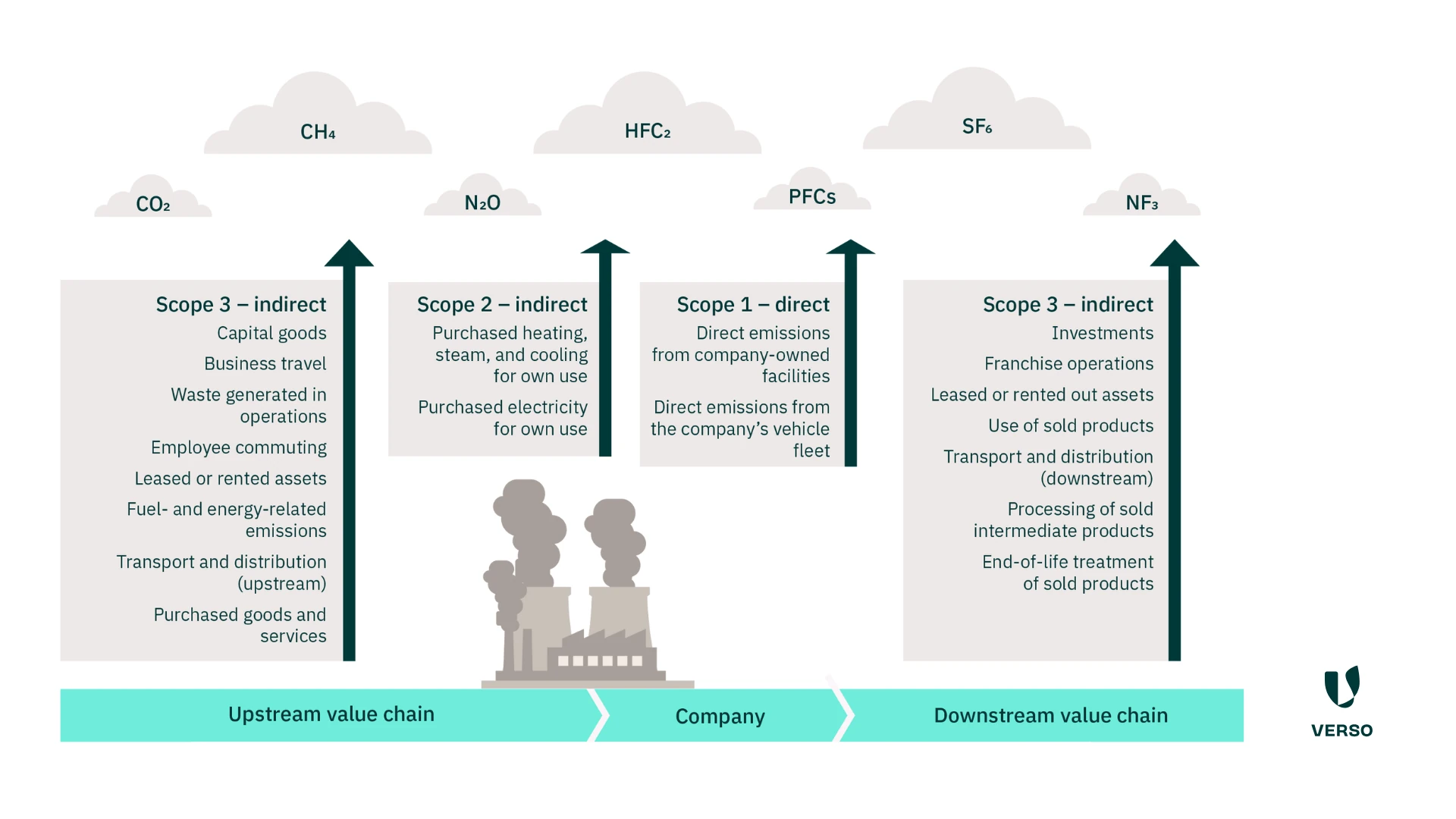
The CCF illustrates how much CO₂ and other greenhouse gases a company emits through its business operations. It typically follows internationally recognized standards such as the GHG Protocol, which categorizes emissions into three scopes: Scope 1 (direct emissions), Scope 2 (indirect emissions from purchased energy), and Scope 3 (other indirect emissions).

The three scopes for calculating the corporate carbon footprint (CCF) according to the GHG Protocol

What is the difference between the CCF and the PCF?

While the CCF looks at a company’s overall carbon footprint, the Product Carbon Footprint (PCF) focuses on a single product. It analyzes the emissions generated throughout the product’s entire life cycle, from raw material extraction and production to transportation, use, and disposal. Both concepts complement each other and are essential building blocks for credible climate action within companies.


Aspect Corporate Carbon Footprint (CCF) Product Carbon Footprint (PCF)
Definition Total greenhouse gas emissions of a company Greenhouse gas emissions of a single product throughout its entire life cycle
System boundary All company activities (operations, vehicle fleet, supply chain, etc.) The complete product life cycle (raw materials, production, use, disposal)
Objective Overview of company-wide emissions, management of climate targets and reduction measures Assessment of a product’s environmental impact, foundation for eco-design and supply chain requirements
Relevance Foundation for climate strategy, carbon accounting, CSRD reporting, climate targets Relevant for customer requirements, eco-design, product development, supplier assessments
Data sources Energy data, business travel, vehicle fleet, procurement, production processes, suppliers, distribution Material and process data, supplier data, usage scenarios, disposal routes
Scopes Scopes 1, 2, and 3 according to the GHG Protocol Scopes not applicable; assessment based on the product life cycle (e.g., cradle-to-gate, cradle-to-grave)
Target audience Executive management, investors, banks, regulatory authorities, general public Customers, procurement, product development, suppliers, end users


Step by step toward a reliable PCF

Want to know how to accurately calculate the emissions of your products—and what it really takes? You’ll find everything you need in the practical PCF guide.

Why is Scope 3 so important?

Many companies start with Scope 1 and 2 – and that often makes sense. These data points are usually easier to access: energy consumption, vehicle fleets, or heating systems can typically be tracked internally without much effort.

Scope 3, on the other hand, is more complex but also critical. Why? Because it covers everything that happens outside a company’s direct operations. And that’s usually where the majority of emissions occur: for many companies, Scope 3 accounts for over 70% of total CO₂ emissions and in some industries, it can be as high as 95%.

Despite the challenges, it’s essential to include all three scopes to gain an accurate picture. Ignoring Scope 3 often leads to a serious underestimation of a company’s climate impact and means missing out on valuable opportunities.

Why? Because Scope 3 often holds surprisingly straightforward levers for reduction, such as switching suppliers, optimizing logistics, or improving product design. These opportunities only become visible when Scope 3 is systematically included in the assessment.

Our tip: Even if you don’t have precise data yet, rough estimates can still provide valuable insights. And they’re far better than doing nothing at all.

Which companies is Scope 3 especially relevant for?

Scope 3 is relevant for all companies including mid-sized businesses. Why?

Many mid-sized companies have:

  • complex or global supply chains,
  • components and materials they don’t produce in-house,
  • transport and logistics structures over which they have limited direct control.

All these emissions fall under Scope 3. For these companies, this means: even if their own operations are energy-efficient, the majority of emissions may occur in upstream or downstream processes – precisely where gaining insight and influence becomes particularly important.

How is the Corporate Carbon Footprint calculated?

Calculating the Corporate Carbon Footprint (CCF) involves several clearly structured steps. The goal is to create a reliable and plausible CO₂ balance for the company that serves as a foundation for management decisions, reduction measures, and external reporting.

1. Scope screening: Defining system boundaries

  • Determining the systematic, organizational, and operational boundaries in line with the GHG Protocol.
  • Deciding which emission categories (Scopes 1, 2, 3) and subcategories will be included.
  • Defining the consolidation scope: Which sites, entities, and company sizes are covered?

2. Responsibilities and project organization

  • Defining who is internally responsible for data collection and preparation.
  • Aligning on the approach, responsibilities, and timeline
  • Holding a joint kickoff meeting with all relevant departments.

3. Data collection within departments

  • Gathering relevant activity data from the departments involved.
  • Closing data gaps through extrapolations and well-founded assumptions.
  • Reviewing whether reliable emission factors are already available or need to be added.
  • Collecting specific data, such as employee commuting patterns, and sending targeted supplier requests to capture upstream emissions.

4. Data validation

  • Reviewing and verifying the collected data, ideally with support from external experts to ensure data quality.

5. Evaluation and interpretation of results

  • Joint analysis of the results with the company.
  • Identification of emission hotspots and priority areas.
  • Discussion on whether additional data needs to be gathered in more detail (e.g., follow-up supplier requests).
  • Discussion on whether additional data needs to be gathered in more detail (e.g., follow-up supplier requests).

What happens after the carbon footprint has been calculated?

The carbon footprint is a key part of any decarbonization strategy – but it’s only the beginning. Calculation alone is not enough. It’s the foundation for taking the next targeted steps:

  • Define measurable climate targets and actions
  • Effectively reduce greenhouse gas (GHG) emissions
  • Responsibly offset unavoidable emissions
  • Responsibly offset unavoidable emissions
    Communicate progress and potential transparently

We support you: with software and expertise

Whether you’re working on a Corporate or Product Carbon Footprint or developing a decarbonization strategy: We support you wherever you need it.

Our climate software is built for both climate professionals and beginners. It lets you structure your data in the way that works best for you, whether for reporting, internal management, or external requirements related to communication or compliance.

And if you’re looking for additional sparring or targeted guidance, our Climate Experts are here to help. Because one thing is clear: only those who truly understand their emissions can take effective action.

Questions and answers about the Corporate Carbon Footprint (CCF)

Everything you need to know about calculating, scoping, and reporting your company’s greenhouse gas emissions.

What’s the difference between the Corporate and Product Carbon Footprint?

The Corporate Carbon Footprint (CCF) shows how much CO₂ a company emits overall, from office heating to the supply chain. The Product Carbon Footprint (PCF) focuses on a single product, from raw materials to disposal. Simply put: CCF = company perspective, PCF = product perspective.

How often should the carbon footprint be calculated?

At least once a year, ideally as part of the sustainability report. This makes it easier to track progress and manage measures effectively. Those with ambitious goals can also reassess quarterly.

Is the Corporate Carbon Footprint mandatory?

Not in general, but for many companies, it effectively becomes mandatory due to reporting obligations such as the CSRD, CBAM, industry-specific requirements, or customer expectations. And without knowing their footprint, companies will struggle to speak credibly about climate targets.

Which companies is the CCF relevant for?

For all companies that want to act responsibly and build a future-proof business. It becomes especially relevant when investors, customers, or regulations demand transparency – and that’s happening more and more often.

How accurate are the results?

In general, the calculation is only as accurate as the data it’s based on. Scope 1 and 2 data are usually solid, while Scope 3 tends to be more complex. What matters is this: even rough estimates provide valuable insights – and they’re far better than doing nothing.

Is it enough to calculate just Scope 1 and 2?

As a starting point: yes. For a complete picture: no. In many companies, the majority of emissions fall under Scope 3, such as those in the supply chain. Ignoring them means missing out on key levers for reduction.

What is the Greenhouse Gas Protocol?

The GHG Protocol is the global standard for corporate carbon accounting. It defines what belongs to Scope 1, 2, and 3, and ensures that carbon footprints are consistent, comparable, and transparent.

* This information is summarized editorial content and should not be construed as legal advice. VERSO accepts no liability.

Nachhaltiges Wirtschaften im Mittelstand
23.04.2025

Sustainable Business Practices: The Business Case for SMEs

Stakeholders, ESG obligations, or simply conviction – For many reasons, sustainability is on the agenda of companies. Whether mandatory or voluntary: sustainability must not only be promised, it must be implemented. This article explains why sustainable business practices are important for all companies – from SMEs to large corporations.

Why is sustainable business important for small and medium-sized enterprises (SMEs)?

Sustainability creates transparency in the supply chain

Sustainable business practices are becoming a prerequisite for medium-sized companies to remain supply-capable and competitive in the long term – as large companies today expect full transparency across the entire supply chain.

Many small and medium-sized enterprises (SMEs) supply products or materials to larger companies that are subject to legal requirements such as the Supply Chain Due Diligence Act (LkSG), the Corporate Sustainability Reporting Directive (CSRD), the EU Deforestation Regulation (EUDR), etc. These companies are often also bound by industry-specific guidelines that demand sustainability information from the supply chain.

Large companies must not only disclose their own ESG information but also that of their suppliers. This means that you, as a supplier, are also affected by the regulations and will be asked for extensive sustainability information:

  • You will need to undergo thorough due diligence processes, such as the EcoVadis sustainability assessment, which identifies potential risks to people and the environment in the supply chain.
  • Proof must often be provided not only by suppliers but also by sub-suppliers.

Sustainability as a factor for financing

Sustainable business practices not only improve the ESG rating but also provide access to better financing terms – whether for loans, investments, or insurance.

Medium-sized companies seeking capital from investors or loans from banks should be prepared for ESG inquiries. In practice, the ESG rating directly influences credit terms – the better the rating, the more favorable the loan conditions.

Investors are also increasingly incorporating ESG criteria into ratings and M&A decisions. At the latest, during transactions or investment decisions, robust sustainability metrics will be expected from you.

In addition, (re)insurers also require ESG information from their clients. Sustainability risks are increasingly being incorporated into the risk assessment during contract negotiations, which can directly impact insurance premiums and coverage.

Sustainability expectations from customers and business partners

Anyone who wants to have a say, collaborate, or bid today needs a clear sustainability position – because ESG criteria are increasingly determining partnerships and contract awards.

In partnerships, collaborations, and tenders, certifications and ESG information are increasingly being requested to demonstrate a company’s sustainability ambitions. When entering negotiations, you need to be well-prepared:

  • No Open Doors without ESG Certifications: A prerequisite for serious discussions – alongside, for example, well-known standards for information security – are increasingly ESG-related certifications. Undergo the assessments early – they are often time-consuming and cannot be “quickly submitted.”
  • Sustainability and ESG Criteria in Tender Processes: If there is a tender, your company might be excluded from consideration due to the lack of a robust sustainability strategy. This is demonstrated, among other things, through recognized ESG certifications. With sustainability and ESG criteria in tender processes, companies want to ensure from the outset that ecological and social standards are adhered to in the supply chain.
  • Sustainability also plays a significant role in other quality standards, such as Fairtrade, organic certifications, employer rankings, or ISO standards: ESG criteria are also requested here.

Protection against greenwashing accusations

Simply labeling oneself as “green” is a thing of the past. With the Green Claims Directive and the EmpCo Directive, the EU specifically outlines what constitutes greenwashing and what does not.

  • Soon, companies will be required to scientifically verify the accuracy of their environmental claims. Failure to do so will not only result in reputational damage, but also actual legal and financial consequences.

You certainly do not intentionally engage in greenwashing, but it can easily happen unintentionally in small and medium-sized enterprises: many greenwashing accusations originate from marketing activities that portray the company in too favorable a light. This often happens when a company’s sustainability data is not transparent.

A climate and sustainability strategy ensures transparent sustainability communication: through a data-driven strategy, KPI tracking, and a CO2 balance, you can communicate numbers, facts, and goals in a verifiable manner.

Improved risk management and resilience

A solid sustainability strategy helps you identify ecological and social risks early – not just within your company but throughout the entire value chain. The foundation for this is the Double Materiality Analysis, which adds a holistic ESG perspective to your existing risk management – including the consideration of opportunities.

This allows risks to be assessed in a targeted way, measures for avoidance or reduction to be derived, and their impact in ESG management to be systematically monitored. This makes your company more resilient to climate impacts, geopolitical changes, or resource shortages – while also saving costs and preventing future losses.

Efficient resource use and optimized processes

A well-thought-out sustainability management system helps you use resources more efficiently. It drives process optimizations and innovations – for example, through energy-saving machines or the recycling of production waste. This saves raw materials, reduces costs, and protects the environment.

With effective ESG management, you not only reduce waste and energy consumption but also save time: you focus on the truly important issues – and can drive them forward in a targeted way. A clear advantage for the future viability of your company.

Holistic corporate strategy and future viability

Individual measures are of little use if the strategic connection is missing. A sustainability strategy provides the necessary overall view: All measures are part of a larger plan – rather than isolated individual initiatives.

The foundation for this is the Double Materiality Analysis, which helps you identify the most important topics. This results in a long-term, systematic strategy – ideally integrated into your corporate strategy. In this way, sustainability becomes a top priority and is managed, measured, and communicated in a targeted manner – for example, with a suitable software solution like the VERSO ESG Hub.

How do you embed sustainability in your company?

For sustainable business practices to be more than just a good intention, they must be deeply embedded in the company. This is achieved with the following building blocks, which demonstrate how small and medium-sized enterprises can move into action in a structured and impactful way.

1. status quo and material topics

Before developing a sustainability strategy, a solid status-quo analysis is needed as a foundation – it provides transparency on data, processes, and challenges within the company. Building on this, a materiality analysis highlights which ESG topics are truly material and where the greatest impacts, risks, and opportunities lie.

2. Setting SMART goals and appropriate measures

Goals are the heart of any sustainability strategy and should be scientifically grounded, formulated in a SMART way, and closely linked to the corporate strategy to avoid conflicts of interest. The development of appropriate measures is crucial for implementation – ideally in collaboration with employees and relevant stakeholders who can contribute practical solutions.

3. Creating awareness for sustainability across the company

Sustainability is a company-wide team project – and that’s why it requires a shared awareness and clear alignment. When developing your sustainability strategy, you should define vision, mission, and values to provide direction, motivate employees, and anchor the topic effectively in the overall strategy. Being transparent about ambitions and strategically using internal communication lays the foundation for living sustainability throughout the company.

4. Moving into implementation: Control is key

After the strategy, the real work begins: Implementing ESG measures is a long-term process that requires continuous adjustment and perseverance. To maintain an overview and be able to respond flexibly to new developments, structured ESG management, regular monitoring, and transparent communication – both internally and externally – are essential. Only in this way will progress remain visible, stakeholders stay engaged, and motivation within the company be maintained.

Start with VERSO

Now it’s time to move from planning to action. We support you every step of the way – with the right software solutions and services throughout your entire sustainability journey: from the first report and goal setting to tracking concrete measures. Step by step, you will build the foundation for sustainable business practices in your company.

Subscribe to our newsletter!

Sign up and receive regular news about:

  • Current ESG topics and legislative changes
  • Individual advice from the VERSO experts
  • News about VERSO
  • Trusted by 250+ customers

Sign up now!

So finden Sie die richtigen Projekte zur CO2-Kompensation – ohne Greenwashing
16.10.2024

CO₂ Compensation – How to Make it Work Without Greenwashing

What to do with unavoidable greenhouse gas emissions? In this article, you will learn how to tackle carbon offsetting – with effective projects and without greenwashing.

Your carbon footprint and climate strategy have been drawn up and you are already reducing the first greenhouse gas emissions. But it is slowly becoming clear: Despite all your efforts, you will be left with certain residual emissions! What to do with the unavoidable emissions? If you are also faced with this question, this article is for you. Because of course, CO₂ compensation is the obvious solution. But…

Careful – Carbon offsetting is a double-edged sword

Carbon offsetting has long been a contentious issue. Quite rightly so, as the situation on the carbon market is actually not so rosy: the voluntary carbon market is currently not regulated by either state supervision or a binding legal framework. Instead of legally binding criteria for the validation of carbon offsetting, there are only a number of private standards and registries with different quality criteria. This makes the market structure opaque and leads to major differences in quality within the climate protection projects on which the so-called CO₂ credits are based. One example: Deutsche Umwelthilfe (DUH) has already successfully filed several lawsuits against offsetting through forest projects and reforestation. The reasons: The estimated forest area could not offset the amount of CO₂ emitted at all or the project did not run long enough to keep up with the lifespan of CO₂ in the atmosphere. This leaves you with two problems:

  1. You cannot rely solely on the information provided by standards and registers for quality assurance
  2. At the same time, your company is expected to report truthfully, as greenwashing is penalised.

Actually, you should now take another look at the certified projects yourself. As you can imagine: It will be time-consuming. With the following factors, we will show you how to efficiently select reputable carbon offsetting projects.

Guide to the decarbonisation strategy

A holistic decarbonisation strategy or climate strategy is more than helpful when implementing climate targets, transition plans and carbon footprints. With this guide, you can get started right away!

6 factors for the selection of serious projects for CO₂ compensation

1. Impact

The projects should have measurable positive effects on the environment that, where possible, go beyond the mere reduction of CO₂ emissions. This includes the protection of biodiversity, but also the improvement of air and water quality as well as the restoration and preservation of ecosystems (co-benefits). A strong environmental impact means that the selected project makes a holistic contribution to environmental protection.

2. Methodology and verification

The projects should be based on recognised scientific methods and standards. They should also be regularly reviewed by independent third parties to ensure the reliability of the emission reductions claimed.

3. Durability and monitoring

It is important that projects are monitored throughout their entire duration to ensure that emissions are actually reduced in the long term. Regular monitoring and reporting help to recognise risks at an early stage and take countermeasures. This ensures the long-term impact of the project.

4. Additionality

Projects are considered additional if they would not have been realised without the expected income from the proceeds of emission allowances. This requires a more detailed analysis and assessment of the initial scenario (project baseline).

5. Double counting

The project of your choice must guarantee that the emission reductions are not sold more than once or claimed by different parties. This protects the integrity of the carbon market.

6. Embedding in the climate strategy

CO₂ offsetting should really only be an option if you have already exhausted all potential for reducing emissions as part of your climate strategy. A serious project should be part of a comprehensive climate strategy and should never be considered in isolation. This ensures that the measures make a meaningful contribution to your overall climate goals and are not just used for ‘greenwashing’.

What you should take away from this article

If you want to offset emissions, you should therefore not choose the first offset project that comes along. Use our tips to select a project with a real impact! And remember: climate neutrality can only be achieved with close coordination between your carbon footprint, decarbonisation strategy, greenwashing awareness and reputable climate and environmental protection projects to offset your unavoidable residual emissions.

Looking for support with your CO₂ management?

As you can see, choosing the right projects for your CO₂ offsetting is not that easy. And who knows, maybe you can still reduce greenhouse gas emissions in one place or another? We would be happy to look at this with you. We will guide you through your decarbonization strategy with climate consulting and CO₂ software.

* This information is summarized editorial content and should not be construed as legal advice. VERSO accepts no liability.