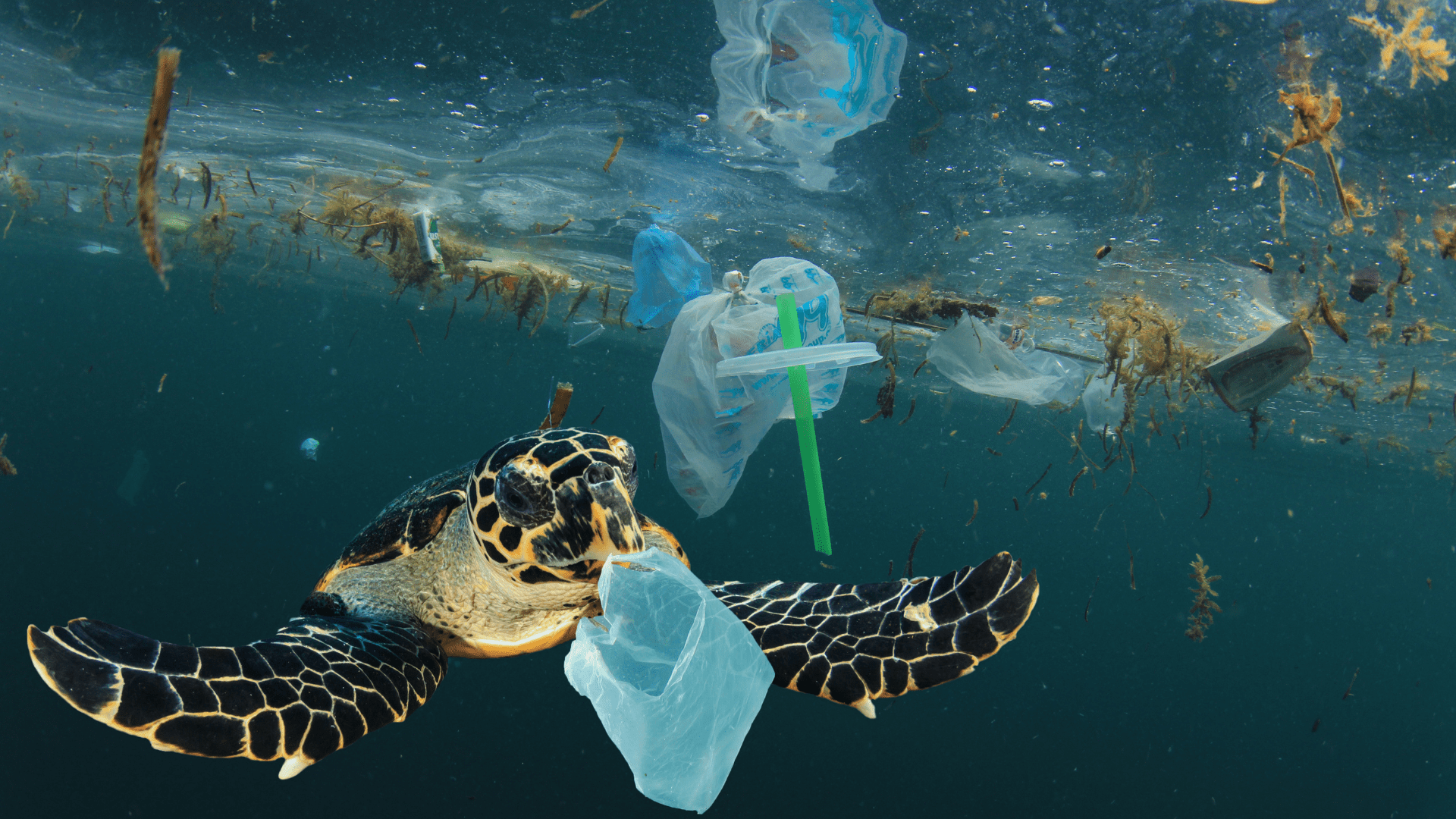

Meeresschildkröte, die durch Plastikmüll schwimmt: Mit der neuen EU-Richtlinie gegen Greenwashing sollen solche Bilder seltener werden
10.06.2026

From the Green Claims Directive to EmpCo: The New Rules Against Greenwashing Starting September 2026

The Green Claims Directive was intended to establish clear, EU-wide rules against greenwashing, but it was withdrawn in June 2025. Instead, EmpCo becomes binding. As a result, new requirements take effect on September 27, 2026, governing which environmental claims companies are still permitted to make.

Green Claims Directive & EmpCo: Tools Against Greenwashing

The Green Claims Directive was intended to establish clear, EU-wide rules against greenwashing, but it was withdrawn in June 2025. Instead, EmpCo becomes binding. As a result, new requirements take effect on September 27, 2026, governing which environmental claims companies are still permitted to make. In this article, we provide an overview of the developments surrounding greenwashing regulation and take a closer look at the requirements introduced by the new EmpCo.

Many Environmental Claims Do Not Hold Up to Scrutiny

In January 2023, DIE ZEIT and The Guardian published an investigation into Verra, the leading provider of carbon credits. According to their findings, a portion of the emission credits that companies used to offset their greenhouse gas emissions did not deliver real reductions. A study by the European Commission painted a similar picture: more than half the environmental claims made by companies in the EU were vague or misleading, and roughly 40% were entirely unsubstantiated. Many green labels are of little help either, since half of them are barely verified, if at all.

The result is something most people know from their own experience: consumers can barely tell which claim actually delivers on its promise. And companies that properly substantiate their statements get lost in the jungle of labels and claims.

Greenwashing: The 5 Biggest Pitfalls

100% sustainable, climate-neutral, or bioplastic – what’s printed on a product isn’t always accurate. Greenwashing often happens unintentionally. In this article on the five most common pitfalls, you’ll learn what the traps are and how to avoid them.

The Green Claims Directive Was Meant to Address This, but It’s Off the Table

On March 22, 2023, the EU Commission presented a draft of the Green Claims Directive (GCD). It was intended to require companies to substantiate their environmental claims scientifically, have them independently verified, and communicate them transparently.

But it didn’t get that far. In June 2025, the EU Commission withdrew the proposal after it lacked a majority in the trilogue and, among others, Italy and the EPP withdrew their support. The main criticism centered on the anticipated bureaucratic burden and the planned inclusion of micro-enterprises.

Anyone breathing a sigh of relief now, however, is mistaken. The Green Claims Directive is not the only regulation against greenwashing, just the best known. The requirements that will actually affect companies starting in fall 2026 have long been settled.

What Is Now Binding: The EmpCo Directive

The Empowering Consumers Directive (EmpCo, an EU directive) already entered into force on March 26, 2024. Member states had to transpose it into national law by March 27, 2026, and it must be applied as binding law starting September 27, 2026. In Germany, implementation takes place through an amendment to the Act Against Unfair Competition (UWG).

EmpCo regulates much of what the Green Claims Directive set out to do, just through a different mechanism: not through a new verification procedure, but through existing competition law. Certain environmental claims will henceforth be considered inherently unfair. This means there is no longer any need for a case-by-case assessment of whether a claim is misleading, it is simply prohibited.

Which Claims EmpCo Prohibits Starting September 2026

EmpCo identifies four categories that will no longer be permitted without solid evidence:

  1. General environmental claims without recognized proof of performance
    Terms such as “environmentally friendly,” “green,” “eco,” “sustainable,” “climate-friendly,” or “biodegradable” may only be used if backed by recognized, outstanding environmental performance. This also applies to implicit claims: green leaves, globe symbols, or water droplets on packaging likewise fall under this rule if they suggest an environmental benefit that is not substantiated.
  2. Carbon-neutrality claims based on offsetting
    Statements such as “climate-neutral” or “carbon-neutral” that rely on purchased credits are no longer permitted. Climate-related claims must refer to real emission reductions within the company’s own value chain.
  3. Self-created sustainability labels
    In-house “eco” or “green” logos without an independent basis are prohibited. Only labels based on a system recognized by authorities or certified by independent third parties remain permissible.
  4. Whole-product claims for a partial aspect
    Anyone who prints “made with recycled material” on a product when only the packaging is meant leaves themselves open to challenge. The precise version that transparently states the scope remains permitted, for example, “packaging is made from 90% recycled PET.”

One important point here: forward-looking promises such as “climate-neutral by 2030” are not prohibited outright, but they are subject to conditions. They must be based on a measurable, verifiable implementation plan and monitored by an independent body.

Who Does EmpCo Apply To?

The directive affects all companies that market products or services to consumers in the EU, regardless of size, revenue, or industry. Manufacturers based outside the EU are also covered as soon as they target EU end customers. Unlike the Green Claims Directive that was under discussion, EmpCo does not exempt micro-enterprises.

What’s at Stake for Violations of EmpCo

Advertising with unsubstantiated environmental claims will be subject to cease-and-desist actions and can be penalized with fines. In the case of serious violations, fines of up to 4% of annual revenue in the member state concerned are possible. On top of this come reputational risks: a publicly challenged claim often damages credibility more than any fine.

This is not an entirely new risk, by the way. Back in June 2024, the Federal Court of Justice ruled that advertising a product as “climate-neutral” without explaining whether this is based on avoidance or offsetting is misleading. EmpCo merely makes enforcement considerably easier starting September 2026.

What You Should Do Now

The deadline for implementing EmpCo is no longer far off. Anyone planning product packaging, campaigns, or website copy with a longer lead time is already working today on material that will go live in September 2026.

Three steps are worth taking now:

  • Claim inventory: Which environmental claims are you currently using—on packaging, your website, in advertising, and in your sustainability report?
  • Evidence mapping: For each claim, check whether solid evidence exists and where it is located.
  • Approval process: Define who signs off on an environmental claim before it is published, so that marketing, legal, and sustainability work together.

The core principle remains simple: you may only claim what you can prove. And that requires a solid data foundation. Greenwashing rarely stems from intent. It usually arises when sustainability is communicated without a sound data basis.

We support you with your sustainability communication

Solid claims require solid data. With the VERSO ESG Hub, you capture your sustainability data in a structured and traceable way, from the data source through to the reporting basis. This makes it possible to demonstrate what each claim is based on. For the communication itself, our Sustainability Consultants support you. They help you publish meaningful information while staying truthful, whether in your sustainability report or in other internal and external formats.

* This information is summarized editorial content and should not be construed as legal advice. VERSO accepts no liability.

Subscribe to our newsletter!

Sign up and receive regular news about:

  • Current ESG topics and legislative changes
  • Individual advice from the VERSO experts
  • News about VERSO
  • Sustainability Events and more

Sign up now!

Sustainable Development Goals (SDGs)
09.06.2026

Sustainable Development Goals (SDGs): What the Sustainability Goals Mean for Companies

This overview tells you everything you need to know to put the Sustainable Development Goals (SDGs) into context for your company.

Sustainability: Licence to Operate

Customers, employees, and other stakeholders are asking about the societal, social, and environmental impacts your business activities have. It is becoming increasingly clear that corporate sustainability is turning into a “license to operate.” ESG management therefore needs to be approached (more) strategically, or even for the very first time. This article explains how the Sustainable Development Goals, or SDGs, can help you do exactly that.

Whenever the implementation of sustainability in companies is discussed today, the United Nations Sustainable Development Goals (SDGs) are a firm part of the agenda. This framework helps to shape ESG management strategically within a company. At the outset, however, it is often unclear how the SDGs can actually be operationalized and integrated into a company’s sustainability strategy.

In this overview article, you will learn everything you need to know to put the Sustainable Development Goals (SDGs) into context for companies for the first time. We introduce the origins of the SDGs as well as the role companies play. Above all, though, we give you answers to one key question: How can your company become a proactive part of sustainable development? But let’s start at the beginning.

The History of the SDGs: From the Brundtland Report to the 2030 Agenda

The debate around the sustainable development of society, the economy, and the environment, which reached a broader public with the publication of the so-called Brundtland Report “Our Common Future” in 1987 (World Commission on Environment and Development), remains as relevant today as ever. Over several stages of development, the global objectives of this debate have found their way into the Sustainable Development Goals (SDGs) published by the United Nations.

Sustainable Development Goals Today: Current Status of the SDGs and Their Relationship to the CSRD

Adopted in 2015, the SDGs are now ten years old, and the midpoint assessment is weak. According to the Sustainable Development Report 2025 and the 2025 UN progress report, not a single one of the 17 goals is on track to be achieved globally by 2030. Fewer than one in five targets is on schedule. Progress is being made primarily on foundational issues such as health and access to electricity, while the structurally difficult goals are lagging behind.

For companies, the role of the SDGs has shifted during this period. Today they serve above all as an understandable, communicable framework: 17 goals, memorable icons, recognized worldwide. This makes them useful for putting your own sustainability work into context and telling its story, whether in reports, on your website, or in your strategy. This connection is still frequently seen.

Actual management, however, now runs through other instruments. The CSRD and ESRS, along with supply chain laws ranging from the LkSG to the CSDDD, the EUDR, and CBAM, now set the pace. These requirements are mandatory; the Sustainable Development Goals are not. Referencing the SDGs alone is therefore no longer a hallmark of a frontrunner. It has largely become standard, and without robust data to back it up, it quickly starts to look like greenwashing.

The SDGs After 2030: What Comes Next for the UN Sustainability Goals?

As the name suggests, the 2030 Agenda expires in 2030. This raises the question of what comes next, and the discussion about it has already begun. At the SDG Summit in September 2027, official negotiations on the post-2031 framework will begin, prepared in part by the Pact for the Future adopted in 2024.

A complete break is not to be expected. Most countries are sticking with the Sustainable Development Goals. What is more likely to be added are additional focus areas such as digital cooperation, the handling of artificial intelligence and data, or intergenerational equity. The SDGs are therefore more likely to be sharpened than replaced.

For companies, this changes little about the actual task at hand. Anyone who builds a clean data foundation and clear responsibilities now will also be well positioned for an adapted framework from 2031 onward. The effort pays off through robust ESG data, not through the SDG logo in a report.

SDGs and Companies: What Role the Economy Plays

This also establishes a framework that defines companies as important actors in sustainable development and offers them support in implementing measures at the regional and operational level. The SDGs emphasize the need for active participation by private companies and appeal to their creativity and innovation to create value for the common good. This includes, for example, reducing poverty, eradicating hunger, and protecting biodiversity.

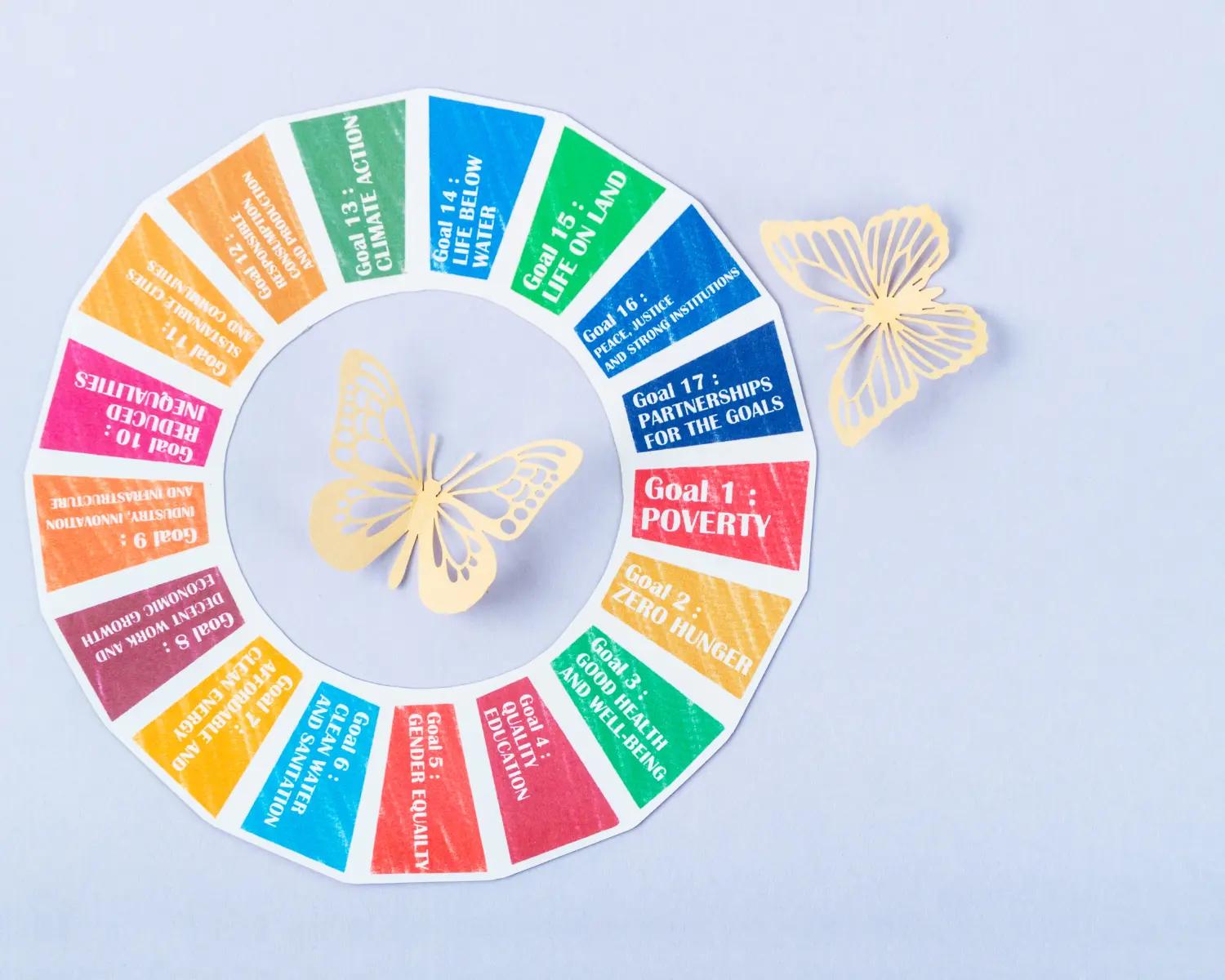
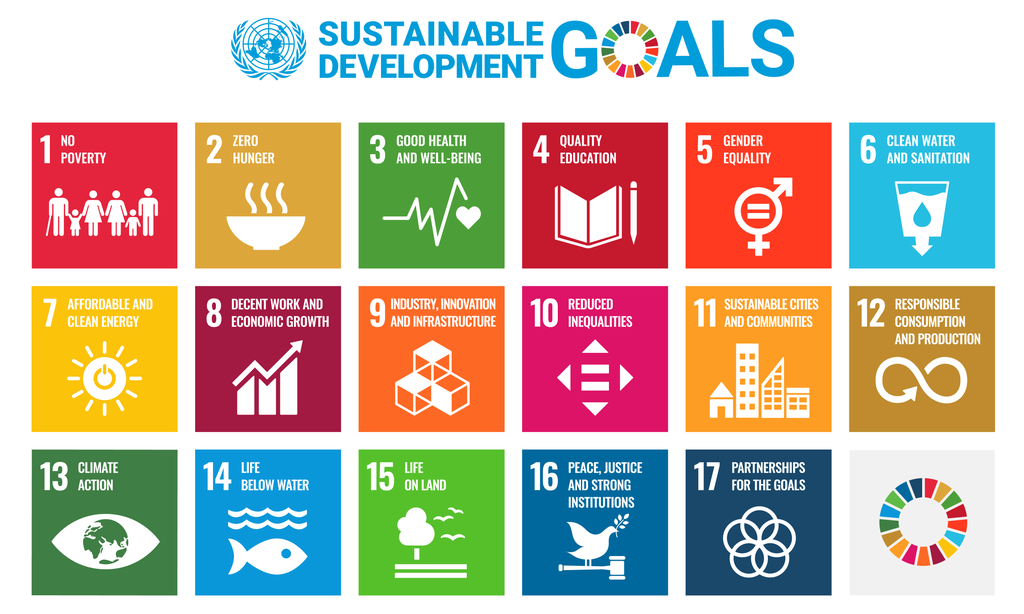
The United Nations 2030 Agenda and its 17 Sustainable Development Goals present companies with the new challenge of aligning their operations and strategies with the requirements of the SDGs.

Sustainable Development Goals

Tackling the Sustainable Development Goals (SDGs) in Your Company

So what exactly do you need in order to meaningfully dedicate yourself to the Sustainable Development Goals and to sustainability in general? Two foundational pillars are decisive to begin with:

  1. Organizational and substantive responsibility assigned to an ESG/sustainability officer.
  2. A single place to consolidate all sustainability-relevant data.

Without these two basic prerequisites, it is virtually impossible for an organization to engage further with the topic.

But even with clear substantive responsibility and consolidated data, tackling the Sustainable Development Goals strategically is a task that should not be underestimated and that must be designed on a highly individual basis, depending on company size, industry, and stakeholders.

Consulting firms in the field of sustainability and sustainability reporting, including us here at VERSO, therefore support companies and ESG managers with practical advice every step of the way.

Implementing the Sustainable Development Goals (SDGs) with the GRI and the UN Global Compact

Various internationally recognized guidelines are available to achieve the implementation of the SDGs and their sub-targets within companies’ supply chains. Two of them:

  1. the Global Reporting Initiative (GRI)
  2. the UN Global Compact

Both guidelines propose indicators and key figures for measuring companies’ sustainability performance for each of the UN Sustainable Development Goals. Companies can therefore work toward implementing the global development goals by taking the route of adopting the GRI indicator system.

How Seriously Do Companies Really Take the SDGs?

Some companies already integrate the SDGs deeply into their sustainability strategy and underpin them with concrete indicators and data. For many others, the connection remains superficial. This commitment is usually related to a company’s commitment to other sustainability-related topics, as well as to its size and level of sustainability maturity.

From this, one can conclude that commitment to the Sustainable Development Goals stems partly from regulatory reasons, where existing laws are simply being followed. On the other hand, there are often institutional reasons behind such commitment. A qualitative review of individual sustainability reports shows that company participation is largely symbolic and not yet substantial. This suggests that many companies regard the SDGs—much like the Global Compact—as a framework with non-binding implications.

Conclusion: Why the Sustainable Development Goals Remain a Useful Tool

Despite all the shift toward the CSRD and the like, the SDGs have not lost their value. They give sustainability work a tangible framework, help with prioritization, and create a common language for explaining commitment both internally and externally. That is precisely what they are still good for.

What they do not provide is binding management. That requires robust data, clear responsibilities, and the appropriate reporting standards. Anyone who combines the two—the Sustainable Development Goals as orientation and solid ESG data as a foundation—turns sustainability into more than a box-ticking exercise. And is prepared for what comes after 2030.

We guide you through sustainability

Building a sustainability strategy involves real work. VERSO supports you holistically every step of the way. Since 2010.

* This information is summarized editorial content and should not be construed as legal advice. VERSO accepts no liability.

Subscribe to our newsletter!

Sign up and receive regular news about:

  • Current ESG topics and legislative changes
  • Individual advice from the VERSO experts
  • News about VERSO
  • Sustainability Events and more
Sign up now!

Nachhaltigkeitsmanager:innen sind gefragt – so sieht der Beruf aus
15.11.2024

Trend job sustainability manager: Skills, tasks and further training

Let’s take a closer look at this up-and-coming professional group. What are the tasks of sustainability managers, what training and further education is available and what does their day-to-day work look like?

What distinguishes sustainability managers?

Sustainability managers, also known as CSR managers, sustainability managers or ESG managers, are usually passionately committed to the topic of sustainability and have set themselves higher goals: a fairer world, environmental and climate protection. They exemplify sustainability and motivate their colleagues for ecological and social issues. At the same time, sustainability managers are confronted with the comprehensive ESG regulations. They act as business strategists and cross-functional interfaces within the company to guide it through the sustainable transformation.

Why are sustainability managers important?

In over 14 years of experience in sustainability management, we at VERSO have learned that the sustainable transformation of a company can only be achieved through an effective strategy and clear responsibilities. Why? Sustainability affects all areas of the company. That’s why someone is needed to bring it all together. Sustainability managers take on this interface function. They analyze business processes, implement sustainable business practices and aspects such as environmental protection, employee and human rights. They help medium-sized companies in particular to differentiate themselves massively from the competition. And for some years now, they have also been ensuring ESG compliance in companies.

What does that mean? Sustainability managers are responsible for compliance with the CSRD and are also involved in other regulations such as EUDR, CBAM, CSDDD and LkSG, at least in a supportive capacity. They are also responsible for preparing a sustainability report, including data collection – which many companies now do in accordance with the complex CSRD. They are therefore jointly responsible for the future viability of companies – both from a sustainability and a business perspective.

How is the profession changing?

Sustainability managers often have to deliver a one-man or one-woman show. This is now slowly changing: with the well-known regulations CSRD, EUDR, CSDDD, CBAM and many other ESG-related tasks, it is becoming increasingly important for companies to build a strong sustainability team: A team that is fully committed to minimizing the company’s negative impact as far as possible, implementing sustainability campaigns and positioning the company for long-term sustainability. This is the only way for companies to survive in the long term. And not just survive: Those who take sustainability seriously can also generate real business value from it – more on this in our blog post on the opportunities of CSRD.

The new and complex ESG requirements have also changed the scope of tasks and the skills required of sustainability managers. In the past it was still very much about internal communication, driving ideas for more sustainability and writing reports as a means of communication. Nowadays, ESG managers often find themselves dealing with complicated legal texts, compliance requirements and time consuming data collection. To ensure that there is still time left to implement sustainability measures, it is worth investing in ESG software such as VERSO. In any case, sustainability managers are now required to have a very broad set of hard and soft skills.

What skills do sustainability managers need?

First of all, the so-called “hard skills” – i.e. technical skills or professional competencies that can be learned and are in demand. Below is a selection of some of the skills that are becoming particularly important in view of ESG regulation:

  • Knowledge of sustainability reporting (e.g. CSRD, GRI, ESRS)
  • Understanding of regulations/legislative texts (e.g. LkSG, CSDDD, EUDR)
  • Data analysis and management (e.g. for measuring CO2 emissions, energy consumption)
  • Understanding of value creation and economic activity
  • Project management (planning, implementation and monitoring of sustainability projects)
  • Supply chain management (assessment of environmental impact, supplier selection)
  • Fundamentals of environmental science, sustainability concepts and ecological footprinting

Hard skills can be learned well, and further training courses such as the VERSO Academy can also provide support here. Software is also a big help for skills such as data collection, carbon footprint and supply chain management. In addition to these skills that can be learned, sustainability managers also need special interpersonal skills, the so-called “soft skills”. Among other things, these skills help to effectively implement sustainability in companies:

  • Empathy and social responsibility (understanding social and ethical implications)
  • Communication skills (convincing communication with internal and external stakeholders)
  • Change management (leading companies through sustainable transformation)
  • Problem-solving and decision-making skills (solving complex challenges)
  • Negotiation skills (negotiating with suppliers, partners or superiors)
  • Ability to work in a team and leadership skills (management of teams, cooperation across departments)
  • Critical and strategic thinking (developing long-term sustainability strategies)
  • Flexibility and willingness to learn (react to changing regulations, findings and market requirements)

What are the tasks of sustainability managers?

Sustainability managers do not have a fixed working routine. They usually juggle between data collection, coordination and writing for the ESG report and the creative and strategic development of sustainability measures. The tasks of ESG managers include:

  • Developing a sustainability strategy
  • Collecting sustainability-relevant data (especially for the CSRD report)
  • Defining and implementing targets and measures, monitoring target achievement using key figures
  • Obtain expectations and input from internal and external stakeholders
  • Check supply chains
  • Create a sustainability report
  • Communicate sustainability issues internally and externally (especially with marketing and management level)
  • Prevent Greenwashing
  • Advising all business divisions on sustainability
  • Setting an example of sustainability as well as training employees and motivating them to follow suit

How much do sustainability managers earn?

According to statistics from the German Federal Employment Agency, the salary of sustainability managers lies between €5,000 and €7,100. The average full-time gross monthly salary in Germany is €6,628. However, the salary can vary greatly – it depends in particular on the size of the company, but also on the individual’s professional experience as well as the federal state they work in. Accelerating the sustainable transformation within a company therefore does not necessarily mean having to settle for a lower salary – quite the opposite: the trend is set to intensify, as demand is extremely high while the supply of qualified sustainability experts is scarce.

How do you become a sustainability manager – what training is required?

To become a sustainability manager, you usually need a degree in a field such as sustainability management, environmental sciences or business administration with a focus on CSR. However, lateral entry is also very possible. Many ESG managers also come from the communications industry or another specialist department. With further training in sustainability management, they can often join a company’s sustainability team directly.

What further training is important for sustainability managers?

With the new regulations and developments in the ESG area, it is particularly important for sustainability managers to continue educating themselves. Otherwise, topics such as CSRD, EU taxonomy or LkSG will quickly become too much for you. It is well worth your time to attend webinars and complete in-depth further training in the specific subject areas.

Subscribe to our newsletter!

Sign up and receive regular news about:

  • Current ESG topics and legislative changes
  • Best practices in the areas of ESG and sustainable supply chains
  • News about VERSO
  • Sustainability events and much more.

Sign up now!

Nuvia Maslo im neuen Kurs der VERSO Academy, Fit for Sustainability
09.07.2024

What specialists and managers should know about sustainability

ESG regulations, sanctions and real environmental threats are putting companies under increasing pressure. This means that sustainability must now be implemented in companies.

And in such a way that it does not become a bureaucratic monster. Because sustainability is not a spoilsport, but can create real business value. Read here to find out how this works and what you need to know as a specialist or manager.

Sustainability starts with specialists and managers

Sustainability ambitions must come from the management level.
Then it can create real business value with competitive advantages, cost savings and resilience.
At management level, the importance of the topic must be understood, priorities set and strategic decisions made for sustainability.
For specialists and managers, this means getting to grips with the topic of sustainability, acquiring knowledge and at least understanding the basics.
We give you 4 tips to help you successfully drive forward the sustainable transformation in your company.

Training tip: The new ESG course “Fit for Sustainability”

Learn everything that specialists and managers need to know about sustainability in our “Fit for Sustainability” online course.
The early bird phase is currently still running – register here for a 25% voucher!

4 tips for starting the sustainable transformation

1. find out about the role of companies in sustainability

Climate change is real.
The first effects are already being felt.
Extreme weather events are more extreme and occur more frequently.
There is a lot to be done to ensure that this planet remains liveable for future generations.
But what role do companies play in this?
Where are the most serious problems and how can we solve them?
You should be clear about this before you put sustainability on the agenda.
Because only then will you be able to win over your employees to the issue and only then will you have the know-how to implement measures with real impact.

2. familiarize yourself with the most important ESG regulations

With the Green Deal, the EU is bringing many laws and directives to the table that oblige companies to be more sustainable.
These include the CSRD reporting obligation, the CSDDD supply chain law and special regulations such as the EU Taxonomy, the SFDR regulation for the financial sector, the CBAM carbon border adjustment mechanism and the EUDR deforestation regulation.
In addition, there are also laws in Germany that require companies to deal with sustainability at all ESG levels, such as the German Supply Chain Act LkSG.
Of course, you don’t need to know all the directives and laws in detail.
However, an overview of the implementation deadlines, what needs to be done and which roles are required in the company is essential.

3. communicate sustainability transparently and without greenwashing

Regardless of whether you have to publish a sustainability report due to the CSRD obligation or would like to report on your sustainability activities voluntarily: Communicating sustainability is a fine line between correct and misleading.
What is communicated can quickly verge on greenwashing, and the CSRD also requires very comprehensive statements that have to be watertight.
Successful and legally compliant communication requires a good understanding of sustainability, of the company’s own activities, of sustainability communication and of the regulatory framework.

4. develop a sustainability strategy and use it to leverage potential for your company

The topic of sustainability and the associated laws and guidelines are often referred to as a “bureaucracy monster”.
But that doesn’t have to be the case: take a strategic approach to the topic and integrate sustainability firmly into your corporate strategy.
This will open up real opportunities for your company.
Because sustainable management makes your company resilient and fit for the future and opens up new business models and competitive advantages.

How do you get started? With knowledge building!

Now it’s time to get started!
At the VERSO Academy, we have the ideal course for you to gain knowledge on all these topics: You will efficiently learn everything important that specialists and managers should know about sustainability in the shortest possible time – tailored to your needs and potential.
After the training course, you can get started with the sustainable transformation straight away. Sounds good?
Get the
25 % Early bird discount – redeemable as soon as the course is bookable:

* This information is summarized editorial content and should not be construed as legal advice. VERSO accepts no liability.

Subscribe to our newsletter!

Sign up and receive regular news about:

  • Pragmatic all-in-one solution for ESG reporting, climate and supply chain management
  • Individual advice from the VERSO experts
  • Developed with expertise from 12+ years of sustainability management
  • Trusted by 250+ customers

Get to know the software!

Gruppe verschiedenster Menschen bei einer Bürofeier
27.05.2024

Diversity in companies: Why and how?

No company can avoid the word “diversity” these days. But diversity is much more than just adding “m/f/d” to a job advertisement. Read this article to find out why diversity is so important in companies, what it actually brings and what you can do to promote diversity in your company in a targeted manner.

Why do companies need diversity?

Every person is different

Let’s start by defining what “diversity” actually means.
Because – spoiler – diversity is more than just sexual orientation and skin color.
To be more precise, there are seven dimensions of diversity.
These are almost unchangeable characteristics that every person has.
After all, each of us has a different personality and a different history:

  1. Age
  2. Ethnic origin & nationality
  3. Gender & gender identity
  4. Physical & mental abilities
  5. Religion & worldview
  6. Sexual orientation
  7. Social background

According to the Diversity Charter, these seven diversity dimensions have the greatest influence on whether we feel included or excluded in society.
In theory, the Basic Law and the General Equal Treatment Act already stipulate that no one should feel excluded.
Diversity is also important for many companies in the context of sustainability reporting.

Diversity in the company is surveyed in the ESG report

Above all ESG regulations, the ESRS – the CSRD reporting framework – has required disclosure of the diversity strategy since 2024.
ESRS S1 in particular asks how your company lives and promotes inclusion and diversity.

However, diversity was already an ESG reporting criterion before that.The German Sustainability Code, or DNKemphasizes the importance of diversity and has included it in its 20 criteria for report content.
Companies must state how they comply with the General Equal Treatment Act.
They should also show how they promote equal opportunities, pay everyone appropriately, avoid discrimination, make a positive contribution to the integration of minorities and promote the compatibility of family and career.

Of course, the globally recognized reporting standard of the Global Reporting Initiative (GRI) also deals with the topic of diversity.
The focus here is primarily on GRI 405.
Here you report, among other things, on the distribution of gender, age or the proportion of people with disabilities among employees and management.
There is also GRI 406, which relates to incidents of discrimination and asks how your company investigates or prevents them.

Decision support: Which ESRS data points are relevant?

Use our ESRS checklist to filter the disclosure requirements and data points relevant to your sustainability report.

Diversity in the company as a cross-section of society

The diversity dimensions also show how different we all actually are.
If we zoom out to Germany, we get an incredibly diverse picture of society.
Now a question for you: With this image in mind, is it close to reality if the company is made up of 80% white, 30 to 50-year-old, Christian or atheist, heterosexual men?
Or would it not be much better, conversely, if a company reflected the diversity of society?

Advantages of diversity in companies

Of course that would be much better.
And there is even solid evidence for this.
We have compiled a small selection for you below.

A study by StepStone and the Handelsblatt Media Group shows that a diverse management team boosts employee motivation.
According to the study, 77% of job seekers are also more likely to apply to companies that are tolerant and diverse.
Not to mention the fact that your company has access to a much larger talent pool if you value diversity when recruiting.

The survey also revealed that 80% of respondents see diversity in management as a major positive influence on the economic success of companies.
One of the reasons for this is that diverse teams bring a wide range of different experiences, perspectives, ways of thinking and problem-solving approaches to the table.
Incidentally, this also means that decisions are made up to 87% faster – and not only with half as many meetings as in homogeneous teams, but also with 60% better results!

Diversity in companies is also considered one of the most important drivers of team engagement. Deloitte found in a study that millennials are 83% more likely to be engaged when the company promotes diversity and inclusion.
No wonder none of the employees feel excluded!

In short: diversity in the company makes the company more attractive, increases employee satisfaction and productivity – and ultimately strengthens competitiveness.
According to another Deloitte study, diverse, inclusive companies perform up to 35% better than their competitors.

Sounds good?
We think so too.
But you should be aware of this: If you want to reap the benefits of diversity, you need to promote diversity in a targeted manner.
Here are a few practical tips from our People team to help you achieve this!

7 tips for diversity in companies

1. diversity starts at the top

Diversity in companies starts in the boardroom.
Make sure that the management team is diverse.
This involves obvious criteria such as origin, age or gender, but cognitive diversity also plays a role.
The management level should also exemplify diversity itself.
Train your managers to use inclusive language and promote a diverse workforce.

2. make job advertisements appealing to everyone

This starts with the classic “m/f/d” or “all genders” reference in the job advertisement.
You should also include a diversity statement that emphasizes once again that everyone is welcome here.
Use a gender decoder to check whether men and women feel equally addressed in your job advertisement – because certain words only address one gender.

Incidentally, it is also interesting to know how men and women read job advertisements.
Women tend to want to fulfill all criteria and often do not apply if they do not fulfill one criterion.
So find the right balance in the level of detail in the job description.
Feel free to encourage applicants with a separate note to apply even if they do not fulfill every single point.

Last but not least: Make sure to write the advertisement in a screen-reader-friendly way.

3. also live diversity in the recruiting process

Involve as many different employees from different departments as possible in your recruiting processes.
Not only the HR team, but also specialist departments or future colleagues and superiors.
On the one hand, you will notice more quickly who harmonizes well with the team and who is needed.
On the other hand, different perspectives ensure less bias and more openness to diversity.

Speaking of bias: offer recruiting staff regular recruiting and interview training.
These training sessions should identify and reduce potential bias (which we all have!).

Give all applicants a chance.
And don’t necessarily base your selection on who is exactly the same as the rest.
It’s much more exciting to see who would complement the team well. What skills, what personality, what character is still missing?

4. create guidelines on diversity

If you want to create more diversity in your company, you may have to adapt guidelines and processes.
As just mentioned, this starts with the job advertisement, which should not exclude anyone and should appeal to everyone.
Other options are

  • Allow religious holidays that are not prescribed by law
  • Offer childcare or establish partnerships with daycare centers
  • Offer more paid sick days than required by law

5. offer flexible working time models

Remote working, part-time models and generally flexible working hours enable employees with children, for example, to juggle everything.
But employees with a different working rhythm also benefit from this.
This is because they can adjust their working hours to when they are most productive – within the framework of legal regulations.

A tip: Work with calendars and certain status options.
Anyone who has a blocker in their calendar or is not available according to their status should not be contacted or assigned tasks.

6. create a working environment in which everyone feels comfortable

Design the workplace in such a way that everyone feels comfortable and can work well.
This includes, for example

  • Barrier-free design of the workplace, but also of the toilets or kitchen and – sounds obvious, but is rarely considered – the entrance to the company!
  • Retreats or quiet zones for undisturbed work
  • Options for individual ergonomic workplace equipment, especially at the desk

7. check the implementation of diversity and have an open ear

Make sure that diversity in the company is not just on paper, but is actually practiced in everyday life.
Make sure that all employees are aware of the guidelines and rights.
Provide (anonymous) surveys and feedback opportunities.

This means that anyone can submit suggestions for improvement, but also draw attention to discrimination and disadvantages.
The Whistleblower Protection Act, for which companies must set up a whistleblower system anyway, is also essential for this.

Always remember: your employees see problems and potential that you probably don’t know about because you are not specifically affected!

Diversity in companies is a process – it pays to keep at it!

Diversity cannot be implemented overnight and certainly not top-down.

Take one step at a time.
Follow best practices and examples from other companies, but be sure to adapt them to your company with the help of your employees.

The first port of call is the Diversity Charter’s resources – e.g. its tips for diversity management in large companies, SMEs, the public sector and associations.
Over time, you will create a company where everyone feels welcome.
We wish you every success!


* This information is summarized editorial content and should not be construed as legal advice. VERSO accepts no liability.

Subscribe to our newsletter!

Sign up and receive regular news about:

  • Pragmatic all-in-one solution for ESG reporting, climate and supply chain management
  • Best practices in the areas of ESG and sustainable supply chains
  • Developed with expertise from 12+ years of sustainability management
  • Sustainability events and much more.

Get to know the software!

Mann im Anzug mit Fahrrad – Symbolbild für Nachhaltigkeit im Unternehmen
23.04.2024

Why is sustainability important for companies? Facts & Figures 2024

Sustainability is becoming increasingly important – not only for private individuals, but also for companies. This article shows why you should not regard sustainability as a mere compulsory exercise.

5 facts why sustainability is important for companies

ESG issues (environmental, social and governance) are playing an increasingly important role in business. And rightly so: sustainability and sustainable action bring many advantages to a company – as various surveys show. Sustainability is therefore important because:

  • it ensures the continued existence of the company
  • it ensures economic success in the future,
  • it increases employee motivation,
  • it strengthens customer loyalty to the company
  • and because it creates new jobs.

ESG has developed into a topic that has become increasingly important for both private households and companies. For companies, sustainability is no longer just a label that can be marketed nicely. In addition to ethical aspects, it also brings major economic benefits – for example in the recruitment of employees, customer loyalty and, as a result, greater economic success. However, in order to implement sustainability efforts in a targeted manner, companies should not just implement loose measures, but rather develop a sustainability strategy – with concrete goals, measures and key figures for monitoring.

How do I create a sustainability report?

Creating a meaningful sustainability report can be quite a challenge.
It’s easier with our practice-oriented playbook “7 steps to a sustainability report”.

Sustainability ensures economic success

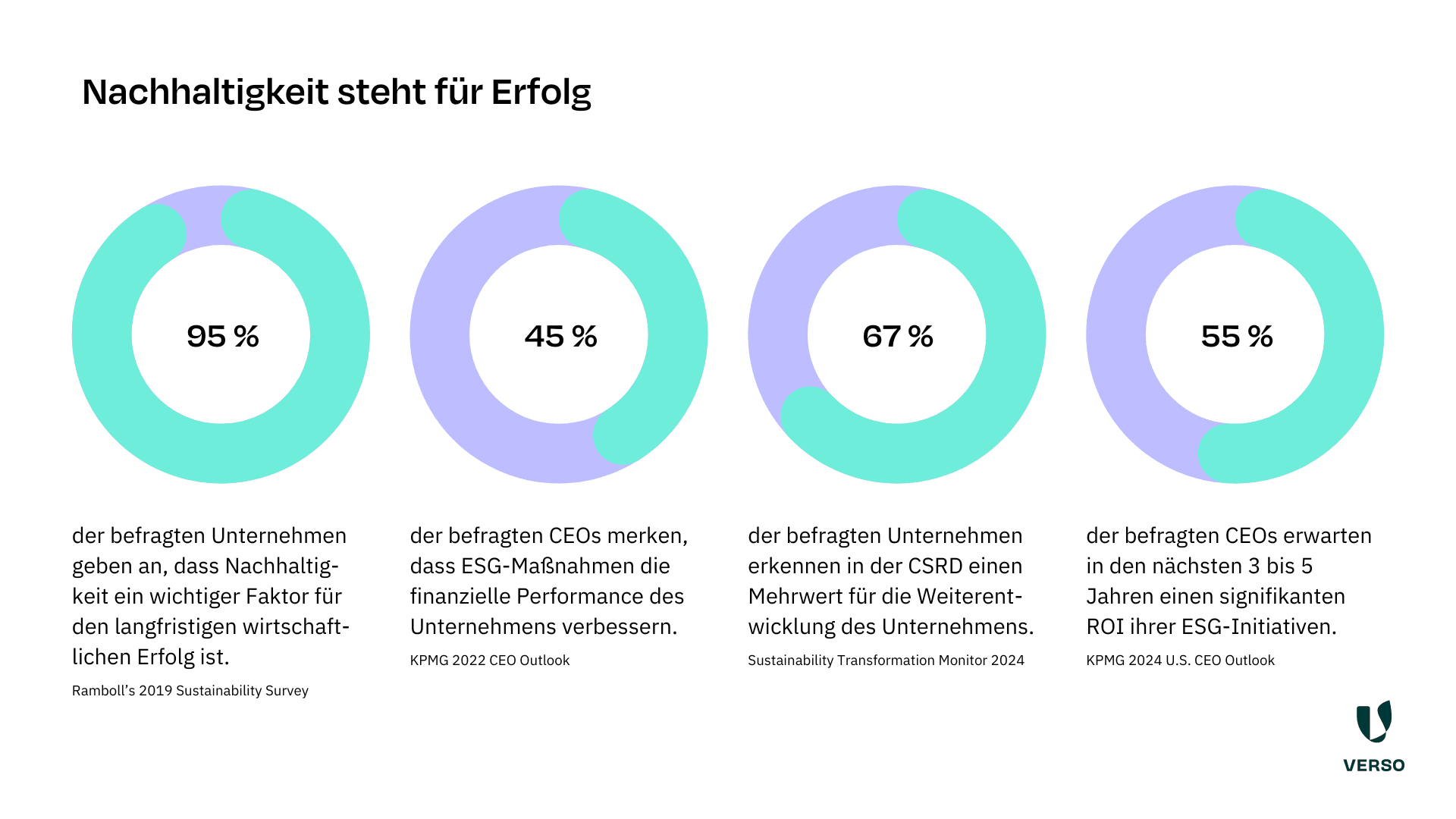
Sustainability is no longer limited to sorting waste in the office, but has a strong influence on many fundamental sectors of a company. Therefore, switching to sustainable business practices can of course be time-consuming and cost-intensive. But the effort is worth it, as these four studies show:

  • 95% of respondents to the Ramboll’s 2019 Sustainability Survey stated that ESG is an important factor for long-term economic success. The reason: consumers are increasingly buying regional and ecologically valuable products.
  • 45 % of the KPMG 2022 CEO Outlook executives surveyed (globally) stated that ESG measures improve their company’s financial performance.
  • 67 % of the Sustainability Monitor 2024 companies surveyed recognize added value in CSRD for the further development of the company.
  • 55 % of the KPMG 2024 U.S. CEO Outlook executives surveyed expect to see a significant ROI from their ESG initiatives in the next three to five years.


Infografik: Studien, wie sich Nachhaltigkeit auf den wirtschaftlichen Erfolg von Unternehmen auswirkt

Practical guide to ESG-Reports

Our practical guide, including a checklist, will help you prepare for ESG-reporting.
Find out what challenges there are and how you can overcome them.

Sustainability secures the future of companies

However, ESG commitment not only ensures that the company is in a good financial position. It is becoming increasingly clear that the climate crisis and its consequences are becoming a real threat to established business models and that business as usual is no longer sustainable. Conversely, this means that sustainable transformation ensures the long-term survival of companies.

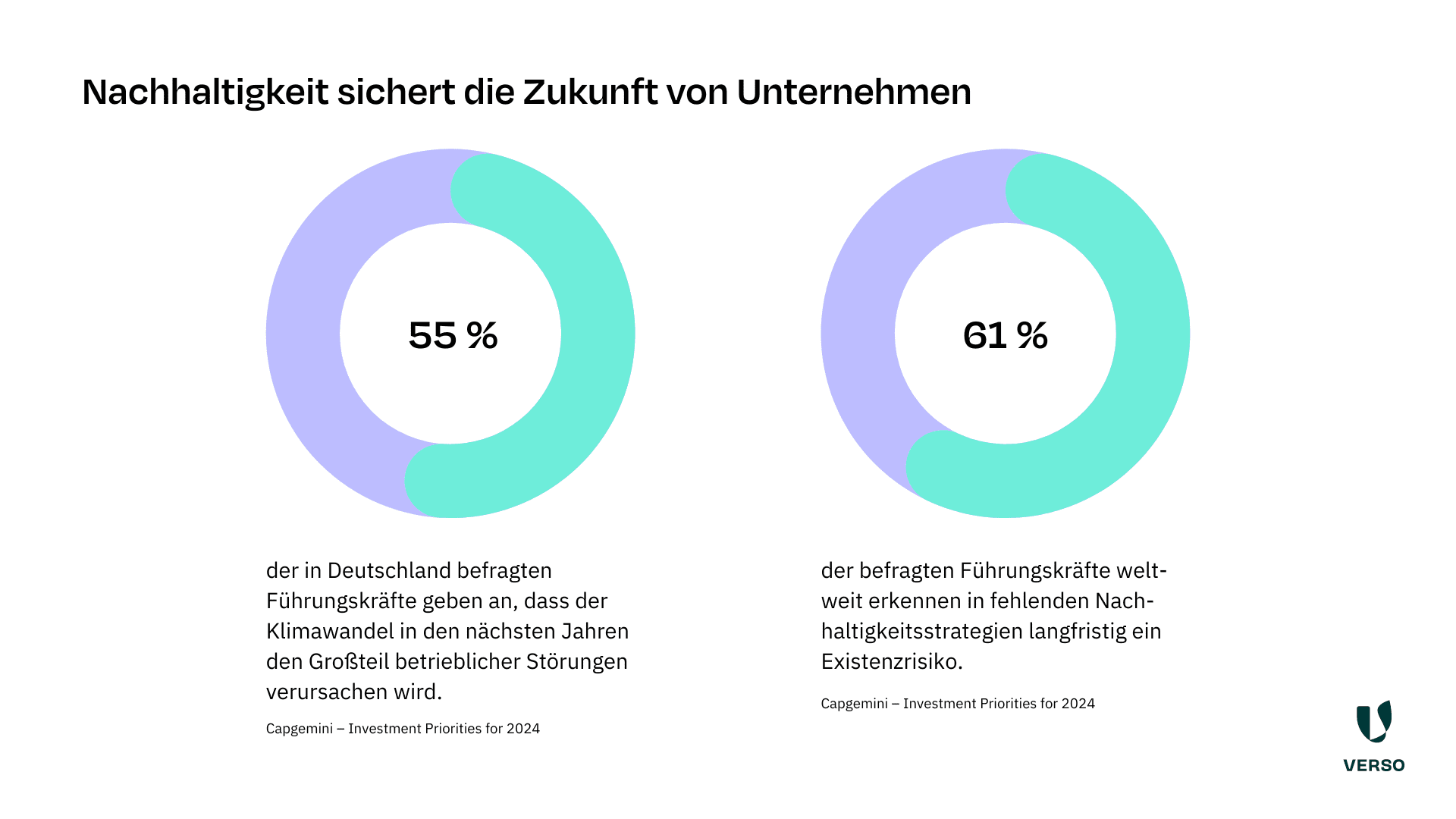
  • 55 % of the Capgemini of the German companies surveyed recognize that something has to change: they consider climate change to be the main cause of future disruptions to operations.
  • 61% of the managers surveyed worldwide in the same study are of the opinion that a lack of sustainability strategy will become an existential risk in the long term.
Infografik: Studien, wie Nachhaltigkeit die Zukunft von Unternehmen sichert

Stronger customer loyalty through sustainable business practices

Satisfied customers are usually also loyal customers – as shown by a survey by Capgemini Study Sustainability in CPR 2020:

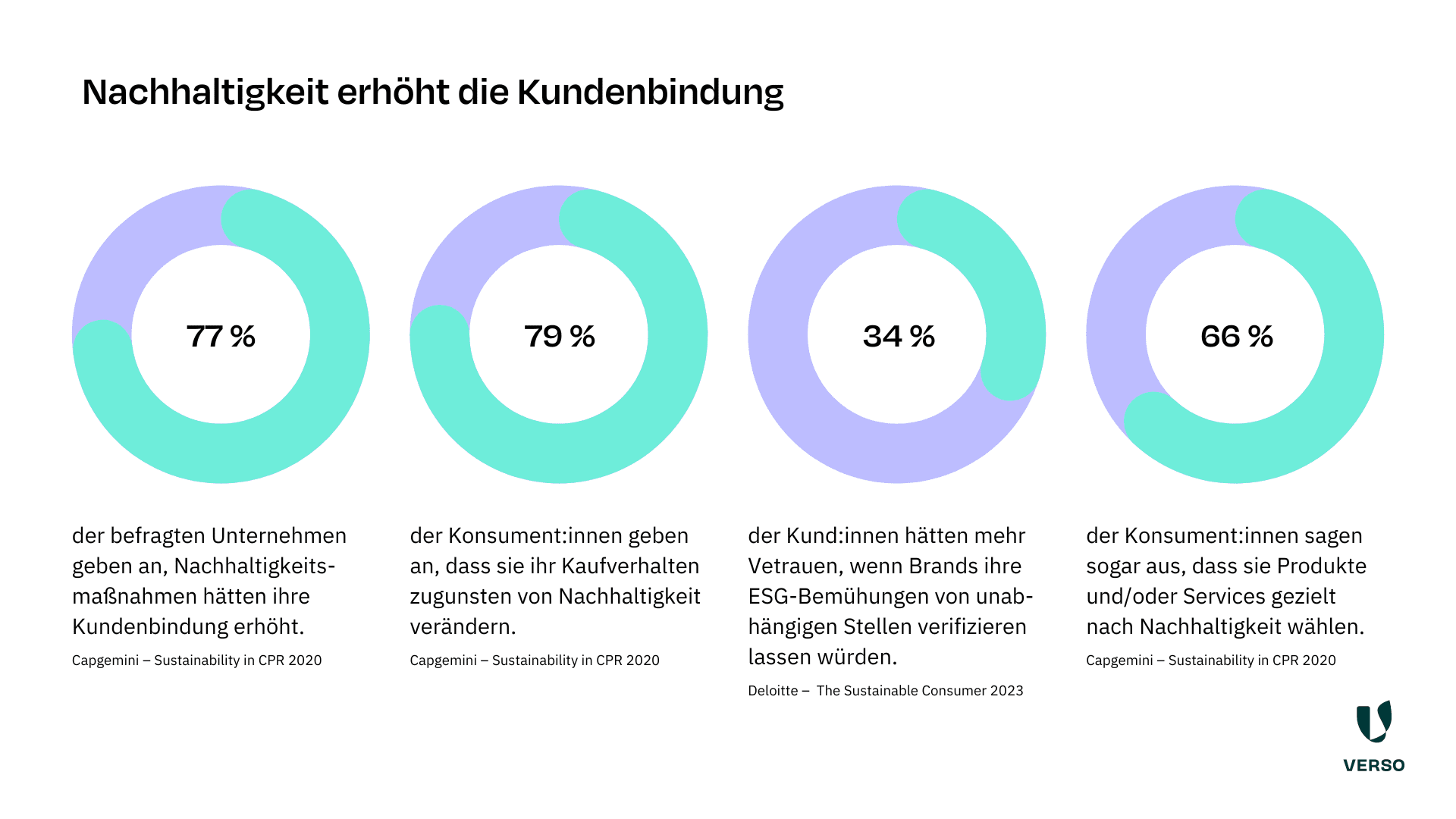
  • Three quarters of the companies surveyed from the consumer goods industry and retail sector stated that the inclusion of sustainability increases their customer loyalty.
  • 79 % change their purchasing behavior in favor of more sustainability.
  • 66% even select products and services specifically according to how sustainable they are.

This is in stark contrast to the 36% of large companies that were also surveyed in this study – and stated that sustainability does not play a major role for their customers. In the study, Deloitte examined The Sustainable Customer 2023study, Deloitte investigated what consumers want from companies when it comes to sustainability. The result: more transparency and honesty, among other things. 34% would trust a brand more if its ESG measures were verified by an independent third party – as the new Green Claims Directive aims to achieve.

Infografik: Studien, wie sich Nachhaltigkeit die Kundenbindung stärkt

Sustainability – the key to motivated employees

However, satisfaction must not only come from outside, but also from within. After all, motivated employees do more for their company. A company with a sustainable focus can provide precisely this additional motivation boost – and also give itself a real advantage in the search for talent:

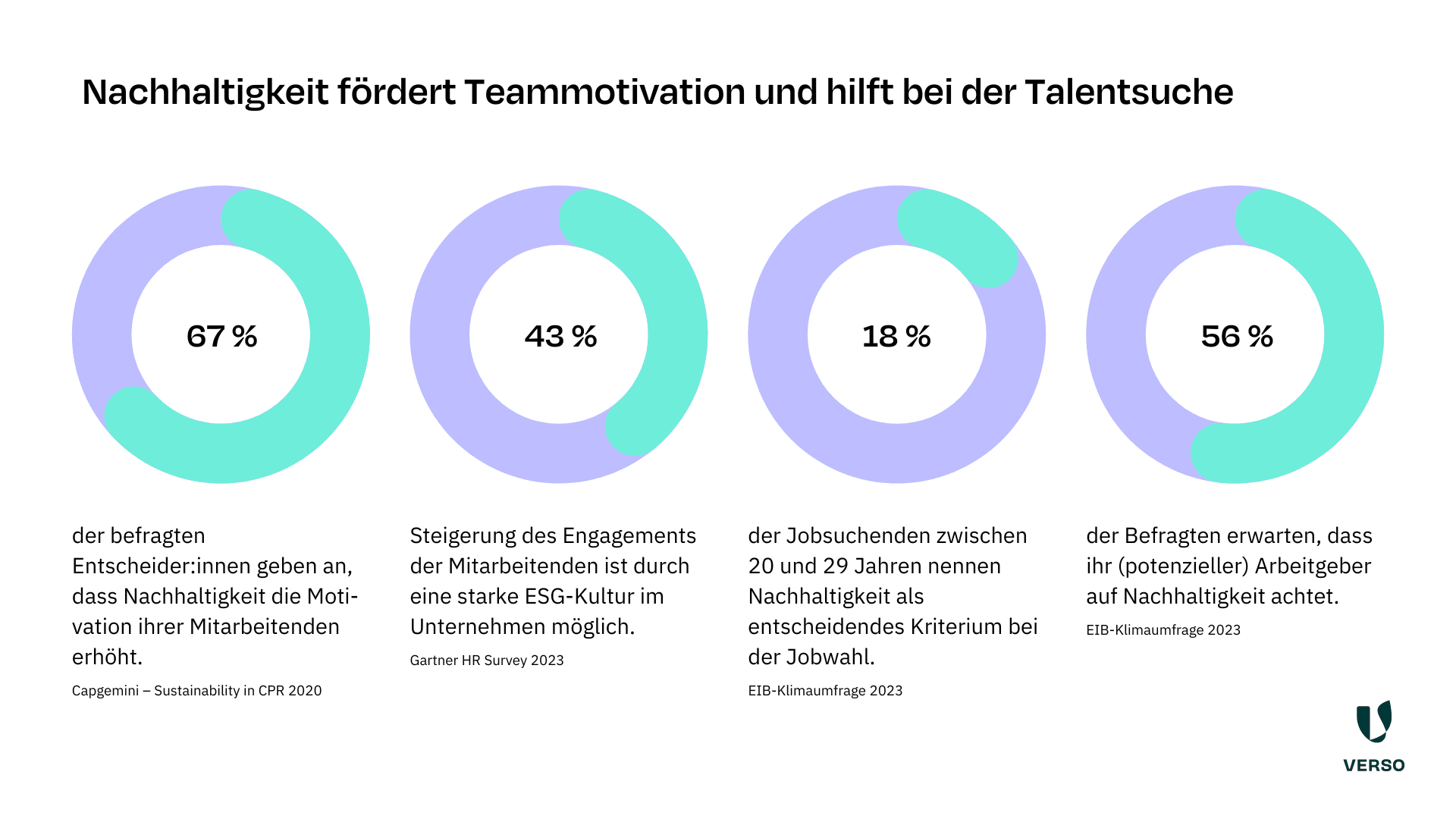
  • 67 % of the employees surveyed for the report Sustainability in CPR report stated that the integration of ESG issues in the company had increased employee motivation.
  • The EIB Climate Survey 2023 found that 56% of people surveyed value an employer that thinks (and acts!) sustainably.
  • For almost a fifth of the younger job seekers surveyed in this study, sustainability is even the criterion when choosing an employer.
  • And an HR survey by Gartner found that a strong ESG culture can increase employee engagement by up to 43%.
Infografik: Studien, wie sich Nachhaltigkeit Mitarbeitermotivation fördert und bei der Talentsuche unterstützt

Sustainability creates jobs

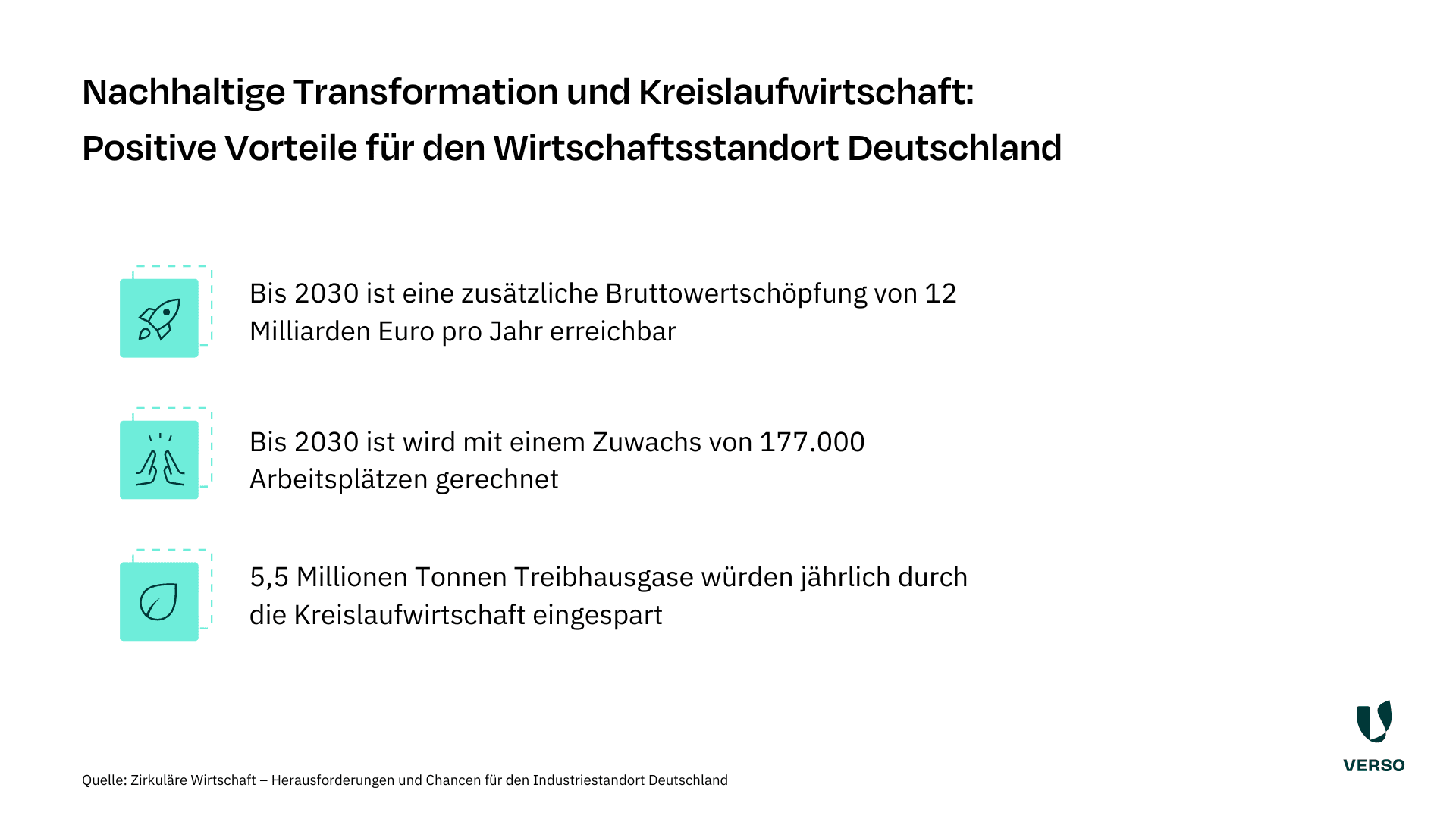
All of these factors play a role in economic success. However, the benefits of a sustainable economy can also be seen in the economy as a whole. According to a study by Deloitte, Germany will generate around 12 billion euros in additional gross value added per year by 2030, creating 177,000 new jobs in the process. In addition to economic successes, 5.5 million tons of greenhouse gases will also be saved each year.

Infografik: 3 Fakten, welche Vorteile eine Nachhaltige Transformation der Wirtschaft bzw. eine Kreislaufwirtschaft für Deutschland bringt

Overwhelmed by the CSRD?

Meet CSRD requirements with ease – with our modular CSRD Suite.

* This information is summarized editorial content and should not be construed as legal advice. VERSO accepts no liability.

Subscribe to our newsletter!

Register now to arrange a free demo appointment and get to know our solutions at first hand.

  • Pragmatic all-in-one solution for ESG reporting, climate and supply chain management
  • Best practices in the areas of ESG and sustainable supply chains
  • Developed with expertise from 12+ years of sustainability management
  • Sustainability events and much more.

Get to know the software!

CO2-Bilanz, Klimaziele, Net-Zero: Hinter all diesen Begriffen steckt die Dekarbonisierungsstrategie bzw. die Klimastrategie von Unternehmen. Die ganzheitliche Erarbeitung einer solchen Strategie hat viele Vorteile. Welche Chancen dahinter stecken, lesen Sie hier.
08.04.2024

5 advantages of a decarbonization strategy: Why it is important for companies

Carbon footprint, climate targets, net zero: behind all these terms lies the decarbonization strategy or the climate strategy of companies. The holistic development of such a strategy has many advantages. You can read about the opportunities behind it here.

Despite the Paris Climate Agreement, the Green Deal and national laws: The amount of greenhouse gases (GHG) in the atmosphere continues to rise.
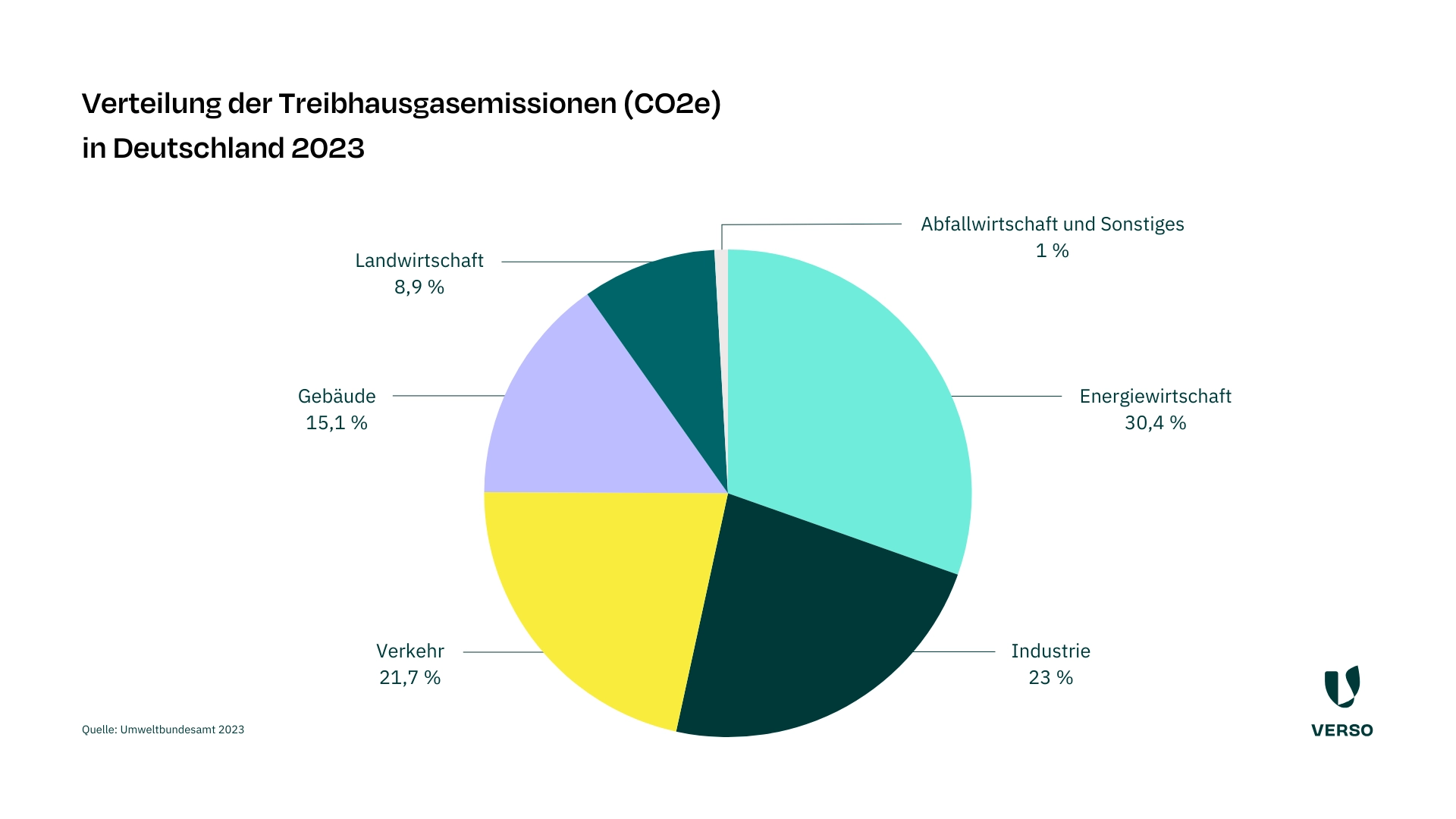
And industry is the second largest contributor to these emissions after the energy sector.
As a result, the pressure on companies to focus on their environmental performance, invest in climate protection and reduce their GHG emissions continues to grow.
You may already be facing requirements such as carbon footprinting, meeting climate targets or, more recently, a climate transition plan required by the CSRD.
All of these topics are part of the holistic climate strategy that we are talking about here.

Laut Umweltbundesamt wurden im Jahr 2023 in Deutschland die meisten Treibhausgasemissionen (CO2e) in den Sektoren Energiewirtschaft und Industrie ausgestoßen.

What is a decarbonization strategy?

A decarbonization strategy can be thought of as a cycle: It comprises six steps that you go through in sequence.
After the sixth step, you start again at number one.
With each step, you look at your challenges in more detail and continue to optimize your processes.
You can manage your goals, adapt measures, reduce emissions further and further – and get closer and closer to your Net Zero goal.
These are the 6 steps of the decarbonization strategy:

  1. Development and recognition of challenges
  2. Preparation of a greenhouse gas balance sheet to determine the status quo
  3. Definition of measurable climate targets and measures
  4. Reducing GHG emissions as far as possible
  5. Offsetting residual emissions through certified projects from e.g. Climate Grid
  6. Transparent communication of successes and potential for improvement

Before you go through the process for the first time, we recommend that you introduce a data and process management tool such as VERSO’s Climate Hub into your company.
Important for the decarbonization plan: The software should not only cover the calculation of the carbon footprint, but also enable proper climate management including KPI tracking, target tracking, creation of measures as well as internal and external collaboration options.

The 5 advantages of a decarbonization strategy

In 2023, the opinion research institute Forsa asked German SMEs that will fall under the new CSRD about their status quo with regard to sustainability and climate reporting: 52% are currently working on a climate strategy, 40% have already formulated a concrete strategy and 9% do not yet see a need for one.
We have here Five advantages that a climate strategy entails for your company:  

1. be prepared for regulatory pressure

In Germany and the EU, the laws resulting from the European Green Deal in particular are calling on companies to decarbonize and operate in a more environmentally conscious manner.
Examples of legal requirements:

  • The CSRD’s ESRS E1 reporting standard alone requires an entire climate transition plan – in addition to the carbon footprint and disclosure of specific climate targets.
  • The CSRD is also linked to the EU taxonomy, which requires companies to disclose how sustainable their business activities are according to strict criteria.
  • The CBAM will be of interest to companies that import goods from non-EU countries, as the CO2 border adjustment mechanism will in future oblige companies that import emission-intensive goods to purchase certificates to offset the emissions emitted.

At the latest when your company is affected by these regulations, you should have a decarbonization plan up your sleeve – otherwise legal consequences are possible.
However, there are also advantages to starting the project before the law takes effect.
You can then pay attention to limit values and risks as early as the target setting stage, collect the data required for legal compliance during data collection and have the relevant disclosure requirements ready in the right form.
This will save you stress and you will not be surprised by requirements that you cannot fulfill.  

2. avoid the risk of greenwashing accusations

Simply calling yourself “green” is a thing of the past.
With the Green Claims Directive the EU is specifying what is greenwashing and what is not.
Soon, companies will have to prove the accuracy of their environmental claims in a scientifically verified manner.
If they fail to do so, they will not only face damage to their image, but also real legal and financial consequences.
They are certainly not deliberately greenwashing – but it can easily happen unknowingly, as many greenwashing accusations originate from marketing activities that portray the company in too good a light.
This happens above all when the company’s sustainability data is not transparent.
However, transparent sustainability communication can succeed with a climate strategy: The number-based strategy, KPI tracking and carbon footprint allow you to communicate comprehensible facts, figures and targets.

Your overview of the new Green Claims Directive

With the Green Claims Directive, the EU now provides a clear framework for sustainability claims.
Get a clear overview of the new Green Claims Directive and its consequences for your company in this factsheet!

3. identify the risks and potential of climate issues

A decarbonization strategy can make a significant contribution to the future viability of your company.
It reveals risks and potential. Risks By collecting detailed data, you can identify risks that often go unnoticed in day-to-day business.
How much electricity do we actually consume?
Which bottlenecks in our production lead to increased CO2 consumption?
You receive figures and comparative values for areas where there was often little clarity before.
Identifying climate risks makes your overall risk management more meaningful.
It helps you to plan more reliably and calculate costs correctly. Potentials In addition, your potentials become visible, such as the environmental commitment of your suppliers, energy savings or the use of renewable energies.
You can measure progress and see which measures may have less impact than expected and where you can actually make a difference.
Ultimately, you can also save costs and increase your efficiency.  

4. advantages with stakeholders for loans, investments and tenders

If you have a decarbonization plan ready, you will make yourself popular with your stakeholders.
After all, they are increasingly asking about a company’s commitment to climate protection.
Which stakeholders are you talking about in particular?

  • Business partners in tenders: Other companies – especially OEMs – are also affected by statutory ESG requirements.
    As a result, they naturally do not want to take on any additional risk and also pay attention to ESG criteria in tenders.
    If you already have a solid decarbonization plan in place, this puts you in a better position in the tendering process.
  • Banks for loans: Banks also face ESG requirements.
    In practice, this means that your borrowing costs also depend on your ESG rating: Better rating, cheaper loan.
    And your strategy naturally has an impact on your rating.
  • Investors: The same applies here – investors also include ESG criteria in their investment ratings.
    With a decarbonization strategy, a lot of things can be ticked off the list.
    And not to forget: The strategy gives investors insights into your company’s potential and options for action.
    You can authentically demonstrate how you want to ensure the future viability of your company in harmony with the environment.
  • Customers: 79% of consumers change their purchasing behavior based on sustainability considerations(study by Capgemini).
    This means that you have a competitive advantage if you can make transparent how your company is committed to climate protection and decarbonization.
    Consumers now look closely at sustainability communication and are quickly suspicious of general sustainability claims.
    You score points with your climate strategy because you can also back up your communication with figures and transparently show your improvement potential and strategy.

5. strengthen supply and business relationships

Companies with which you have a business or supply relationship may also be affected by the CSRD or the German Supply Chain Act, the LkSG.
You now need ESG transparency throughout your supply chain – including climate and CO2 data.
With your climate strategy, you are already prepared for the questionnaires from your business partners.
If you have nothing to show, business relationships may be on the brink of collapse.

How VERSO supports you with your decarbonization strategy

If you want to take a strategic approach to decarbonization, we will be happy to support you: The VERSO Climate Hub, combined with the VERSO ESG Hub, enables you to achieve holistic climate management.
We are also happy to support you with our consulting team: many questions arise, especially in the first year of balancing or strategy development, and it takes some time to familiarize yourself with the topic.
We support you in integrating the processes in your company, in correctly preparing the first carbon footprint and in developing sensible targets, measures and strategies to reduce your emissions.
With this support, we enable you to subsequently implement your climate strategy on your own responsibility.
Does that sound like what you’re looking for?
Please feel free to contact us.

* This information is summarized editorial content and should not be construed as legal advice. VERSO accepts no liability.

Subscribe to our newsletter!

Sign up and receive regular news about:

  • Pragmatic all-in-one solution for ESG reporting, climate and supply chain management
  • Individual advice from the VERSO experts
  • Developed with expertise from 12+ years of sustainability management
  • Trusted by 250+ customers

Get to know the software!

CSR, ESG oder Nachhaltigkeit: Wo liegen die Unterschiede? © yunus susanto, Getty Images via canva.com
29.01.2024

CSR, ESG, Sustainability – What’s the Difference?

CSR, ESG, sustainability: What may seem like the same thing at first glance actually differs. In this post, we clarify the difference between the terms “ESG,” “CSR,” and “Sustainability”!

In this article, we’re comparing apples to pears that, at first glance, all seem like applesbecause it’s about the very similar terms “CSR,” “ESG,” and “Sustainability.” You’ll read what these terms actually mean and how they differ.  

What does CSR mean?

You can think of “CSR” as a kind of moral and ethical foundation for a company’s sustainability strategy. CSR stands for “Corporate Social Responsibility.” And although the word “Social” is included, it doesn’t only refer to the social aspect of sustainability. CSR also encompasses environmental and governance issues. You may have come across the abbreviation “CR” – which stands for “Corporate Responsibility” and intentionally excludes “Social” to avoid confusion. CSR or CR is essentially the predecessor to ESG. Or, to put it with an English saying: CSR walked so that ESG could run. The EU Commission defined CSR as follows back in 2011:

“[A] concept that serves as a basis for companies to integrate social and environmental concerns into their business activities and their interactions with stakeholders on a voluntary basis.”

If we look at it closely, CSR primarily refers to a company’s awareness of the impact it has – whether actively or passively – on society or the environment. In terms of CSR, companies address their responsibility by taking qualitative actions that go beyond the legal minimum (e.g. CSRD, LkSG).

Whitepaper: The ESRS at a Glance

With the CSRD, new standards for sustainability reporting were introduced. In this whitepaper, learn all the essential information about the European Sustainability Reporting Standards (ESRS).

What does ESG mean?

“ESG” stands for “Environmental, Social, Governance.” Unlike CSR, ESG is a more pragmatic, detail-oriented approach to sustainability efforts. The term encompasses the impact of corporate strategies and practices on these three areas:

  • Environmental: Environmental criteria such as energy consumption, climate strategy, or resource management.
  • Social: Criteria related to stakeholders (beyond investors), such as working conditions along the supply chain, diversity, or the gender pay gap.
  • Governance: Criteria for ethical corporate governance, such as anti-corruption measures, whistleblower protection, or supplier selection.

ESG is quantitatively oriented. For example, the ESRS, the framework for sustainability reporting under the CSRD, predominantly requires clear key figures.

At the core of ESG is the so-called “triple bottom line,” also known as the “3-pillar model of sustainability.” This approach posits that sustainable development is only possible when environmental, social, and economic sustainability goals are pursued equally.

Practical Guide to CSRD

With our practical guide, including a checklist, you can prepare for CSRD reporting. Learn about the challenges involved and how to overcome them.

And what is sustainability?

Let’s now address the final point in our distinction between ESG, CSR, and sustainability.

Sustainability, or “Sustainability” in English, is essentially an umbrella term for ESG and CSR. Without CSR and ESG, sustainability cannot exist.

Let’s take a brief journey to the Ore Mountains in the early 18th century. In the mining region, wood was such an important resource for fuel, construction, and ore smelting that it became increasingly scarce. Hans Carl von Carlowitz, who was, among other things, the head of the Upper Mining Office in Freiberg and responsible for timber supply, first formulated the definition of sustainability, stating that only as many trees should be cut from the forest as could grow back. By the 19th century, this definition became established in other areas as well.

Zooming out to the big picture, sustainability means that systems—regardless of their type—can only be stressed to the extent that they can withstand without damage. Resource usage should only occur within these limits.

Today, in 2024, we are all more aware than ever: Most of our systems have already reached their limits or are being used far beyond their capacities. Whether it’s overfishing or deforestation, mining rare earths or oil extraction, air pollution or human exploitation, we need to strengthen the concept of sustainability and act now to create a livable future for future generations.

Companies play the key role in sustainability, as enablers of consumer needs, facilitators of familiar conveniences and living standards. By becoming aware of their responsibility (CSR) and adjusting their business strategies and supply chains (ESG), they hold the key to sustainable transformation.

Overwhelmed by the CSRD?

Make the CSRD as easy as possible for yourself: Our new CSRD Suite provides tools and support for every stage of CSRD compliance.

Conclusion: Is ESG or CSR more important?

To answer the often-asked question of whether ESG or CSR is more important: Both complement each other. However, ESG has today become the more common term for a comprehensive sustainability strategy.

CSR represents the fundamental idea necessary for the sustainable transformation of the economy: the awareness that companies bear responsibility and must act accordingly. ESG, on the other hand, provides the framework for targeted action. Thus, measurable and effective actions are derived from a sense of responsibility.


* This information is summarized editorial content and should not be considered legal advice. VERSO assumes no liability.

Subscribe to our newsletter!

Register now to arrange a free demo appointment and get to know our solutions at first hand.

  • Pragmatic all-in-one solution for ESG reporting, climate and supply chain management
  • Individual advice from the VERSO experts
  • Developed with expertise from 12+ years of sustainability management
  • Trusted by 250+ customers
Nachhaltigkeit auf der Website kommunizieren
18.12.2023

How to communicate your sustainability on the website

Your company is sustainable – but do potential customers know that? In this article, you will find 6 tips for communicating your sustainability measures credibly on your website.

More and more consumers are specifically choosing companies based on sustainability aspects – and more and more companies have to pay close attention to ensuring that everything is above board in their supply chain since the LkSG came into force.

Sustainability is increasingly becoming an important criterion when making purchasing and partnership decisions. And what better way than your own website to inform potential customers and partners about your sustainability efforts? So it’s high time to put your company’s sustainability efforts in the spotlight.

But what’s the best way to do this?

6 tips for communicating sustainability credibly on the website

Tip 1: Transparency and measurable data

Facts, facts, facts: Solid figures are still the most credible. That’s why our first tip is to provide a detailed sustainability report on your website – e.g. as a separate page or as a downloadable PDF document. The report shows existing measures, but also describes what your company will implement in the future. In addition, show prominently and separately to the report what goals you have set yourself and what measures you intend to take to achieve them. Also state openly where there is still a need for action. From 2024, the CSRD will require around 15,000 companies to publish a sustainability report anyway. However, a voluntary report is also a good thing for all companies that want to clearly show: “We take sustainability seriously!”

CSRD: New requirements for sustainability reports

As part of the Green Deal, the EU is driving forward numerous measures for sustainable transformation – including the CSRD.
You can find all the details, including the latest innovations, in our factsheet.

Tip 2: Awards from independent bodies

Has your company been certified for sustainability measures? Then be sure to place the relevant seals and certificates on your website! External confirmation of your sustainability efforts increases credibility enormously. Important here:

  1. Don’t hide your awards in a small section on a subpage that isn’t even linked in the menu.
    Whether as a banner on the homepage or as a separate menu item: If you do good, it’s okay to show it!
  2. Look for awards from recognized, independent bodies.
    Certificates and seals that any company can simply buy with enough money harbor the risk of greenwashing.

Speaking of greenwashing: you can find out how to avoid the most common stumbling blocks in the article “The five biggest greenwashing traps and how to avoid them”.

Tip 3: Present cooperations

Where do you source your raw materials or goods? Which companies do you work with – and how sustainable are they? Do you cooperate with environmental, animal welfare or human rights organizations with which your company creates impact beyond its own backyard? What projects is your company involved in? These are all interesting points that you should definitely not sweep under the carpet! Show how you are getting involved and actively shaping the change towards sustainability through your responsibility. But be careful not to fall into any greenwashing traps here either.

Communicating sustainability successfully and confidently

Dos and don’ts as well as framework conditions for sustainability communication and more: In the course “ESG management in practice”, Nuvia Maslo (CMO/CCO at VERSO) shows you how to communicate your sustainability effectively.

Tip 4: Show commitment

Was the fact that you planted a flowering meadow next to the company headquarters in 2020 the latest news in terms of sustainability? Hopefully not! If you really want to communicate your company’s sustainability credibly, you should plan for the long term – ideally on the basis of a holistic sustainability strategy. In any case, describe what your company has already achieved. List how sustainability is currently practiced. For example, through a healthy working environment for your employees or fair pay in your own supply chain. After all, sustainability is not just about the environment. But also show what you are planning for the future. Present long-term sustainability goals with clear milestones on your website. Make sustainability an integral part of your company’s purpose statement. Share progress reports. Continuity and commitment are still the best way to show that sustainability was more than just a short-term marketing measure for you.

Tip 5: Be honest

Honesty lasts the longest. This also applies to sustainability communication. No company is 100% sustainable – so don’t try to pull sustainability measures out of the air. Present your previous measures and successes, but also admit openly and honestly where there may still be a problem. This will not make you look bad – on the contrary! It shows that your company is seriously thinking about sustainability.

Tip 6: Demonstrate sustainability with a sustainable website

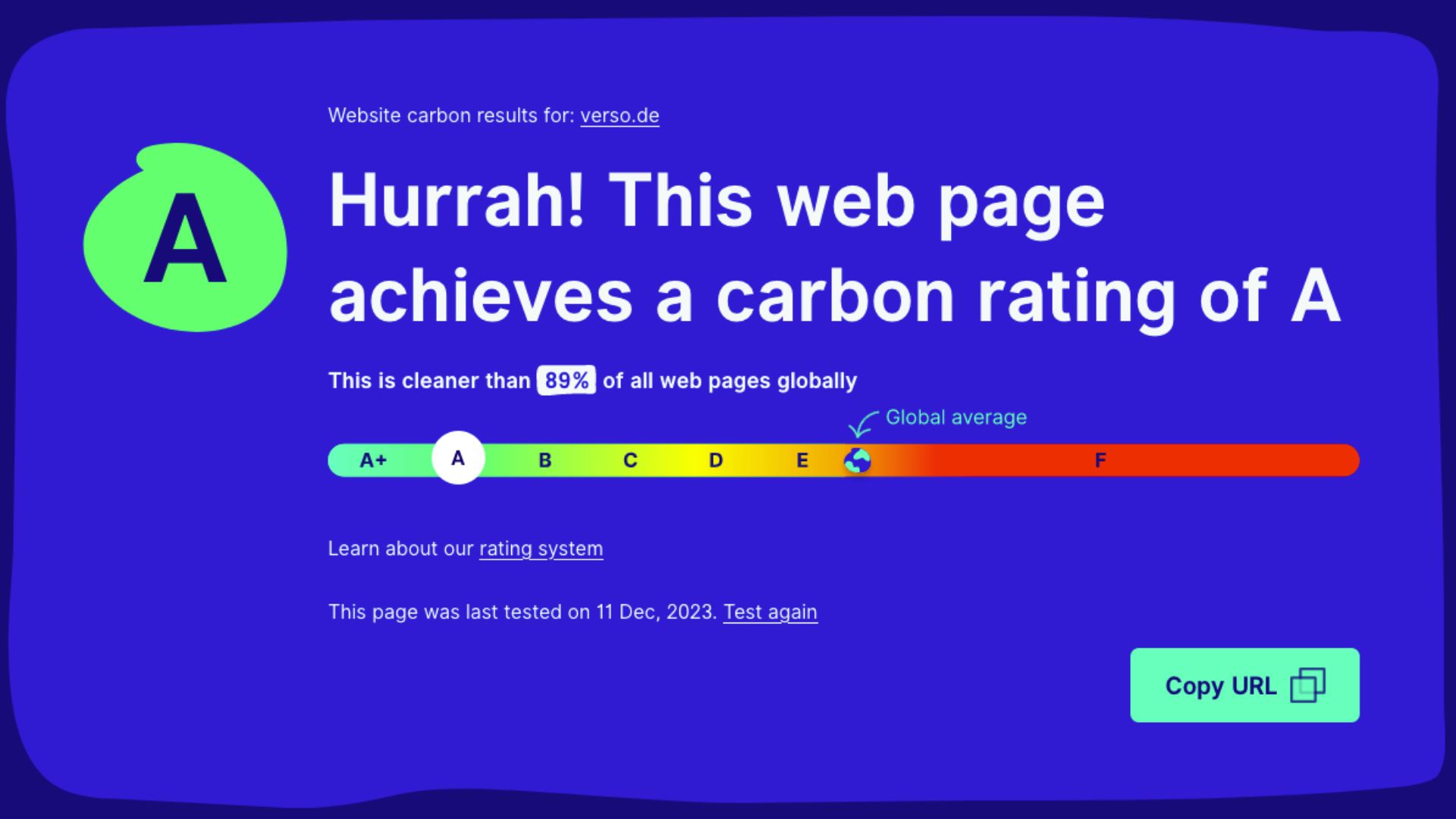
Last but not least, a point that is easy to forget at first glance: if you want to emphasize the sustainability of your company, you should definitely take a close look at your website! Tools such as the Website Carbon Calculator will calculate the CO2 footprint of your website in no time at all.

CO2-Fußabdruck der Seite verso.de

Is your website more of a global average? Then look out for specialists in green web design to exploit the full sustainability potential of your site.

Until then, some simple tips like these will help you to make your website more sustainable without any design or coding knowledge:

  • Reduce file sizes (images and videos).
  • Check whether your site is powered by coal – you can do this very quickly using the Green Web Foundation tool, for example. If not, switch to a web hosting provider with transparently traceable green electricity.
  • Design your website to be barrier-free in order to also do justice to social sustainability – a first step here would be descriptive texts for images, for example.
  • Take the plunge and declutter so that outdated content and superfluous tools don’t continue to waste energy for no reason.

We wish you every success – and are happy to help if you need support with your sustainability communication!

* This information is summarized editorial content and should not be construed as legal advice. VERSO accepts no liability.

Subscribe to our newsletter!

Register now to arrange a free demo appointment and get to know our solutions at first hand.

  • Pragmatic all-in-one solution for ESG reporting, climate and supply chain management
  • Individual advice from the VERSO experts
  • Developed with expertise from 12+ years of sustainability management
  • Trusted by 250+ customers

Get to know the software!

Dominosteine, die beim Fallen gestoppt werden – Symbolbild für 5 Nachhaltigkeitsmaßnahmen mit echtem Impact
24.05.2023

5 sustainability measures with real impact

5 ESG measures with real impact

Many companies have already recognized that sustainability is no longer a trend, but a necessity.
Customers, investors and other stakeholders expect companies to treat their employees fairly and do their bit to protect the environment.
In short: implement ESG issues within the company.
However, instead of seeing sustainability as a sincere task, some companies unfortunately see their sustainability efforts primarily as “green” marketing.
In particular, the purchase of CO2 certificates to minimize their own CO2 footprint, which is subject to criticism, harbours the risk of greenwashing.
Measures that minimize or prevent emissions are more effective than compensating for them afterwards.
In this blog article, we present five ESG measures that have a real impact – for your sustainability and your company.

How do I create a sustainability report?

Creating a meaningful sustainability report can be quite a challenge.
It’s easier with our practice-oriented playbook “7 steps to a sustainability report”.

Make your business operations energy-efficient

Focus on energy efficiency to reduce your environmental footprint.
Start by developing an energy concept: examine existing lighting, heating and cooling systems in your building and look for energy efficiency labels when selecting IT hardware and other equipment.
Even with external data centers that host your software or website, for example, you can save a lot on emissions by choosing energy-efficient providers.

Adopt a circular economy approach

Design your products so that they are durable, can be repaired and recycled at the end of their life cycle.
You can introduce recycling programs for your products and inform your customers about the entire product life cycle.
Product instructions can also include repair instructions and alternative reuse options to limit the throw-away mentality.

CSRD: New requirements for sustainability reports

As part of the Green Deal, the EU is driving forward numerous measures for sustainable transformation – including the CSRD.
You can find all the details in our factsheet.

Invest in the satisfaction of your employees

Sustainability is a multifaceted issue that is often associated with climate protection.
However, we must not neglect the social aspect.
An important component of sustainability lies in the satisfaction of the workforce, because satisfied employees who are treated fairly stay with the company longer and are more motivated.
Offer fair pay, attractive employee benefits and opportunities for further training.
A healthy work-life balance, a good error culture and opportunities for co-determination help to create a positive working environment and allow your employees to develop their full potential.
In order to build a diverse and inclusive workforce, diversity and inclusion should be part of your company’s identity and part of the recruitment process.

Optimize your supply chain

For many companies, the supply chain is a black box.
However, a sustainable supply chain is crucial to achieving your corporate ESG goals.
Choose responsible suppliers and partners who adhere to high ethical and sustainable standards.
Where possible, give preference to regional suppliers to reduce transportation distances and support the local economy.
Due to often globally networked supply chains, this is no easy task.
With the VERSO Supply Chain Hub, you can create transparency in your supply chain.

The ESRS standards at a glance

With the new CSRD reporting obligation, the EU is also introducing uniform European standards for ESG reports – the ESRS.
Get an overview in the factsheet.

Demonstrate transparency and accountability

Talk openly about your sustainability efforts, set yourself concrete, ambitious goals and remain open to continuous improvement.
It is important to put your money where your mouth is and communicate the results transparently.
Publish your ESG data, targets and measures in a regular sustainability report to keep your stakeholders informed and document your progress.   Our conclusion: Every step towards sustainability is a step in the right direction, but true sustainability requires a comprehensive rethink and the integration of sustainable principles into all aspects of the company.
Remember that sustainability is an ongoing process and take the time to evaluate and continuously improve your strategy.
The VERSO team will be happy to support you on your path to sustainability with our ESG software and advice from our sustainability experts.

* This information is summarized editorial content and should not be construed as legal advice. VERSO accepts no liability.

Subscribe to our newsletter!

Sign up and receive regular news about:

  • Pragmatic all-in-one solution for ESG reporting, climate and supply chain management
  • Best practices in the areas of ESG and sustainable supply chains
  • Developed with expertise from 12+ years of sustainability management
  • Sustainability events and much more.

Get to know the software!