
Der Aufbau der ESRS: SO berichten Sie CSRD-konform.
28.11.2024

Structuring an ESRS report: How to ensure CSRD compliance

Tens of thousands of companies are required to publish a CSRD compliant sustainability report for the first time. Many are now faced with over 1,000 data points and wondering: How do we turn this into a structured sustainability report? What is the structure of an ESRS report?

This article will guide you through the process and provide you with a checklist to help identify the key data points for your report.

Creating an ESRS report – What needs to be done?

For most companies, preparing a CSRD-compliant sustainability report is uncharted territory. So far, only a few have completed this process, meaning you are not alone. To understand the structure of an ESRS report, it is helpful to first familiarize yourself with the individual ESRS standards. The next step is to focus on the disclosure requirements and data points that are most relevant to your company. To support you in this process, we have prepared a practical checklist.

What do CSRD and ESRS require?

Being affected by the CSRD means that a company is required to publish a sustainability report as part of its management report. This sustainability report is not meant to be a marketing brochure but a comprehensive document covering environmental, social, and governance (ESG) topics.

A key aspect: Companies do not have the freedom to choose their reporting framework – the ESRS are the mandatory standards they must follow. Additionally, just like the management report, the sustainability report must be audited by external auditors. This makes it even more crucial to understand the framework, be familiar with the structure of the report, and ensure that you report on the correct, material data points.

How should I approach the double Materiality Assessment?

Speaking of key data points: The double materiality assessment is the core of the ESRS report.

Download the full blog post now and gain access to:

  • Tips for conducting the double materiality assessment,
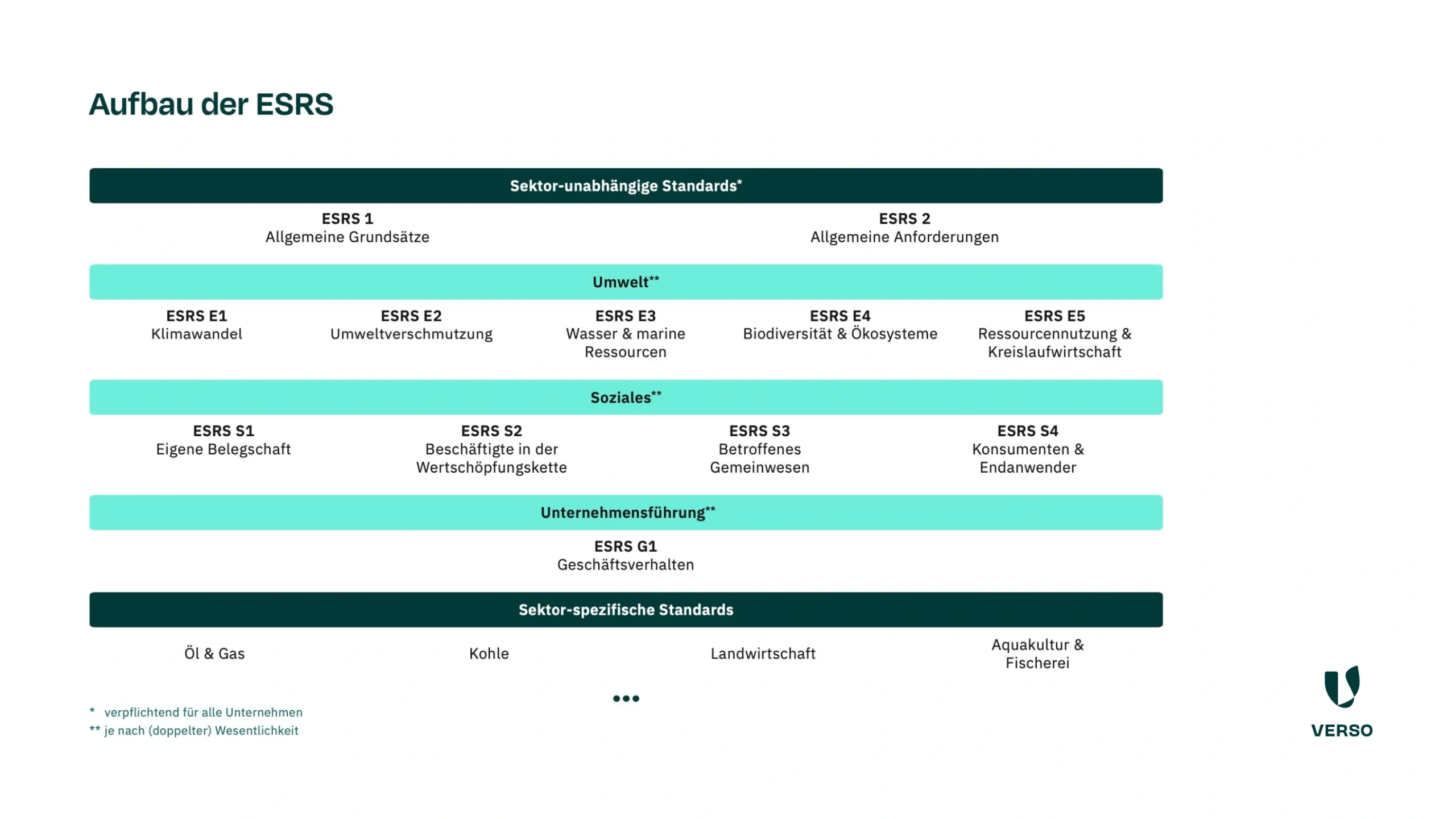
  • An overview of the ESRS structure,
  • In-depth insights into the content of the ESRS standards, and
  • A checklist for identifying the key material data points.

Before we continue

The content on this website is the result of the work of people who immerse themselves in the world of ESG with much passion and care. We take the time to present complex topics in an understandable way and provide practical tips. To prevent our work from being copied or used as AI training material, we ask you to leave us your e-mail address for particularly extensive and detailed content such as this. You will then receive the article as a PDF directly in your mailbox.

Subscribe to our newsletter!

Sign up and receive regular news about:

  • Current ESG topics and legislative changes
  • Individual advice from the VERSO experts
  • News about VERSO
  • Trusted by 250+ customers
Sign up now!

Mann schiebt sein Fahrrad durch Hochwasser. Symbolbild für den Klimawandel, auf den sich ESRS E1 fokussiert
24.09.2024

CSRD and climate: tips on reporting in accordance with ESRS E1

Anyone facing CSRD reporting cannot avoid ESRS E1. Read this article to find out what makes the first environmental standard so important and how you can meet the requirements efficiently!

ESRS E1 – the standard to which (almost) everyone must report

The work on each CSRD report starts with a double materiality analysis. This determines which of the more than 1000 data points of the CSRD your company actually has to report on. The first environmental standard ESRS E1 is an exception. Regardless of the result of the double materiality analysis, every company must basically report on the 230 or so data points required by this standard. Why? Because every company causes emissions and therefore has an impact on climate change. Conversely, every company is likely to be affected by climate change. In short: no company can avoid ESRS E1. At the same time, reporting according to this standard is complex. So let’s go through step by step how to master ESRS E1.

The ESRS standards at a glance

The European Sustainability Reporting Standards (ESRS) are intended to make sustainability reports more meaningful and comparable. All information can be found in the whitepaper.

What is ESRS E1 about?

Data collection and reporting are easier if you know the “why” behind it. ESRS E1 is designed to show you why,

  • … how your company affects climate change (positively and negatively, real and potential).
  • … what risks and opportunities climate change holds for your company and how your company deals with them.
  • … how your company is working to protect the climate – this includes previous and current measures, but also future ones.
  • … the financial consequences of the climate crisis for your company.

The requirements of ESRS E1 can be divided into two subject areas:

  • Mitigation of climate change (“Climate Change Mitigation”): Strategies and measures to limit global warming
  • Adaptation to climate change (“Climate Change Adaptation”): Approaches to strengthen resilience to current and expected consequences of climate change

The data points at a glance

As already mentioned, ESRS E1 is relevant for almost all companies. In total, E1 comprises nine disclosure requirements – but not all of them are immediately relevant or important for every company. Here is a brief overview:

  • E1-1 – Transition plan for climate protection
  • E1-2 – Concepts related to climate change mitigation and adaptation
  • E1-3 – Measures and resources in connection with the climate strategies
  • E1-4 – Goals related to climate change mitigation and adaptation
  • E1-5 – Energy consumption and energy mix
  • E1-6 – Gross GHG emissions in Scope 1, 2 and 3 categories and total emissions
  • E1-7 – Greenhouse gas abatement and greenhouse gas reduction projects financed throughcarbon credits
  • E1-8 – InternalCO2 pricing
  • E1-9 – Expected financial impact of significant physical and transition risks and potential climate-related opportunities

There are also three requirements from the overarching ESRS 2 standard:

  • ESRS 2 GOV-3 – Inclusion of sustainability-related performance in incentive systems
  • ESRS 2 IRO-1 – Description of procedures for the identification and assessment of significant climate-related impacts, risks and opportunities
  • ESRS 2 SBM-3 – Significant impacts, risks and opportunities and their interaction with strategy and business model

Good to know: There are some exceptions to ESRS E1 reporting. In principle, any company can use internalcarbon pricing(ESRS E1-8), but in practice it only makes sense for large companies. ESRS E1-8 is therefore not a mandatory part of every CSRD report. You only have to report on E1-9 from the second reporting year onwards. And Scope 3 data is only mandatory in the first reporting year for companies with more than 750 employees. Nevertheless, a lot of information is requested here. To make matters worse, most of the required data points are not simply available, but must first be determined. This raises the question: What is the best way to approach ESRS E1? Here is your guide to ESRS E1.

Guide for your climate strategy

A holistic climate strategy is more than helpful for climate targets, transition plans and CO2 balances. You can find tips on this in this guide.

Step by step through ESRS E1

The ESRS E1 disclosure requirements make sense in the order just mentioned when reading and reporting/writing. However, if you stick to this order when collecting data, you will be missing important data at the beginning. We therefore recommend the following procedure for data collection instead. During the actual reporting, you then present your results in the actual order: E1-1, E1-2, …

Step 1: ESRS E1-6 and ESRS E1-5

ESRS 1 stands and falls with the GHG balance for Scopes 1 to 3, which serves as a baseline for all further disclosure requirements. Determine your energy balance directly here so that you have all the data to hand in the next steps.

Step 2: ESRS E1-4

Based on your balance sheet baseline, develop or name your short and medium-term climate targets as well as your long-term net zero target. Make sure that your targets are science-based and in line with the goals of the Paris Climate Agreement. Don’t have any targets yet? Then you can also indicate when you will set your targets.

Step 3: ESRS E1-3

Now identify your decarbonization levers. Describe which measures you want to use to achieve the stated targets and which measures have already been implemented. Alternatively, you can specify here by when you want to have developed your measures – similar to the targets.

Step 4: ESRS E1-7

Does your company offset unavoidable residual emissions viaCO2 credits or compensation projects? Then of course you must also report on this. Caution: Be careful here to avoid falling into the greenwashing trap.

Step 5: ESRS E1-1

Now comes your transition plan. Here you describe in detail how your company is working to protect the climate, how you are preparing your company for the climate crisis and its consequences and how your company is making a concrete contribution to limiting global warming. There is a transition period for ESRS E1-1 in the first reporting years.

Step 6: ESRS E1-2

You then name concepts in connection with climate protection and adaptation to climate change – and how you implement these strategies. This includes, for example, internal control elements such as the internalCO2 price according to ESRS E1-8, but also IT and software strategies. Here, too, you can alternatively specify by when you will develop your concept.

Step 7: Reporting

Once the data has been collected, targets set and measures defined to achieve these targets, the next step is reporting.

Practical guide CSRD

Special features, practical examples and stumbling blocks: Our guide makes it easier for you to get started and prepare for the CSRD and the ESRS standard. Including checklist!

Practical tips for implementation

Not all companies manage to report on all disclosure requirements in their first report. Nevertheless, we would like to conclude by giving you a few basic tips on what you should pay particular attention to when reporting on ESRS E1.

Never underestimate the carbon footprint

The carbon footprint must be based on a stable foundation of data. You should therefore carefully consider all of your company’s sources of emissions. From employees’ commute to work to logistics. Even if this means a lot of work, don’t take any shortcuts in the wrong places. The results run like a red thread through the entire standard. All further measures are derived from the carbon footprint. At the same time, you can only achieve your climate targets if they are reflected in the carbon footprint. Thirdly, inaccuracies and errors lead to false claims in climate statements – something that is now sanctioned under the Green Claims Directive. So approach ESRS E1-6 with a keen eye and the necessary level of detail to ensure that the next steps are also successful.

Customize your processes

The enormous amounts of data that need to be collected from a wide variety of sources for ESRS E1 require a high level of transparency about what is going on in your company and your supply chains. Depending on how your company is already set up, new processes and structures may be needed to effectively map the requirements.

Allow sufficient time

CSRD reporting is already very extensive. ESRS E1 in particular takes a lot of time. The carbon footprint alone can take six months – and the climate strategy based on it is also time-consuming. So plan enough time and a buffer!

From carbon footprint to reporting: VERSO supports you!

Probably the most important tip: don’t waste any time. And don’t hesitate to seek support. VERSO helps you with software and advice to meet the requirements of ESRS E1 – from thecarbon footprint and transparent, truthful climate communication to the finished sustainability report.

Stress-free CSRD compliance

Our practical software package supports you every step of the way – right through to the finished CSRD report.

* This information is summarized editorial content and should not be construed as legal advice. VERSO accepts no liability.

Subscribe to our newsletter!

Register now to arrange a free demo appointment and get to know our solutions at first hand.

  • Pragmatic all-in-one solution for ESG reporting, climate and supply chain management
  • Individual advice from the VERSO experts
  • Developed with expertise from 12+ years of sustainability management
  • Trusted by 250+ customers
Get to know the software!

Blog Fahrradbranche Lieferkette
09.09.2024

Compliance in the supply chain: How the bicycle industry is mastering the task

Sustainability regulatory obligations are increasing and compliance in the supply chain is becoming ever more important. Read our article to find out how companies fullfil the ESG requirements for the supply chain and how VERSO specifically supports the bicycle industry in this task.

The economy is undergoing a profound change. More and more companies are integrating sustainability into their business models. This topic is also becoming increasingly important in the bicycle industry – especially in relation to the supply chain, as this is where the greatest risks and the greatest impact of bicycle manufacturers lie.

Two factors play a key role. Firstly, many companies are launching sustainable initiatives to improve their environmental footprint. This enables them to generate business value and Competitive advantages.

On the other hand, regulatory pressure is growing – including throughtheCSRD reporting obligation, the CO2-border-adjustment mechanism CBAM and the EUDR regulation for deforestation-free supply chains. Compliance with sustainability requirements is becoming mandatory.

CSRD, EUDR and CBAM: New requirements for compliance in the supply chain

There are numerous new requirements in the area of sustainability that also affect the bicycle industry. The CSRD, the EU directive on sustainability reporting, plays a major role. Companies have to provide extensive ESG information – and not only consider their own company, but also the supply chain. We have summarised what exactly is required in our blog post „CSRD and the supply chain”. However, the industry is also confronted with new obligations arising from the use of certain raw materials. For example, companies are subject to the EUDR because rubber is used for bicycle tyres. By using CO2-intensive materials such as aluminium or steel, companies may also be affected by CBAM. Both regulations include an assessment of certain raw materials as well as a documentation and reporting obligation. Those who create transparency here and thus address the risks identified have created the basis for fulfilling almost all requirements and compliance in the supply chain.

Compliance in the supply chain: the challenge of a complex supply chain

Cycling is – apart from walking – the most environmentally friendly form of transport: emission-free, quiet, efficient and climate-friendly. However, this only applies to pedalling. When it comes to the production of bicycles, especially e-bikes, the balance is somewhat different.

In addition to emissions – including CO2-intensive materials – the use of high-risk materials also plays a role. “Raw materials for motors, electronics and batteries are associated with major sustainability risks,” explains Klaus Wiesen, Head of Sustainable Supply Chain at VERSO. In addition, the bicycle industry often has complex supply chains. This makes it all the more important to create transparency with regard to these issues and reduce risks.

The complexity of the supply chain results from the large number of players involved in the production of the numerous components of a bicycle or e-bike. These players are distributed internationally, which results in different framework conditions and long transport routes.

Compared to conventional bicycles, e-bikes bring additional challenges. New technologies and raw materials for the drive and battery have become relevant in production. Here, bicycle manufacturers are competing with industries such as the IT sector, with which they previously had little contact.

CSRD and supply chain: these disclosures are required

The CSRD obliges companies to provide extensive information on the supply chain. Find out what information is required and what opportunities and risks arise from the EU directive.

The growing importance of transparency and data management

“Transparency in the supply chain is the key to complying with current and future regulations,” emphasises Klaus Wiesen. Many VERSO customers have voluntarily established corresponding processes before they are obliged to do so by regulations such as the Supply Chain Act (LkSG).

Riese Müller is a pioneer in the bicycle industry and aims to be the most sustainable company in the e-bike sector by 2025. With the VERSO Supply Chain Hub the company creates the necessary transparency in the supply chain and promotes its suppliers in terms of sustainability. Riese Müller is also improving risk management and supply chain mapping to ensure compliance in the supply chain.

However, not all companies in the bicycle industry are that advanced. A key problem is the collection and management of data along the supply chain. Smaller manufacturers in particular have some catching up to do.

“Many companies have hardly collected any structured data, which now presents them with considerable challenges if they want to fulfil the requirements of CSRD, CBAM, EUDR and other regulations,” says Klaus Wiesen. This is where VERSO comes in and offers solutions to support companies in realigning their processes and fulfilling the requirements.

Compliance in the supply chain: benefiting from the network

VERSO is the bicycle industry’s leading platform for sustainability in the supply chain. Their customers include German companies such as Riese Müller as well as international manufacturers – for example from the Netherlands, Switzerland and the USA.

“As there is a large overlap in the supplier base in the bicycle industry, our customers benefit from the networks created and stored in our software,” explains Klaus Wiesen. All customers also benefit from learning effects from previous projects. VERSO integrates new regulations into its software at an early stage to ensure future compliance in the supply chain.

EUDR: Everything you need to know

The EU regulation for deforestation-free supply chains (EUDR) aims to prevent the ongoing deforestation of forests. In our article, we answer the most important questions about the EUDR.

Leveraging supply chain ompliance as a chance for the bicycle industry

The regulations are not only associated with additional tasks. They also open up new opportunities for companies.

One example is risk management. Companies in the bicycle industry have suffered particularly badly from supply bottlenecks in the past. Resilience in the supply chain has therefore become an important issue. By identifying risks (e.g. political instability, natural disasters or human rights violations), a company can take measures to minimize or avoid the impact of these risks. This ensures robust supply chains.

Bicycle manufacturers’ customers often attach great importance to sustainability. Those who fulfill the compliance requirements show that their company takes responsibility for ethical and environmentally friendly standards in the supply chain. This creates trust, provides a competitive advantage and contributes to the long-term success and good reputation of the brand.

Avoiding reputational damage and penalties also plays a role. Companies that do not fulfill their regulatory obligations must expect sanctions. We have summarised possible penalties in the blog post Sanctions at a glance: The cost of mistakes in reporting and implementing sustainability” for an easy overview.

Holistic sustainability management at VERSO

In order to fulfill the requirements, companies should prepare for the new regulations at an early stage. Thanks to our expertise in the bicycle industry (among others) VERSO is the ideal partner. “With the VERSO Supply Chain Hub we have been supporting our customers for years with transparency in the supply chain and the fulfillment of their due diligence obligations. Our software solution enables optimized preparation for current and future regulations,’ emphasizes Klaus Wiesen.

The supply chain harbors the greatest risks and has the greatest impact in the bicycle industry. However, a holistic view of a company is necessary, particularly with regard to CSRD. This includes the upstream and downstream value chain as well as the company’s own business activities. VERSO offers an all-in-one solution here.

With the VERSO ESG Hub you can collect all relevant data and create a meaningful sustainability report. With the Climate Hub the corporate carbon footprint is calculated and a climate strategy is mapped. The VERSO sustainability experts will support you throughout the entire process. Furthermore, you can gain additional know-how about sustainability in our VERSO Academy courses.

Subscribe to our newsletter!

Sign up and receive regular news about:

  • Pragmatic all-in-one solution for ESG reporting, climate and supply chain management
  • Individual advice from the VERSO experts
  • Developed with expertise from 12+ years of sustainability management
  • Trusted by 250+ customers
Sonnenstrahlen brechen durch Wolken hindurch – Symbolbild für die Chancen, die die CSRD bringt, auch wenn sie erst einmal wie belastende Bürokratie wirkt
07.08.2024

Why the CSRD is more than bureaucracy

Despite the many requirements, working on the CSRD report creates a profound awareness of genuine sustainability. Even if the CSRD is primarily a bureaucratic obligation, it also conceals valuable opportunities for business. Read this article to find out what these are.

The first companies have already published their CSRD report, and many more have yet to do so. In Germany alone, around 15,000 companies are affected by the new EU directive on sustainability reporting. And if we look a little further: Across Europe, a total of around 50,000 companies will have to report in accordance with the CSRD in the coming years.

What is the aim of the CSRD?

The CSRD is primarily intended to improve the transparency and comparability of sustainability reports, but also to close gaps in previous reporting obligations. To understand this, it helps to look back at the past of sustainability reporting. Sustainability reporting used to be voluntary for companies, was subject to no or only a few rules and often ended up as a kind of marketing brochure.

The first EU directives then put a stop to this. However, the CSRD now goes one step further. On the one hand, a whole host of companies are affected by the new reporting obligation, from small and medium-sized enterprises to large corporations. Across Europe. And in some cases even beyond the EU.

On the other hand, there are stricter rules: All disclosures must now be verifiable and signed off by auditors. The CSRD also requires significantly more and more in-depth quantitative and qualitative data. This should make the reports more comparable.

In this way, the EU wants to drive forward the sustainable transformation of the economy.
At the same time, the CSRD is a sensible response to the growing expectations of investors, customers and society as a whole. Companies are increasingly being held accountable for their sustainability performance – and more and more often, sustainability efforts also form the basis for economic success.

In a nutshell: CSRD makes sustainability transparent and comparable, creating the basis for us to steer our economy towards a more sustainable future in a targeted manner. “That sounds all well and good,” you may be thinking, “but what’s the point of all the pink clouds if I’m sitting here at my desk and can’t see sustainability for all the data?”

Overwhelmed by the CSRD?

Make CSRD as easy as possible: Our new CSRD Suite provides tools and support for every stage of CSRD compliance.

Awareness arises from bureaucracy

PwC recently published a study according to which the majority of the companies surveyed were confident: Yes, we will be ready for our new reporting obligations by the deadline. The respondents were mainly listed companies with an annual turnover of over one billion. However, we know from our own experience that small and medium-sized enterprises in particular are groaning in the face of the work involved in preparing and implementing the CSRD.

They tend to have mixed feelings about the CSRD. “The CSRD is just another useless bureaucracy that will create a burden, stress and work and tie up considerable resources, but ultimately won’t change anything at all.” This and similar criticism of the new directive is often voiced. And yes – of course there is a lot of bureaucracy behind the new laws and reporting obligations relating to sustainability.

A lot of data has to be collected, a lot of time is spent on preparation and implementation and a lot of employees are involved. However, in our work with our customers, we see time and again that anyone who writes sustainability reports and takes an in-depth look at the topic of sustainability also recognizes the potential of CSRD.

More than just a bureaucracy monster: 6 potentials of CSRD for your company

Despite (or perhaps because of!) the many requirements, working on the CSRD report creates a profound awareness of genuine sustainability. So even if the CSRD is primarily a bureaucratic obligation, it conceals valuable insights and potential. And let’s take a look at them now.

1. the CSRD promotes a better understanding of one’s own risks and opportunities

Before the actual CSRD report is prepared, the double materiality analysis is carried out. Here you determine:

  • How do sustainability aspects influence your company?
  • What impact does my company have on the environment and society?

Background: The ESRS, the CSRD framework, lists over 1,000 possible data points for the report. In the end, however, only selected data points such as ESRS 2 and those whose associated impacts, risks and opportunities (IROs) you have determined to be material are required to be reported. On the one hand, the double materiality analysis gives you clarity as to what belongs in your CSRD report. On the other hand, it also gives you a very helpful picture of how your company relates to the environment and society. You also get a crystal-clear overview of the risks your company could still face – where undiscovered opportunities for the future of your company lie dormant – and how your company is developing. Find out more in our article “The double materiality analysis in 7 steps”.

The ESRS standards at a glance

With the CSRD, the EU is also introducing uniform European standards.
The European Sustainability Reporting Standards (ESRS) are intended to make sustainability reports more meaningful and comparable.
All information can be found in the whitepaper.

2. the CSRD brings economic benefits, supports innovation …

The majority of decision-makers surveyed in a Noerr study assume that ESG will bring about change in the company. However, the transformation of business models in turn requires comprehensive adjustments to product development, internal processes and management.

This is where the wealth of data you collect and analyze for CSRD provides useful insights. Where are resources still being wasted without this being noticed? Which processes that “we’ve always done this way” could be optimized – and thus promote not only sustainability but also efficiency? Where do we need to rethink in order for the sustainable transformation to succeed? These are just a few situations in which ESG data management lays the foundation for a sustainable future.

In the best case scenario, you don’t just write your CSRD report for the sake of it, but take something away from it for the success of your company.

3. … and strengthens the resilience of your company

Let’s take a concrete example: ESRS E1, the “climate change standard”. Here you have to report, among other things,

  • how your company has a positive and negative impact on the climate,
  • which climate protection measures you implement,
  • what risks and opportunities arise from climate change,
  • and how to adapt your company to climate change.

The smaller the company, the greater the likelihood that the issue of climate change will not necessarily be a high priority due to time constraints – i.e. it will be postponed for the time being without the CSRD. However, the first consequences of climate change are already making themselves felt. And will occur more frequently in the future. Heavy rain, floods, heatwaves, droughts and fires can paralyze production facilities, lead to staff absences, cause supply chain delays or destroy transport routes. 55% of managers surveyed in Germany in a Capgemini study estimate that climate change will cause the majority of operational disruptions in the coming years. So it only makes sense to look at what climate change means for your company and how you can counteract it. And in the course of CSRD, you approach such and similar considerations in a very structured way.

CSRD: 10 tips for successful data collection

CSRD presents companies with new challenges – and this starts with data collection. Our article gives you 10 tips for efficient processes.

4. solid sustainability reports create trust

Investors and other stakeholders are now looking very closely at what is happening in your company in terms of sustainability. Sustainability reports are a great way to communicate your status quo and your ambitions in this area. The best way to do this, however, is with a reporting standard that specifies uniform requirements for all companies concerned in order to ensure maximum comparability. As we wrote at the beginning, CSRD transforms sustainability reports into transparent and, above all, verifiable documentation of your sustainability journey.

And if we want to look at things from a negative perspective: Intentional and grossly negligent errors in the CSRD report are punishable by, among other things, “naming and shaming” – i.e. public disclosure. If your company violates its CSRD reporting obligations or attempts to falsify data, this can ruin its reputation and trust. In this respect too, it is therefore worth seeing the CSRD as an opportunity and implementing it conscientiously. You can find more information on the possible sanctions in our article “The cost of mistakes in reporting and implementing sustainability.”

5 The CSRD report as a repository for fact-based sustainability communication

Once you have identified stakeholders, determined opportunities and risks, set up strategies and collected ESG data from all possible areas as part of your CSRD obligation, you have one thing in addition to the report: a very useful repository of information. This, in turn, is ideal for any sustainability communication outside of the report.

After all, this is also becoming increasingly important. Here we would like to quote a Capgemini survey once again: 77% of consumers surveyed are changing their purchasing behavior in favor of more sustainability. 66% are even specifically looking for sustainable products. Conversely, 36% of the companies surveyed also stated that Our customers are not interested in sustainability! This shows a major perception gap that needs to be closed.

The best way to do this is with comparable reports that are checked by a third party (you guessed it: the CSRD…). This is what 34% of consumers surveyed in a Deloitte study would like. Fact-based sustainability communication is also beneficial when it comes to recruiting talent and employee satisfaction. According to the EIB Climate Survey 2023, 56% of people surveyed value an employer that thinks and acts sustainably. According to a Gartner survey, a strong ESG culture even boosts employee engagement by up to 43%.

6 ESG data facilitates access to credit

It’s not just investors and the public who are demanding ESG measures, but also banks and credit institutions. Just as a disability insurer is interested in whether you prefer to solve crossword puzzles or skydive in your free time when taking out insurance, financial institutions are now increasingly looking at ESG risks when granting loans. The list of questions is based on the CSRD, among other things. This means that if you are already collecting ESG data for the CSRD anyway, you will have it to hand more quickly when applying for financing. Read more about this in our article “ESG in financing: This data decides on loans”.

Conclusion: CSRD is worthwhile in many respects – and it doesn’t have to be complicated at all

Let’s summarize once again. CSRD helps you to identify risks and opportunities for your company in a targeted manner. It provides your company with economic advantages and can even become a driver of innovation. Furthermore, it strengthens your company’s resilience in the long term if you take a close look at sustainability.

Externally, CSRD promotes the trust of your stakeholders and serves as a basis for general sustainability communication, which in turn appeals to customers and employees. Last but not least, the data once collected will help in future when granting loans. It’s exciting to see the wide-ranging effects of this report, which seems so dry at first, isn’t it?

And the best thing is that CSRD doesn’t necessarily have to be a nerve-wracking challenge.
With software and advice at eye level, VERSO will guide you step by step through the CSRD process. For example, with our new AI-supported module for audit-proof double materiality analysis. Or with our all-in-one solution for ESG management and ESG reporting – including carbon footprint and supply chain transparency.

Feel free to contact us!

* This information is summarized editorial content and should not be construed as legal advice. VERSO accepts no liability.

Subscribe to our newsletter!

Register now to arrange a free demo appointment and get to know our solutions at first hand.

  • Pragmatic all-in-one solution for ESG reporting, climate and supply chain management
  • Individual advice from the VERSO experts
  • Developed with expertise from 12+ years of sustainability management
  • Trusted by 250+ customers
CSRD und Lieferkette - Was der Einkauf beachten muss
17.06.2024

CSRD and supply chain: What procurement needs to consider

The CSRD with its ESRS standards is not only a lot of work, it also has a major impact on companies: This is because you have to make extensive ESG disclosures – and not only look at your own company, but also at the supply chain. Read here what purchasing departments need to consider and what opportunities and risks arise from the EU directive.

The CSRD (Corporate Sustainability Reporting Directive) has applied to the first companies since January 2024, and others are gradually being added. Ultimately, around 50,000 companies in Europe will be obliged to publish a report with comprehensive information on ESG (environmental, social and governance) issues.

The ESRS, the European Sustainability Reporting Standards, were also introduced with the CSRD. For the first time in the EU, they provide a standardized framework for the preparation of a sustainability report – in simple terms: which ESG information is required and in what form it must be reported.

It is important to note that the reporting obligation not only relates to the company itself, but also extends to the entire value chain. In this blog post, we look at the upstream value chain – i.e. the supply chain. And this is where companies subject to CSRD reporting requirements can quickly run into problems: they need a lot of information from their suppliers and the data situation is often inadequate – according to the Bertelsmann Stiftung’s Sustainability Transformation Monitor 2024. With VERSO, you can master this challenge. Our Supply Chain Hub creates transparency in the supply chain and enables you to analyze risks, develop targeted measures and comply with reporting obligations. We will now take a closer look at these disclosure requirements within the framework of the CSRD and the impact on purchasing.

CSRD and supply chain: What needs to be reported?

The CSRD demands a lot from companies: the ESRS comprises around 1150 data points and over 100 of these relate to the supply chain. Purchasing is therefore an important player in the reporting process.

The information involved can be roughly summarized as follows: The ESG report must contain information on environmental and social IROs (impacts, risks and opportunities) in the supply chain as well as measures related to the IROs. If your company is affected by the LkSG, you will probably recognize some disclosure requirements and can realize synergies: This is because some BAFA requirements overlap with the ESRS.

Bei den ESRS gibt es sektorunabhängige Standards und sektorspezifische Standards. Die Sektorunabhängigen Standards teilen sich in die Bereiche Allgemeines, Umwelt, Soziales und Unternehmensführung. Die Allgemeinen Standards sind verpflcihtend für alle Unternehmen, die Themenstandards sind je nach doppelter Wesentlichkeit berichtspflichtig oder nicht.

But what does this mean in detail? To answer this question, let’s take a closer look at some ESRS standards and clarify how they relate to the supply chain.

ESRS E1 – the climate protection standard

The name says it all: ESRS E1 is about climate protection – in your company and in your supply chain. Your company must therefore not only disclose its own greenhouse gas emissions, but also the CO2 emissions in the upstream and downstream value chain – i.e. in Scope 3. Incidentally, the majority of companies generate the most emissions in this category.
E1 also requires companies to set themselves climate targets. Transparency about the targets and measures of their own suppliers is crucial in this respect.

ESRS E5 – Resource utilization and circular economy

The supply chain naturally plays an important role in ESRS E5, as many resources are obtained or processed here. For example, the CSRD asks for:

  • Measures to avoid the generation of waste
  • Resource utilization
  • Measures to promote the circular economy
  • Cooperation or initiatives to improve the recyclability of products and materials


ESRS S2 – Workforce in the value chain

The fact that the ESRS S2 also relates to the supply chain and entails disclosure obligations is already in the name, so to speak. Among other things, the CSRD is concerned here with how your company fulfills the due diligence obligations. This means How do you Ensure compliance with human rights, labor standards andgood working conditions at suppliers? The CSRD does not require much more than the LkSG. You should also show whether there is a complaints management or whistleblower system for workers in the supply chain, how you handle complaints and resolve any problems raised.

ESRS S3 – Affected communities

The ESRS S3 addresses the impacts that your company’s operations, products or services, and upstream and downstream value chains have on “affected communities”. This refers to people and groups who live or work in the same area as a company. The standard also explicitly refers to impacts on indigenous peoples. Impacts can arise, for example, from truck transportation, the extraction of raw materials or controversial land use.

ESRS G1 – Company policy

With regard to the supply chain, your company must disclose the following:

  • Management of relationships with suppliers, payment practices, in particular with regard to late payments to small and medium-sized enterprises
  • Strategies for detecting and preventing corruption and bribery, including training for suppliers

However, you do not have to provide information on every standard in your CSRD report. This depends on whether a topic is material for your company. VERSO offers you an AI-supported materiality analysis here. In our white paper “All information on the ESRS” you will also find further detailed information on the European standards, in particular on the transition periods.

Is your purchasing department ready for the ESG requirements?

Companies are now affected by a large number of sustainability requirements – and purchasing is no exception.
Use our checklist to find out whether your purchasing organization is optimally prepared for ESG requirements.

CSRD and the supply chain: opportunities and risks for procurement

The CSRD is a major challenge – we can’t hide that and we don’t want to. With almost 1200 data points, ESRS reporting is a mammoth task. It is complex and resource-intensive. But with the right support, you can manage it – we will be happy to assist you with the sustainable transformation. What’s more, the CSRD doesn’t just end with a sustainability report.

The fact that your company is systematically addressing the issue of sustainability opens up great opportunities. The double materiality analysis and reporting will make opportunities and risks in the supply chain more visible. This enables your company to address these in a targeted manner. Sustainability requirements can trigger innovations, such as the use of environmentally friendly materials or the optimization of logistics processes.

Many customers also tell us that the reporting process has enabled them to get to know their suppliers even better. The increased transparency ensures better and more sustainable supply chain practices. By working closely together, you strengthen long-term partnerships and thus improve the stability and efficiency of the supply chain. The reporting process promotes digital development. Software specialized in CSRD, LkSG and CBAM requirements helps monitor the supply chain and ensures compliance with legal requirements. It can collect and process the necessary large volumes of data.

Risk management for sustainability in the supply chain

In our white paper, you will learn how to implement the requirements of the German Supply Chain Act (LkSG) in a future-proof manner through digitalization and collaboration.

How does CSRD influence purchasing and the supply chain?

CSRD has a major impact on purchasing and requires a high degree of transparency and responsibility. Your company must collect and provide detailed information and comply with legal due diligence obligations in relation to environmental and social standards. This includes a new assessment in the purchasing process to ensure that suppliers comply with sustainability requirements.

So you need to be even more careful about who your company does business with.
Teamwork is also required when it comes to climate change. Climate change and extreme weather will affect us all. That’s why we need to act together to slow down climate change and reduce its impact.

Climate protection measures must not stop at the gates of your own company: Together with your suppliers, you can implement initiatives that help reduce greenhouse gas emissions.
You can find specific tips for decarbonizing your supply chain in the blog post “Why is climate protection in the supply chain relevant?”.

How VERSO supports you in implementing the CSRD

VERSO offers you the all-in-one package for implementing the CSRD. The EU directive makes the topic of sustainability in the supply chain even more relevant, as companies must now also report robustly on sustainability activities in the supply chain. The VERSO Supply Chain Hub helps procurement to record the necessary data in the supply chain, monitor suppliers and provide the required reporting key figures with minimal effort.

We round off the package for implementing your CSRD obligations with additional software solutions and consulting services. With VERSO, you can carry out an AI-supported materiality analysis. In the ESG Hub, you collect all relevant data and create a meaningful sustainability report. The Climate Hub supports you with your carbon footprint and decarbonization strategy. And in the VERSO Academy, you will acquire the necessary knowledge about CSRD and ESRS.

* This information is summarized editorial content and should not be construed as legal advice. VERSO accepts no liability.

Subscribe to our newsletter!

Sign up and receive regular news about:

  • Pragmatic all-in-one solution for ESG reporting, climate and supply chain management
  • Individual advice from the VERSO experts
  • Developed with expertise from 12+ years of sustainability management
  • Trusted by 250+ customers

Get to know the software!

Ältere Frau arbeitet am Laptop und guckt sehr konzentriert
15.05.2024

Sanctions at a glance: The cost of mistakes in reporting and implementing sustainability

A slap on the wrist and, if it becomes public, a brief outcry from the public: until a few years ago, companies didn’t have to worry too much if they put sustainability on the back burner or engaged in greenwashing. This is now a thing of the past. Read here about the consequences if the new requirements are not implemented correctly – and get tips on how to do it right!

Some simply lack an overview of their own data. Others are overwhelmed by the numerous requirements of the new ESG regulations. Still others underestimate the effort involved and start far too late. And then, of course, there are companies that try to cover up their lack of commitment to sustainability with falsified information. The possible reasons for inadequate implementation of the new regulations in sustainability, climate and supply chain management are as varied as the people who implement them for their companies.

Until a few years ago, there were hardly any consequences. There might have been a shitstorm and a few calls for a boycott, but over time – or a lot of PR work – these soon petered out. However, with the introduction of the new regulations and guidelines for sustainable business practices, which are being rolled out across Europe as part of the Green Deal, this is now a thing of the past. Errors and misrepresentations can be expensive. How expensive exactly? We have summarized this for you in this article – including recommended reading to help you get it right!

This information is editorial content that should not be construed as legal advice. VERSO accepts no liability.

Stress-free CSRD compliance

Make CSRD as easy as possible: Our new CSRD Suite provides tools and support for every stage of CSRD compliance.

Sanctions for EU taxonomy, CSRD and SFDR

As far as uniform sanctions are concerned, the trio is unfortunately still rather incomplete. This is because the three directives have yet to be transposed into national law. Each EU member state must independently determine the extent to which it wishes to sanction errors in financial and non-financial reporting. In line with the CSR-RUG – the predecessor of the CSRD – errors in reporting in accordance with the CSRD, SFDR and EU taxonomy will presumably also be penalized in accordance with §331 and §334 HGB. In figures, this means

  • Prison sentences of up to 3 years
  • For members of authorized representative bodies or supervisory boards of a corporation: prison sentences of up to 3 years; companies face fines of up to 2 million euros or twice the economic benefit they have derived from the incorrect report – whichever is higher.
  • For capital market-oriented companies: Fines of up to 10 million euros, 5 percent of annual turnover or twice the economic benefit – the highest amount is also chosen here.

On top of this – as the fermented icing on the cake, so to speak – there may also be legal action for breach of competition law, exclusion from public procurement procedures and “naming and shaming”, i.e. publicity including loss of reputation.

Important to know: Only intentional errors and errors due to gross negligence are punishable. Incidentally, the Auditors’ Association wants to relax the CSRD for auditors: With a cap on the amount of liability and limited liability for gross negligence. However, this demand has been heavily criticized – so there is still some way to go here. From 2025, the first court proceedings will show the exact direction of sanctions for breaches of the EU taxonomy, CSRD and SFDR.

Read more:

Practical guide to CSRD

Our practical guide, including a checklist, will help you prepare for CSRD reporting.
Find out what challenges there are and how you can overcome them.

Sanctions for LkSG and CSDDD

CSDDD

After a long back and forth, an agreement was reached in March 2024 on the CSDDD; the European supply chain law. Here, too, there is still some time before it is transposed into national law. However, the liability and sanction framework in the event of a breach of the due diligence obligations for people and the environment enshrined in the CSDDD is already clear. Affected companies are liable for all damages that occur along the upstream supply chain due to inadequate or missing risk prevention or remedial measures – unless these are caused by a business partner. In other words:

  • If your company knows about irregularities and ignores them, supervisory authorities can impose fines of up to 5% of global turnover.
  • Civil liability will also be introduced.
    Those affected can therefore assert claims against your company with the help of NGOs or trade unions, for example.
  • There is also the threat of naming and shaming and exclusion from public procurement.

LkSG

In contrast to the CSDDD, there is no civil liability under the German Supply Chain Act. However, there are expensive fines if the legal obligations are not complied with. Under the LKSG, these include environmental and human rights due diligence obligations towards indirect suppliers and, if known, also towards direct suppliers. Under the LkSG, risks must also be identified, documented and then eliminated or at least minimized. Otherwise there is a risk of fines of up to 8 million euros. For companies with an annual turnover of more than 400 million euros, the fine increases to up to 2% of global annual turnover. And: companies can be excluded from public procurement.

Read more:

EU ETS and CBAM sanctions

EU ETS

With the EU Emissions Trading System (EU ETS), the EU aims to cap the emissions of the member states. Companies only have a certain amount of freedom to emit emissions – otherwise certificates must be purchased. Non-compliance could result in fines:

  • 100 euros per metric ton of CO2 equivalents emitted without a certificate

In order to avoid certificate prices on the one hand and sanctions on the other, some companies relocated their production to non-EU countries (“carbon leakage”). The CBAM was therefore also introduced as part of the EU ETS reform.

CBAM

Since January 2024, the CBAM reporting obligation has applied to all companies that import certain emission-intensive goods from non-EU countries. The so-called “climate tariff” supplements the EU ETS – and entails a whole range of possible sanctions:

  • Transitional phase: If the CBAM report is incomplete, contains incorrect information or is not submitted at all, or is not corrected after being requested to do so, a penalty of 10 to 50 euros per ton of unreported emissions will be imposed.
  • Implementation phase: In accordance with the EU ETS, fines of EUR 100 per tonne of CO2 equivalent are imposed for missing certificates.
  • Anyone importing CBAM goods without the status of authorized user must expect even higher penalties.
  • In addition to the financial sanctions, it is also possible that the “Authorized Declarant” status will be withdrawn – the company concerned would then no longer be allowed to import CBAM goods from 2026.

Good to know: As a CBAM applicant, you will have noticed that there was a delay in activating the registration options. As a result, the first CBAM reports could not be submitted on time. According to the Federal Environment Agency, however, this delay will not be penalized.

Read more:

Is your purchasing department ready for the ESG requirements?

Companies are now affected by a large number of sustainability requirements – and purchasing is no exception. Use our checklist to find out whether your purchasing organization is optimally prepared for ESG requirements.

Sanctions with the EUDR

Supply chain officers and buyers must prepare themselves for even more sanctions. If you place products on the EU internal market that have been produced without deforestation, you could face the following penalties under the directive:

  • Skimming off profits unlawfully made as a result of non-compliance with the EUDR
  • Fines in proportion to forest damage and value of goods, but at least 4 % of annual turnover
  • Seizure of goods or products
  • Temporary import bans
  • Exclusion from public funds and public tenders
  • Inclusion in a public list incl.
    Information on the violation

Also important: If you do not have the relevant geo-information and proof of origin for your goods, you will no longer be allowed to import them into the EU once the EUDR comes into force. Keep this in mind now if you are ordering goods that you want to import into the EU single market from 2026.

Read more:

Sanctions under the Green Claims Directive

There is already a whole range of regulations on environmental claims and environmental labeling systems on the market. The Green Claims Directive will be added shortly. It is specifically aimed at advertising claims that make a product or company appear more sustainable than it actually is. False green claims are punished as follows:

  • Fines of at least 4% of the annual turnover
  • Exclusion from public procurement
  • Recovery of the revenue that your company has generated through the false statements.

Read more:

Save money and nerves with VERSO

To ensure that companies do not approach the sustainable transformation too carelessly, the EU provides for “effective, proportionate and dissuasive” measures in any case.

In view of the possible sanctions, we are happy to believe this – and help you to correctly implement the guidelines and regulations that apply to you. Not only our top software, but also our experienced consultants and our specialized partners are at your side. Feel free to get in touch with us!

Subscribe to our newsletter!

Register now to arrange a free demo appointment and get to know our solutions at first hand.

  • Pragmatic all-in-one solution for ESG reporting, climate and supply chain management
  • Individual advice from the VERSO experts
  • Developed with expertise from 12+ years of sustainability management
  • Trusted by 250+ customers

Get to know the software!

EU-Flaggen: Die EU hat zur Umsetzung des Green Deal drei wichtige Richtlinien in Kraft gesetzt
21.08.2023

The EU ESG guidelines and how they relate to each other

The European Union’s Green Deal

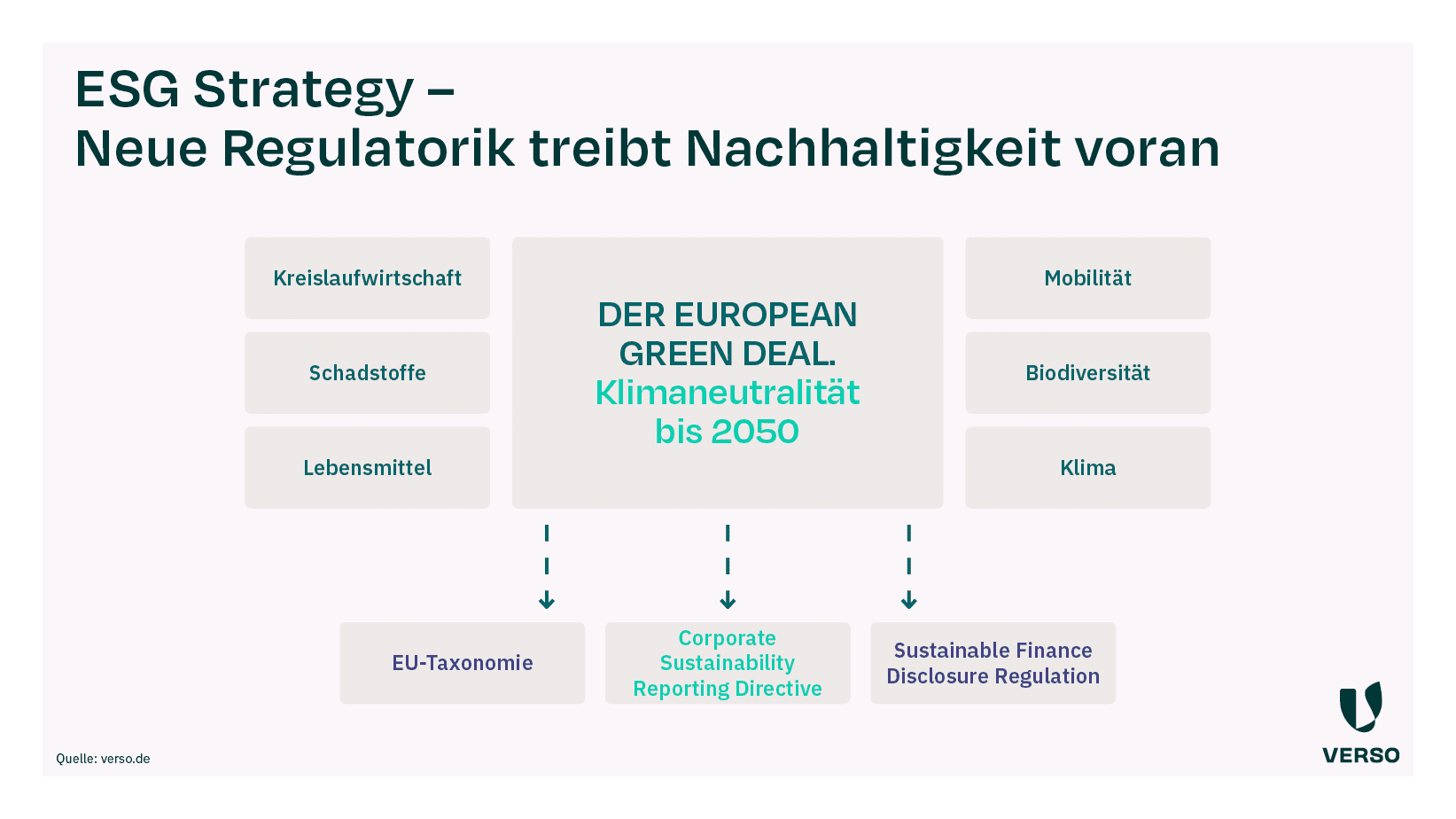
With its Green Deal, the European Union wants to make the EU climate-neutral by 2050 and channel financial flows into sustainable projects and companies. The extensive program also includes three important ESG guidelines and regulations for sustainability reporting:

  • EU taxonomy,
  • Corporate Sustainability Reporting Directive (CSRD) and
  • Sustainable Finance Disclosure Regulation (SFDR).

But how are they connected and why are all three important for companies?

EU taxonomy, CSRD and SFDR briefly explained

Before we take a closer look at the relationship between the EU taxonomy, CSRD and SFDR, we will first look at the three EU requirements individually. The European Union adopted the EU Green Deal back in 2019. The program provides for extensive measures that penetrate deep into the economy and industry. This also includes the three directives.

Der European Green Deal im Überblick

EU taxonomy

The EU taxonomy came into force on January 1, 2022 and defines which economic activities can be classified as sustainable. The regulation sets out criteria for climate and environmentally friendly activities and products. Accordingly, an economic activity must

  • make a substantial contribution to at least one of the six environmental goals,
  • do not compromise one or more of the other environmental objectives, and
  • in compliance with the minimum protection (OECD Guidelines).

Further information can be found in our factsheet on the EU taxonomy.

CSRD

While the EU taxonomy focuses on activities and products, the Corporate Sustainability Reporting Directive focuses on the company level. The CSRD will be introduced in stages from 2024 and regulates sustainability reporting by companies. Ultimately, around 15,000 companies in Germany and around 50,000 in the EU will be affected by the directive.

The CSRD creates a uniform framework for the disclosure of ESG (environmental, social and governance) data. In this context, there is a binding reporting standard in the European Union for the first time: the European Sustainability Reporting Standards (ESRS). Further information can be found in our factsheet on the CSRD.

SFDR

The Sustainable Finance Disclosure Regulation came into force on March 10, 2021. It obliges financial market participants such as private equity, venture capital and fund companies as well as financial advisors to disclose sustainability information on their products and portfolios. The increased transparency is intended to ensure that environmental and social factors are given greater consideration when making investment and financing decisions. A commitment to “sustainable finance”, so to speak. Further information can be found in our factsheet on the SFDR.

The relationship between the EU taxonomy, CSRD and SFDR

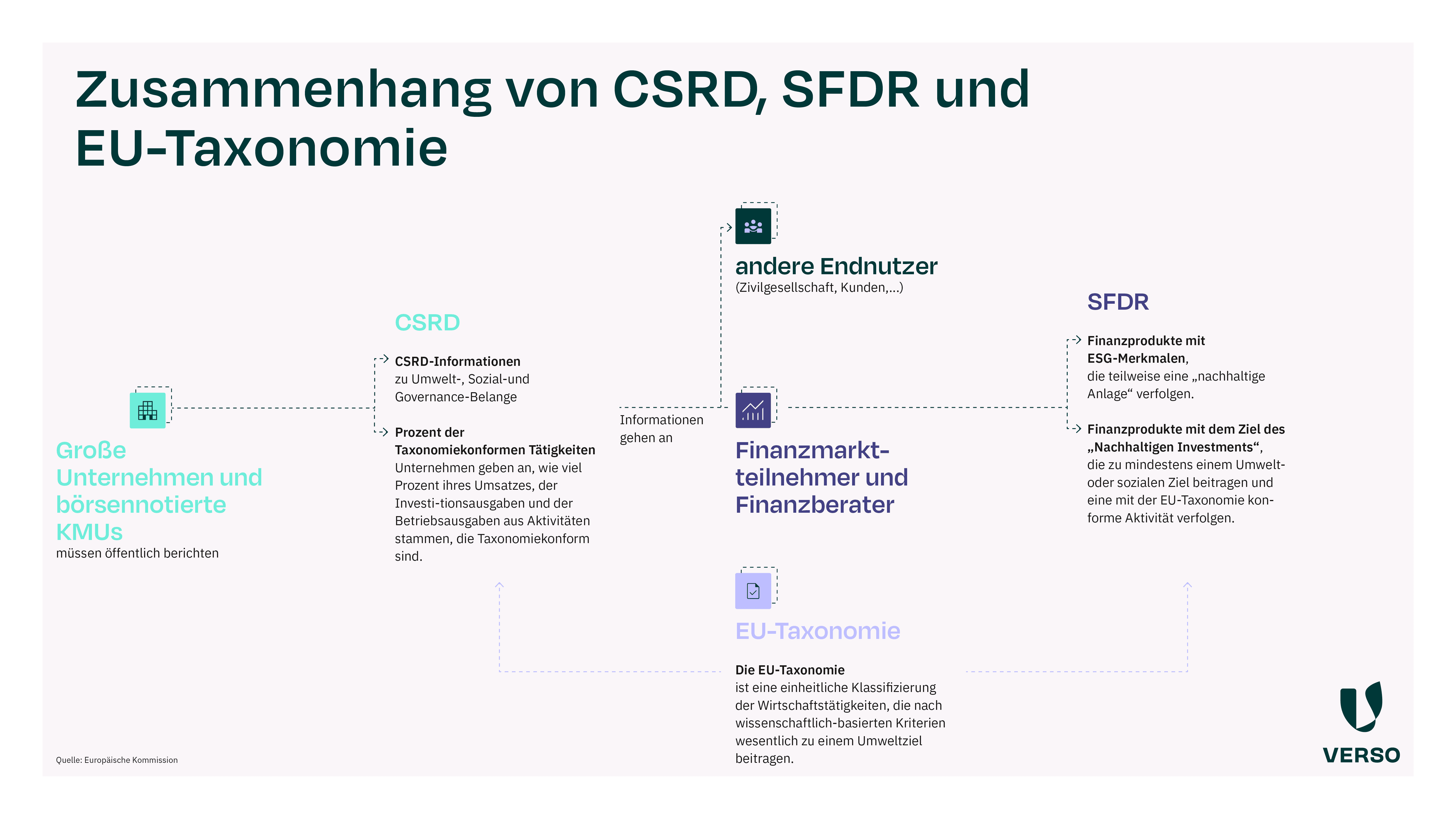
Transparency is crucial to channeling more money into sustainable projects and companies. Customers, employees, investors and many other individuals and groups demand detailed information on environmental, social and governance (ESG) issues. The interaction between the EU Taxonomy, CSRD and SFDR sets the framework for the disclosure of sustainability aspects. The mutual relationships between the EU Taxonomy, CSRD and SFDR can be clearly seen in our illustration.

As you can see, the three sets of rules are closely interrelated and even overlap in terms of content. First of all, the EU Taxonomy provides a classification system for sustainable economic activities, which is applied within the framework of the CSRD and SFRD.

Zusammenhang von CSRD, SFDR und EU-Taxonomie

How do I create a sustainability report?

Creating a meaningful sustainability report can be quite a challenge.
It’s easier with our playbook “7 steps to a sustainability report”.

The CSRD obliges companies to report on various ESG aspects. Affected companies must also provide information on three key indicators of the EU taxonomy – namely the proportion of taxonomy-eligible economic activities

  • of total sales
  • in capital expenditure (CapEx) and
  • operating expenses (OpEx).

The EU taxonomy and CSRD also play a role in the SFDR. Financial market participants and financial advisors must report on key figures from the EU taxonomy for their ESG financial products that promote environmental or social characteristics or have a completely sustainable investment objective. This requires information on the proportion of a financial product that invests in taxonomy-compliant activities.

For example, information is requested on greenhouse gas emissions, consumption and production of non-renewable energy, wage differences and gender diversity.

The financial service providers in turn obtain this sustainability-related information from the CSRD reports of the companies in which they invest. However, there is currently a certain amount of tension.

The CSRD, i.e. the obligation to prepare a sustainability report, does not yet apply to many companies. It will be introduced in stages from 2024. The group of companies subject to reporting requirements will only gradually expand from 2025. However, due to the SFDR, many companies already have to report sustainability information to financial market participants if they require a loan or investment. It is therefore clear that it is worthwhile for companies to start reporting and collecting data at an early stage.

The most important sustainability standards

The factsheet on the most important standards gives you an overview of what is suitable for your company now – quickly and reliably.

Why is sustainability important for companies?

There are numerous reasons to make a company more sustainable. Firstly, there is growing pressure from outside – from regulatory requirements, for example, but also from customers, business partners and competitors.
But current and potential employees are also paying more attention to how their (future) employer acts and whether this is compatible with their views.

Sustainability can therefore provide a competitive advantage, strengthen the brand, increase employee motivation, retain customers and create new jobs, among other things. As we have seen above, it also helps in the search for investors. And, of course, a company makes a contribution to protecting our planet. You can find numerous studies that prove this in the blog post “Why is sustainability important for companies?”.

We support you with the ESG report

You should therefore start collecting the relevant sustainability information in your company at an early stage. You can save yourself a lot of time and effort by using specialized sustainability software such as the VERSO ESG Hub.

Our sustainability experts will also support you throughout the entire reporting process – from the materiality analysis, strategy and carbon footprint to the final reporting.

* This information is summarized editorial content and should not be construed as legal advice. VERSO accepts no liability.

Subscribe to our newsletter!

Sign up and receive regular news about:

  • Pragmatic all-in-one solution for ESG reporting, climate and supply chain management
  • Best practices in the areas of ESG and sustainable supply chains
  • Developed with expertise from 12+ years of sustainability management
  • Sustainability events and much more.

Get to know the software!