
ESG in der Lieferkette
14.02.2025

ESG in the supply chain: 19+1 to-dos

Requirements as far as the eye can see: Where should you best start to establish ESG compliance along the supply chain and unlock the many ESG opportunities for your company? This article shows you how – with 19 to-dos and one bonus tip.

For procurement and supply chain managers, regulations such as the LkSG, CSDDD, CSRD, EUDR, and CBAM mean more documentation requirements, higher transparency demands, and increasing pressure on suppliers.

Despite all these challenges, ESG compliance in the supply chain is an opportunity to identify risks early, reduce costs, and strengthen your own market position. With the right strategy, sustainability can shift from a cost center to a profit center.

But where should you start? This practical checklist with 19 actionable to-dos and one bonus tip provides clarity.

Feel free to share this article if you found it helpful.

Review and prioritize ESG regulations

1. Assess which ESG regulations may affect your supply chain

Supply chain regulations applicable in 2025 Supply chain regulations applicable after 2025
LkSG Forced Labour Regulation
CSRD CSDDD
EUDR ESPR / Digital Product Passport
EU-Taxonomy Right to Repair
CBAM
EU-ETS
Additional regulations such as the EU Battery Regulation or the Circular Economy Act

2. Review which regulations apply to your company and when – some regulations (e.g., CSRD, CSDDD, and EUDR) are implemented in phases

3. For most companies, CSRD, LkSG/CSDDD, CBAM, and EUDR are currently the most relevant

Read more:

Collect ESG data in the supply chain and increase transparency

4. Obtain up-to-date supplier master data and define points of contact

5. Use standardized ESG questionnaires for suppliers and verify them through targeted audits

6. Capture Scope 3 emissions and identify hotspots

7. Define climate targets for the supply chain and implement a climate strategy

Read more:

Identify and manage ESG risks

8. Review suppliers for human rights, environmental, and climate-related risks (abstract, concrete, and event-driven risk analysis)

9. Establish measures for risk prevention and implement remedial actions

10. Establish a holistic, future-proof management system for supply chain risks

Strengthen supplier management for long-term ESG compliance

11. Embed ESG criteria in supplier contracts and communicate a Code of Conduct

12. Assess the ESG maturity level of suppliers

13. Provide training and support for suppliers to improve ESG standards

14. Regularly review supplier ESG performance

Review IT systems and optimize data management

15. Review the interoperability of your IT systems

16. Implement digital ESG data management to ensure full transparency and communication with suppliers

Check off ESG reporting and ensure compliance

17. Consolidate data and standardize reporting processes

18. Ensure regular reporting and leverage synergies: Some BAFA requirements (LkSG) overlap with the ESRS (CSRD), EUDR, and CBAM data and can be reused for CSRD reporting

19. Involve external auditors (e.g., certified public accountants) at an early stage

Bonus tip: How to achieve ESG compliance in the supply chain with less effort

Admittedly, ESG requirements for supply chain managers are demanding. However, with the right strategy, they can be addressed efficiently. Use this checklist as a starting point to make your supply chain ESG-compliant. A more detailed breakdown is available in our practical guide to sustainable supply chains.

Our bonus tip: The VERSO Supply Chain Hub creates transparency and supports you efficiently in implementing the LkSG, CSRD, CBAM, and EUDR – automated and legally compliant.

Practical guide to sustainable supply chains

This guide provides an overview of all key obligations and requirements across 17 pages.

* This information is summarized editorial content and should not be construed as legal advice. VERSO accepts no liability.

Subscribe to our newsletter

Sign up and receive regular news about:

  • Current ESG topics and legislative changes
  • Individual advice from the VERSO experts
  • News about VERSO
  • Sustainability Events and more

Sign up now!

Blog Fahrradbranche Lieferkette
09.09.2024

Compliance in the supply chain: How the bicycle industry is mastering the task

Sustainability regulatory obligations are increasing and compliance in the supply chain is becoming ever more important. Read our article to find out how companies fullfil the ESG requirements for the supply chain and how VERSO specifically supports the bicycle industry in this task.

The economy is undergoing a profound change. More and more companies are integrating sustainability into their business models. This topic is also becoming increasingly important in the bicycle industry – especially in relation to the supply chain, as this is where the greatest risks and the greatest impact of bicycle manufacturers lie.

Two factors play a key role. Firstly, many companies are launching sustainable initiatives to improve their environmental footprint. This enables them to generate business value and Competitive advantages.

On the other hand, regulatory pressure is growing – including throughtheCSRD reporting obligation, the CO2-border-adjustment mechanism CBAM and the EUDR regulation for deforestation-free supply chains. Compliance with sustainability requirements is becoming mandatory.

CSRD, EUDR and CBAM: New requirements for compliance in the supply chain

There are numerous new requirements in the area of sustainability that also affect the bicycle industry. The CSRD, the EU directive on sustainability reporting, plays a major role. Companies have to provide extensive ESG information – and not only consider their own company, but also the supply chain. We have summarised what exactly is required in our blog post „CSRD and the supply chain”. However, the industry is also confronted with new obligations arising from the use of certain raw materials. For example, companies are subject to the EUDR because rubber is used for bicycle tyres. By using CO2-intensive materials such as aluminium or steel, companies may also be affected by CBAM. Both regulations include an assessment of certain raw materials as well as a documentation and reporting obligation. Those who create transparency here and thus address the risks identified have created the basis for fulfilling almost all requirements and compliance in the supply chain.

Compliance in the supply chain: the challenge of a complex supply chain

Cycling is – apart from walking – the most environmentally friendly form of transport: emission-free, quiet, efficient and climate-friendly. However, this only applies to pedalling. When it comes to the production of bicycles, especially e-bikes, the balance is somewhat different.

In addition to emissions – including CO2-intensive materials – the use of high-risk materials also plays a role. “Raw materials for motors, electronics and batteries are associated with major sustainability risks,” explains Klaus Wiesen, Head of Sustainable Supply Chain at VERSO. In addition, the bicycle industry often has complex supply chains. This makes it all the more important to create transparency with regard to these issues and reduce risks.

The complexity of the supply chain results from the large number of players involved in the production of the numerous components of a bicycle or e-bike. These players are distributed internationally, which results in different framework conditions and long transport routes.

Compared to conventional bicycles, e-bikes bring additional challenges. New technologies and raw materials for the drive and battery have become relevant in production. Here, bicycle manufacturers are competing with industries such as the IT sector, with which they previously had little contact.

CSRD and supply chain: these disclosures are required

The CSRD obliges companies to provide extensive information on the supply chain. Find out what information is required and what opportunities and risks arise from the EU directive.

The growing importance of transparency and data management

“Transparency in the supply chain is the key to complying with current and future regulations,” emphasises Klaus Wiesen. Many VERSO customers have voluntarily established corresponding processes before they are obliged to do so by regulations such as the Supply Chain Act (LkSG).

Riese Müller is a pioneer in the bicycle industry and aims to be the most sustainable company in the e-bike sector by 2025. With the VERSO Supply Chain Hub the company creates the necessary transparency in the supply chain and promotes its suppliers in terms of sustainability. Riese Müller is also improving risk management and supply chain mapping to ensure compliance in the supply chain.

However, not all companies in the bicycle industry are that advanced. A key problem is the collection and management of data along the supply chain. Smaller manufacturers in particular have some catching up to do.

“Many companies have hardly collected any structured data, which now presents them with considerable challenges if they want to fulfil the requirements of CSRD, CBAM, EUDR and other regulations,” says Klaus Wiesen. This is where VERSO comes in and offers solutions to support companies in realigning their processes and fulfilling the requirements.

Compliance in the supply chain: benefiting from the network

VERSO is the bicycle industry’s leading platform for sustainability in the supply chain. Their customers include German companies such as Riese Müller as well as international manufacturers – for example from the Netherlands, Switzerland and the USA.

“As there is a large overlap in the supplier base in the bicycle industry, our customers benefit from the networks created and stored in our software,” explains Klaus Wiesen. All customers also benefit from learning effects from previous projects. VERSO integrates new regulations into its software at an early stage to ensure future compliance in the supply chain.

EUDR: Everything you need to know

The EU regulation for deforestation-free supply chains (EUDR) aims to prevent the ongoing deforestation of forests. In our article, we answer the most important questions about the EUDR.

Leveraging supply chain ompliance as a chance for the bicycle industry

The regulations are not only associated with additional tasks. They also open up new opportunities for companies.

One example is risk management. Companies in the bicycle industry have suffered particularly badly from supply bottlenecks in the past. Resilience in the supply chain has therefore become an important issue. By identifying risks (e.g. political instability, natural disasters or human rights violations), a company can take measures to minimize or avoid the impact of these risks. This ensures robust supply chains.

Bicycle manufacturers’ customers often attach great importance to sustainability. Those who fulfill the compliance requirements show that their company takes responsibility for ethical and environmentally friendly standards in the supply chain. This creates trust, provides a competitive advantage and contributes to the long-term success and good reputation of the brand.

Avoiding reputational damage and penalties also plays a role. Companies that do not fulfill their regulatory obligations must expect sanctions. We have summarised possible penalties in the blog post Sanctions at a glance: The cost of mistakes in reporting and implementing sustainability” for an easy overview.

Holistic sustainability management at VERSO

In order to fulfill the requirements, companies should prepare for the new regulations at an early stage. Thanks to our expertise in the bicycle industry (among others) VERSO is the ideal partner. “With the VERSO Supply Chain Hub we have been supporting our customers for years with transparency in the supply chain and the fulfillment of their due diligence obligations. Our software solution enables optimized preparation for current and future regulations,’ emphasizes Klaus Wiesen.

The supply chain harbors the greatest risks and has the greatest impact in the bicycle industry. However, a holistic view of a company is necessary, particularly with regard to CSRD. This includes the upstream and downstream value chain as well as the company’s own business activities. VERSO offers an all-in-one solution here.

With the VERSO ESG Hub you can collect all relevant data and create a meaningful sustainability report. With the Climate Hub the corporate carbon footprint is calculated and a climate strategy is mapped. The VERSO sustainability experts will support you throughout the entire process. Furthermore, you can gain additional know-how about sustainability in our VERSO Academy courses.

Subscribe to our newsletter!

Sign up and receive regular news about:

  • Pragmatic all-in-one solution for ESG reporting, climate and supply chain management
  • Individual advice from the VERSO experts
  • Developed with expertise from 12+ years of sustainability management
  • Trusted by 250+ customers
CSRD und Lieferkette - Was der Einkauf beachten muss
17.06.2024

CSRD and supply chain: What procurement needs to consider

The CSRD with its ESRS standards is not only a lot of work, it also has a major impact on companies: This is because you have to make extensive ESG disclosures – and not only look at your own company, but also at the supply chain. Read here what purchasing departments need to consider and what opportunities and risks arise from the EU directive.

The CSRD (Corporate Sustainability Reporting Directive) has applied to the first companies since January 2024, and others are gradually being added. Ultimately, around 50,000 companies in Europe will be obliged to publish a report with comprehensive information on ESG (environmental, social and governance) issues.

The ESRS, the European Sustainability Reporting Standards, were also introduced with the CSRD. For the first time in the EU, they provide a standardized framework for the preparation of a sustainability report – in simple terms: which ESG information is required and in what form it must be reported.

It is important to note that the reporting obligation not only relates to the company itself, but also extends to the entire value chain. In this blog post, we look at the upstream value chain – i.e. the supply chain. And this is where companies subject to CSRD reporting requirements can quickly run into problems: they need a lot of information from their suppliers and the data situation is often inadequate – according to the Bertelsmann Stiftung’s Sustainability Transformation Monitor 2024. With VERSO, you can master this challenge. Our Supply Chain Hub creates transparency in the supply chain and enables you to analyze risks, develop targeted measures and comply with reporting obligations. We will now take a closer look at these disclosure requirements within the framework of the CSRD and the impact on purchasing.

CSRD and supply chain: What needs to be reported?

The CSRD demands a lot from companies: the ESRS comprises around 1150 data points and over 100 of these relate to the supply chain. Purchasing is therefore an important player in the reporting process.

The information involved can be roughly summarized as follows: The ESG report must contain information on environmental and social IROs (impacts, risks and opportunities) in the supply chain as well as measures related to the IROs. If your company is affected by the LkSG, you will probably recognize some disclosure requirements and can realize synergies: This is because some BAFA requirements overlap with the ESRS.

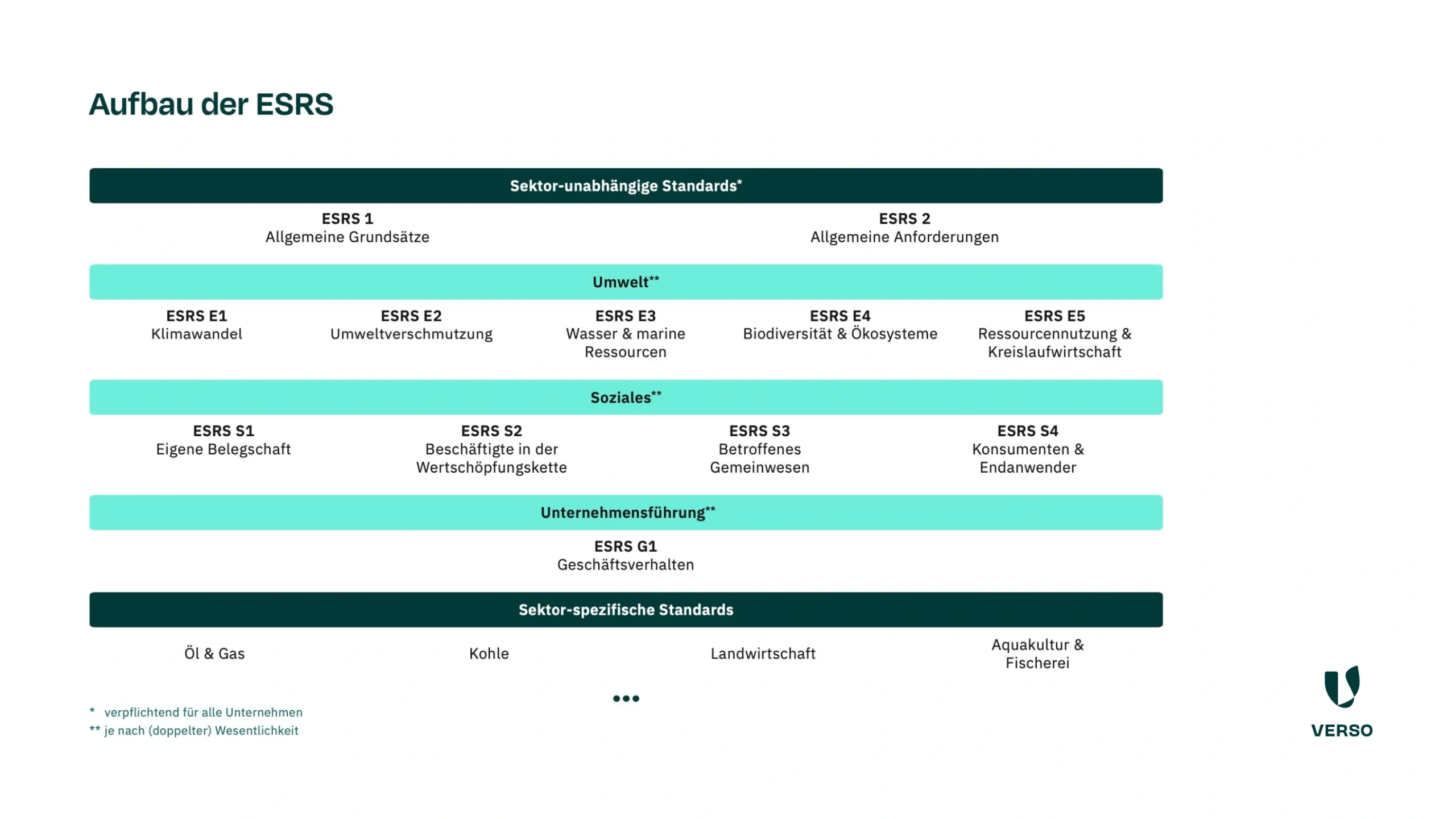
Bei den ESRS gibt es sektorunabhängige Standards und sektorspezifische Standards. Die Sektorunabhängigen Standards teilen sich in die Bereiche Allgemeines, Umwelt, Soziales und Unternehmensführung. Die Allgemeinen Standards sind verpflcihtend für alle Unternehmen, die Themenstandards sind je nach doppelter Wesentlichkeit berichtspflichtig oder nicht.

But what does this mean in detail? To answer this question, let’s take a closer look at some ESRS standards and clarify how they relate to the supply chain.

ESRS E1 – the climate protection standard

The name says it all: ESRS E1 is about climate protection – in your company and in your supply chain. Your company must therefore not only disclose its own greenhouse gas emissions, but also the CO2 emissions in the upstream and downstream value chain – i.e. in Scope 3. Incidentally, the majority of companies generate the most emissions in this category.
E1 also requires companies to set themselves climate targets. Transparency about the targets and measures of their own suppliers is crucial in this respect.

ESRS E5 – Resource utilization and circular economy

The supply chain naturally plays an important role in ESRS E5, as many resources are obtained or processed here. For example, the CSRD asks for:

  • Measures to avoid the generation of waste
  • Resource utilization
  • Measures to promote the circular economy
  • Cooperation or initiatives to improve the recyclability of products and materials


ESRS S2 – Workforce in the value chain

The fact that the ESRS S2 also relates to the supply chain and entails disclosure obligations is already in the name, so to speak. Among other things, the CSRD is concerned here with how your company fulfills the due diligence obligations. This means How do you Ensure compliance with human rights, labor standards andgood working conditions at suppliers? The CSRD does not require much more than the LkSG. You should also show whether there is a complaints management or whistleblower system for workers in the supply chain, how you handle complaints and resolve any problems raised.

ESRS S3 – Affected communities

The ESRS S3 addresses the impacts that your company’s operations, products or services, and upstream and downstream value chains have on “affected communities”. This refers to people and groups who live or work in the same area as a company. The standard also explicitly refers to impacts on indigenous peoples. Impacts can arise, for example, from truck transportation, the extraction of raw materials or controversial land use.

ESRS G1 – Company policy

With regard to the supply chain, your company must disclose the following:

  • Management of relationships with suppliers, payment practices, in particular with regard to late payments to small and medium-sized enterprises
  • Strategies for detecting and preventing corruption and bribery, including training for suppliers

However, you do not have to provide information on every standard in your CSRD report. This depends on whether a topic is material for your company. VERSO offers you an AI-supported materiality analysis here. In our white paper “All information on the ESRS” you will also find further detailed information on the European standards, in particular on the transition periods.

Is your purchasing department ready for the ESG requirements?

Companies are now affected by a large number of sustainability requirements – and purchasing is no exception.
Use our checklist to find out whether your purchasing organization is optimally prepared for ESG requirements.

CSRD and the supply chain: opportunities and risks for procurement

The CSRD is a major challenge – we can’t hide that and we don’t want to. With almost 1200 data points, ESRS reporting is a mammoth task. It is complex and resource-intensive. But with the right support, you can manage it – we will be happy to assist you with the sustainable transformation. What’s more, the CSRD doesn’t just end with a sustainability report.

The fact that your company is systematically addressing the issue of sustainability opens up great opportunities. The double materiality analysis and reporting will make opportunities and risks in the supply chain more visible. This enables your company to address these in a targeted manner. Sustainability requirements can trigger innovations, such as the use of environmentally friendly materials or the optimization of logistics processes.

Many customers also tell us that the reporting process has enabled them to get to know their suppliers even better. The increased transparency ensures better and more sustainable supply chain practices. By working closely together, you strengthen long-term partnerships and thus improve the stability and efficiency of the supply chain. The reporting process promotes digital development. Software specialized in CSRD, LkSG and CBAM requirements helps monitor the supply chain and ensures compliance with legal requirements. It can collect and process the necessary large volumes of data.

Risk management for sustainability in the supply chain

In our white paper, you will learn how to implement the requirements of the German Supply Chain Act (LkSG) in a future-proof manner through digitalization and collaboration.

How does CSRD influence purchasing and the supply chain?

CSRD has a major impact on purchasing and requires a high degree of transparency and responsibility. Your company must collect and provide detailed information and comply with legal due diligence obligations in relation to environmental and social standards. This includes a new assessment in the purchasing process to ensure that suppliers comply with sustainability requirements.

So you need to be even more careful about who your company does business with.
Teamwork is also required when it comes to climate change. Climate change and extreme weather will affect us all. That’s why we need to act together to slow down climate change and reduce its impact.

Climate protection measures must not stop at the gates of your own company: Together with your suppliers, you can implement initiatives that help reduce greenhouse gas emissions.
You can find specific tips for decarbonizing your supply chain in the blog post “Why is climate protection in the supply chain relevant?”.

How VERSO supports you in implementing the CSRD

VERSO offers you the all-in-one package for implementing the CSRD. The EU directive makes the topic of sustainability in the supply chain even more relevant, as companies must now also report robustly on sustainability activities in the supply chain. The VERSO Supply Chain Hub helps procurement to record the necessary data in the supply chain, monitor suppliers and provide the required reporting key figures with minimal effort.

We round off the package for implementing your CSRD obligations with additional software solutions and consulting services. With VERSO, you can carry out an AI-supported materiality analysis. In the ESG Hub, you collect all relevant data and create a meaningful sustainability report. The Climate Hub supports you with your carbon footprint and decarbonization strategy. And in the VERSO Academy, you will acquire the necessary knowledge about CSRD and ESRS.

* This information is summarized editorial content and should not be construed as legal advice. VERSO accepts no liability.

Subscribe to our newsletter!

Sign up and receive regular news about:

  • Pragmatic all-in-one solution for ESG reporting, climate and supply chain management
  • Individual advice from the VERSO experts
  • Developed with expertise from 12+ years of sustainability management
  • Trusted by 250+ customers

Get to know the software!