
Nachhaltigkeitsmanager:innen sind gefragt – so sieht der Beruf aus
15.11.2024

Trend Job Sustainability Manager: Skills, Tasks and Further Training

Let’s take a closer look at this up-and-coming professional group. What are the tasks of sustainability managers, what training and further education is available and what does their day-to-day work look like?

What distinguishes sustainability managers?

Sustainability managers, also known as CSR managers, sustainability managers or ESG managers, are usually passionately committed to the topic of sustainability and have set themselves higher goals: a fairer world, environmental and climate protection. They exemplify sustainability and motivate their colleagues for ecological and social issues. At the same time, sustainability managers are confronted with the comprehensive ESG regulations. They act as business strategists and cross-functional interfaces within the company to guide it through the sustainable transformation.

Why are sustainability managers important?

In over 14 years of experience in sustainability management, we at VERSO have learned that the sustainable transformation of a company can only be achieved through an effective strategy and clear responsibilities. Why? Sustainability affects all areas of the company. That’s why someone is needed to bring it all together. Sustainability managers take on this interface function. They analyze business processes, implement sustainable business practices and aspects such as environmental protection, employee and human rights. They help medium-sized companies in particular to differentiate themselves massively from the competition. And for some years now, they have also been ensuring ESG compliance in companies.

What does that mean? Sustainability managers are responsible for compliance with the CSRD and are also involved in other regulations such as EUDR, CBAM, CSDDD and LkSG, at least in a supportive capacity. They are also responsible for preparing a sustainability report, including data collection – which many companies now do in accordance with the complex CSRD. They are therefore jointly responsible for the future viability of companies – both from a sustainability and a business perspective.

How is the profession changing?

Sustainability managers often have to deliver a one-man or one-woman show. This is now slowly changing: with the well-known regulations CSRD, EUDR, CSDDD, CBAM and many other ESG-related tasks, it is becoming increasingly important for companies to build a strong sustainability team: A team that is fully committed to minimizing the company’s negative impact as far as possible, implementing sustainability campaigns and positioning the company for long-term sustainability. This is the only way for companies to survive in the long term. And not just survive: Those who take sustainability seriously can also generate real business value from it – more on this in our blog post on the opportunities of CSRD.

The new and complex ESG requirements have also changed the scope of tasks and the skills required of sustainability managers. In the past it was still very much about internal communication, driving ideas for more sustainability and writing reports as a means of communication. Nowadays, ESG managers often find themselves dealing with complicated legal texts, compliance requirements and time consuming data collection. To ensure that there is still time left to implement sustainability measures, it is worth investing in ESG software such as VERSO. In any case, sustainability managers are now required to have a very broad set of hard and soft skills.

What skills do sustainability managers need?

First of all, the so-called “hard skills” – i.e. technical skills or professional competencies that can be learned and are in demand. Below is a selection of some of the skills that are becoming particularly important in view of ESG regulation:

  • Knowledge of sustainability reporting (e.g. CSRD, GRI, ESRS)
  • Understanding of regulations/legislative texts (e.g. LkSG, CSDDD, EUDR)
  • Data analysis and management (e.g. for measuring CO2 emissions, energy consumption)
  • Understanding of value creation and economic activity
  • Project management (planning, implementation and monitoring of sustainability projects)
  • Supply chain management (assessment of environmental impact, supplier selection)
  • Fundamentals of environmental science, sustainability concepts and ecological footprinting

Hard skills can be learned well, and further training courses such as the VERSO Academy can also provide support here. Software is also a big help for skills such as data collection, carbon footprint and supply chain management. In addition to these skills that can be learned, sustainability managers also need special interpersonal skills, the so-called “soft skills”. Among other things, these skills help to effectively implement sustainability in companies:

  • Empathy and social responsibility (understanding social and ethical implications)
  • Communication skills (convincing communication with internal and external stakeholders)
  • Change management (leading companies through sustainable transformation)
  • Problem-solving and decision-making skills (solving complex challenges)
  • Negotiation skills (negotiating with suppliers, partners or superiors)
  • Ability to work in a team and leadership skills (management of teams, cooperation across departments)
  • Critical and strategic thinking (developing long-term sustainability strategies)
  • Flexibility and willingness to learn (react to changing regulations, findings and market requirements)

What are the tasks of sustainability managers?

Sustainability managers do not have a fixed working routine. They usually juggle between data collection, coordination and writing for the ESG report and the creative and strategic development of sustainability measures. The tasks of ESG managers include:

  • Developing a sustainability strategy
  • Collecting sustainability-relevant data (especially for the CSRD report)
  • Defining and implementing targets and measures, monitoring target achievement using key figures
  • Obtain expectations and input from internal and external stakeholders
  • Check supply chains
  • Create a sustainability report
  • Communicate sustainability issues internally and externally (especially with marketing and management level)
  • Prevent Greenwashing
  • Advising all business divisions on sustainability
  • Setting an example of sustainability as well as training employees and motivating them to follow suit

How much do sustainability managers earn?

According to statistics from the German Federal Employment Agency, the salary of sustainability managers lies between €5,000 and €7,100. The average full-time gross monthly salary in Germany is €6,628. However, the salary can vary greatly – it depends in particular on the size of the company, but also on the individual’s professional experience as well as the federal state they work in. Accelerating the sustainable transformation within a company therefore does not necessarily mean having to settle for a lower salary – quite the opposite: the trend is set to intensify, as demand is extremely high while the supply of qualified sustainability experts is scarce.

How do you become a sustainability manager – what training is required?

To become a sustainability manager, you usually need a degree in a field such as sustainability management, environmental sciences or business administration with a focus on CSR. However, lateral entry is also very possible. Many ESG managers also come from the communications industry or another specialist department. With further training in sustainability management, they can often join a company’s sustainability team directly.

What further training is important for sustainability managers?

With the new regulations and developments in the ESG area, it is particularly important for sustainability managers to continue educating themselves. Otherwise, topics such as CSRD, EU taxonomy or LkSG will quickly become too much for you. It is well worth your time to attend webinars and complete in-depth further training in the specific subject areas.

Subscribe to our newsletter!

Sign up and receive regular news about:

  • Current ESG topics and legislative changes
  • Best practices in the areas of ESG and sustainable supply chains
  • News about VERSO
  • Sustainability events and much more.

Sign up now!

So finden Sie die richtigen Projekte zur CO2-Kompensation – ohne Greenwashing
16.10.2024

CO₂ Compensation – How to Make it Work Without Greenwashing

What to do with unavoidable greenhouse gas emissions? In this article, you will learn how to tackle carbon offsetting – with effective projects and without greenwashing.

Your carbon footprint and climate strategy have been drawn up and you are already reducing the first greenhouse gas emissions. But it is slowly becoming clear: Despite all your efforts, you will be left with certain residual emissions! What to do with the unavoidable emissions? If you are also faced with this question, this article is for you. Because of course, CO₂ compensation is the obvious solution. But…

Careful – Carbon offsetting is a double-edged sword

Carbon offsetting has long been a contentious issue. Quite rightly so, as the situation on the carbon market is actually not so rosy: the voluntary carbon market is currently not regulated by either state supervision or a binding legal framework. Instead of legally binding criteria for the validation of carbon offsetting, there are only a number of private standards and registries with different quality criteria. This makes the market structure opaque and leads to major differences in quality within the climate protection projects on which the so-called CO₂ credits are based. One example: Deutsche Umwelthilfe (DUH) has already successfully filed several lawsuits against offsetting through forest projects and reforestation. The reasons: The estimated forest area could not offset the amount of CO₂ emitted at all or the project did not run long enough to keep up with the lifespan of CO₂ in the atmosphere. This leaves you with two problems:

  1. You cannot rely solely on the information provided by standards and registers for quality assurance
  2. At the same time, your company is expected to report truthfully, as greenwashing is penalised.

Actually, you should now take another look at the certified projects yourself. As you can imagine: It will be time-consuming. With the following factors, we will show you how to efficiently select reputable carbon offsetting projects.

Guide to the decarbonisation strategy

A holistic decarbonisation strategy or climate strategy is more than helpful when implementing climate targets, transition plans and carbon footprints. With this guide, you can get started right away!

6 factors for the selection of serious projects for CO₂ compensation

1. Impact

The projects should have measurable positive effects on the environment that, where possible, go beyond the mere reduction of CO₂ emissions. This includes the protection of biodiversity, but also the improvement of air and water quality as well as the restoration and preservation of ecosystems (co-benefits). A strong environmental impact means that the selected project makes a holistic contribution to environmental protection.

2. Methodology and verification

The projects should be based on recognised scientific methods and standards. They should also be regularly reviewed by independent third parties to ensure the reliability of the emission reductions claimed.

3. Durability and monitoring

It is important that projects are monitored throughout their entire duration to ensure that emissions are actually reduced in the long term. Regular monitoring and reporting help to recognise risks at an early stage and take countermeasures. This ensures the long-term impact of the project.

4. Additionality

Projects are considered additional if they would not have been realised without the expected income from the proceeds of emission allowances. This requires a more detailed analysis and assessment of the initial scenario (project baseline).

5. Double counting

The project of your choice must guarantee that the emission reductions are not sold more than once or claimed by different parties. This protects the integrity of the carbon market.

6. Embedding in the climate strategy

CO₂ offsetting should really only be an option if you have already exhausted all potential for reducing emissions as part of your climate strategy. A serious project should be part of a comprehensive climate strategy and should never be considered in isolation. This ensures that the measures make a meaningful contribution to your overall climate goals and are not just used for ‘greenwashing’.

What you should take away from this article

If you want to offset emissions, you should therefore not choose the first offset project that comes along. Use our tips to select a project with a real impact! And remember: climate neutrality can only be achieved with close coordination between your carbon footprint, decarbonisation strategy, greenwashing awareness and reputable climate and environmental protection projects to offset your unavoidable residual emissions.

Looking for support with your CO₂ management?

As you can see, choosing the right projects for your CO₂ offsetting is not that easy. And who knows, maybe you can still reduce greenhouse gas emissions in one place or another? We would be happy to look at this with you. We will guide you through your decarbonization strategy with climate consulting and CO₂ software.

* This information is summarized editorial content and should not be construed as legal advice. VERSO accepts no liability.
Die Geschichte des Nachhaltigkeitsberichts beginnt in den 1980er Jahren – damals gab es die ersten freiwilligen Umweltberichte. Seitdem hat sich enorm viel getan – bis hin zu einer Berichtspflicht.
20.08.2024

The History of the Sustainability Report: How It Has Evolved

The history of the sustainability report begins in the 1980s, when the first voluntary environmental reports were published. A lot has happened since then – right up to mandatory reporting. Read about the milestones and drivers that have shaped the ESG report and how the reports have developed in terms of depth and quality.

History of the sustainability report from 1980-2000: The era of environmental reports

The history of the sustainability report goes back to the 1980s. But for the introduction to this blog article, let’s go back a little further. This will help us to understand why the topic of sustainability and ESG suddenly became so popular. Let’s transport ourselves back to the early 1970s, so to speak. The world was characterized by rapid change and far-reaching social, economic and political developments. The Cold War dominated international politics. The oil crisis made people aware of their dependence on fossil fuels and their finite nature. Economic growth and industrialization continued.

At the same time, however, environmental conditions deteriorated, for example due to polluted air and water. It was precisely at this time that a book was published that attracted worldwide attention. The title: “The Limits to Growth”. It was published by the Club of Rome, an association of scientists, economists, business people and former politicians. This was a turning point. The Club of Rome played a central role in ensuring that the issues of environmental awareness and sustainability were recognized globally for the first time. But here we need to put the brakes on: not everything changed immediately. Awareness was only gradually followed by action. But there have already been the first Forerunner of the sustainability report.

In the 1980s, chemical companies published so-called environmental reports on their environmental activities. These were voluntary and mainly served to improve their image, as the industry was subject to strong criticism.

In the 1990s, small and medium-sized enterprises (SMEs) followed suit and became involved in environmental issues. However, the reports of the time were still a decade away from the holistic approach of today’s sustainability reports. Only then did the consideration of all ESG aspects – i.e. environmental, social and corporate governance – become established.

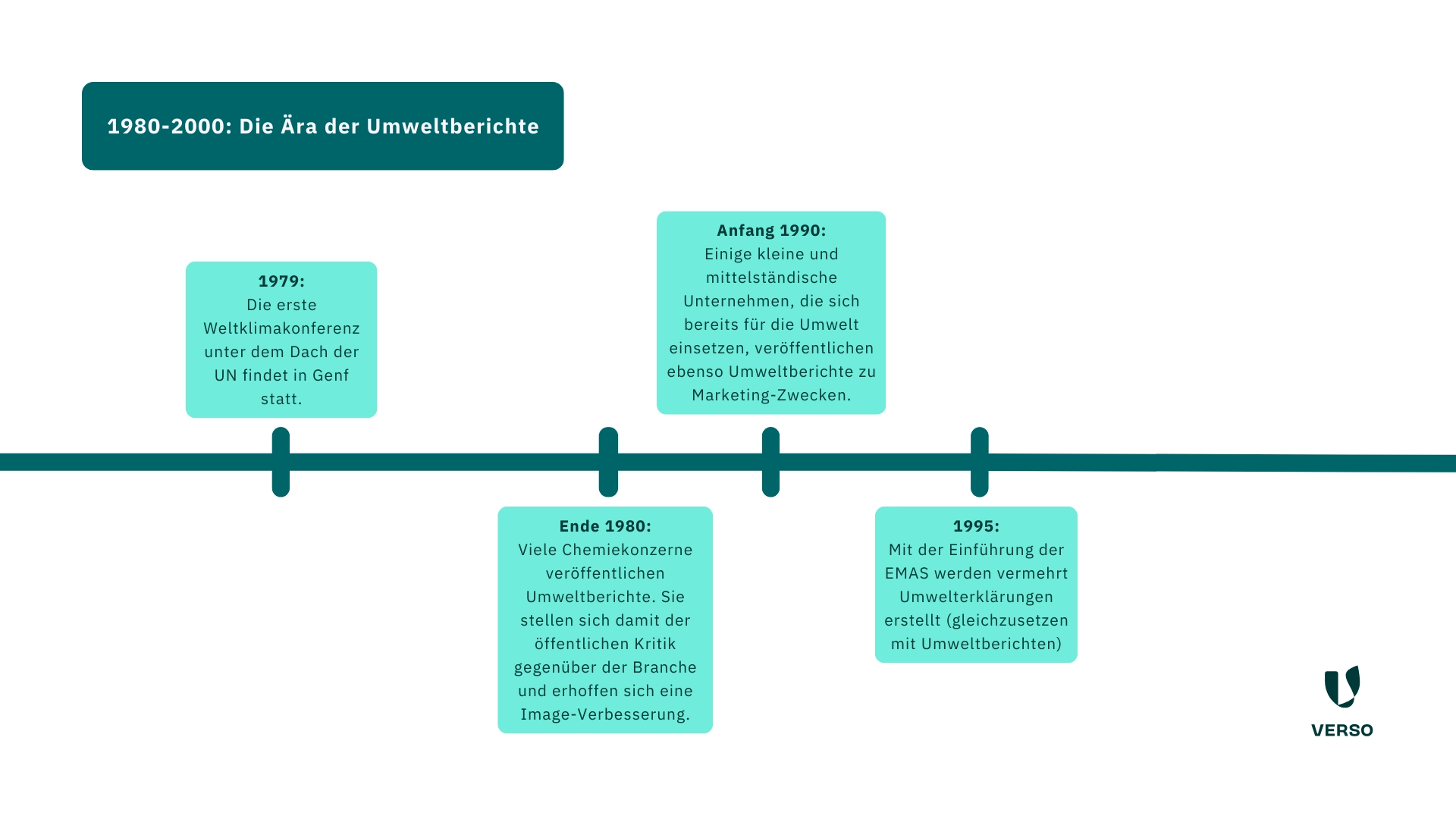
Before we continue our journey through time, let’s take a look at a few highlights from the years of environmental reports:
  • 1979: The first world climate conference under the auspices of the UN takes place in Geneva.
  • End of 1980: Many chemical companies publish environmental reports.
  • Early 1990: Some small and medium-sized companies follow suit and also publish environmental reports for marketing purposes.
  • 1995: With the introduction of EMAS, more and more environmental declarations are drawn up (equivalent to environmental reports).

The challenge of the first sustainability report

A company’s first ESG report is always particularly time-consuming.
We have created a practical guide for your first sustainability report.
You will be guided step by step through the process of creating a meaningful sustainability report.

History of the sustainability report from 2000-2010: Major corporations report

Our journey through the history of sustainability reporting continues with the turn of the millennium. Compared to today, the attention paid to sustainability and ESG was manageable. But there were important developments that brought it into the national and international spotlight.

The Kyoto Protocol was signed in 1997 and came into force in 2005. It was the first international agreement to set binding targets for reducing greenhouse gas emissions.

In 2002, Germany, like other countries, adopted a “National Sustainability Strategy”. In addition to public interest, new technologies also gave the topic of sustainability a boost. At the turn of the millennium, wind power became the most important of all renewable energies. Ten years later, it was replaced at the top by solar energy.
The overall advance of all renewable energies was unstoppable.

While the topic of sustainability itself gained in importance, this did not yet have a major impact on ESG reporting. Until 2010, it was mainly large companies that published a voluntary sustainability report – they recognized the increasing attention for the topic.

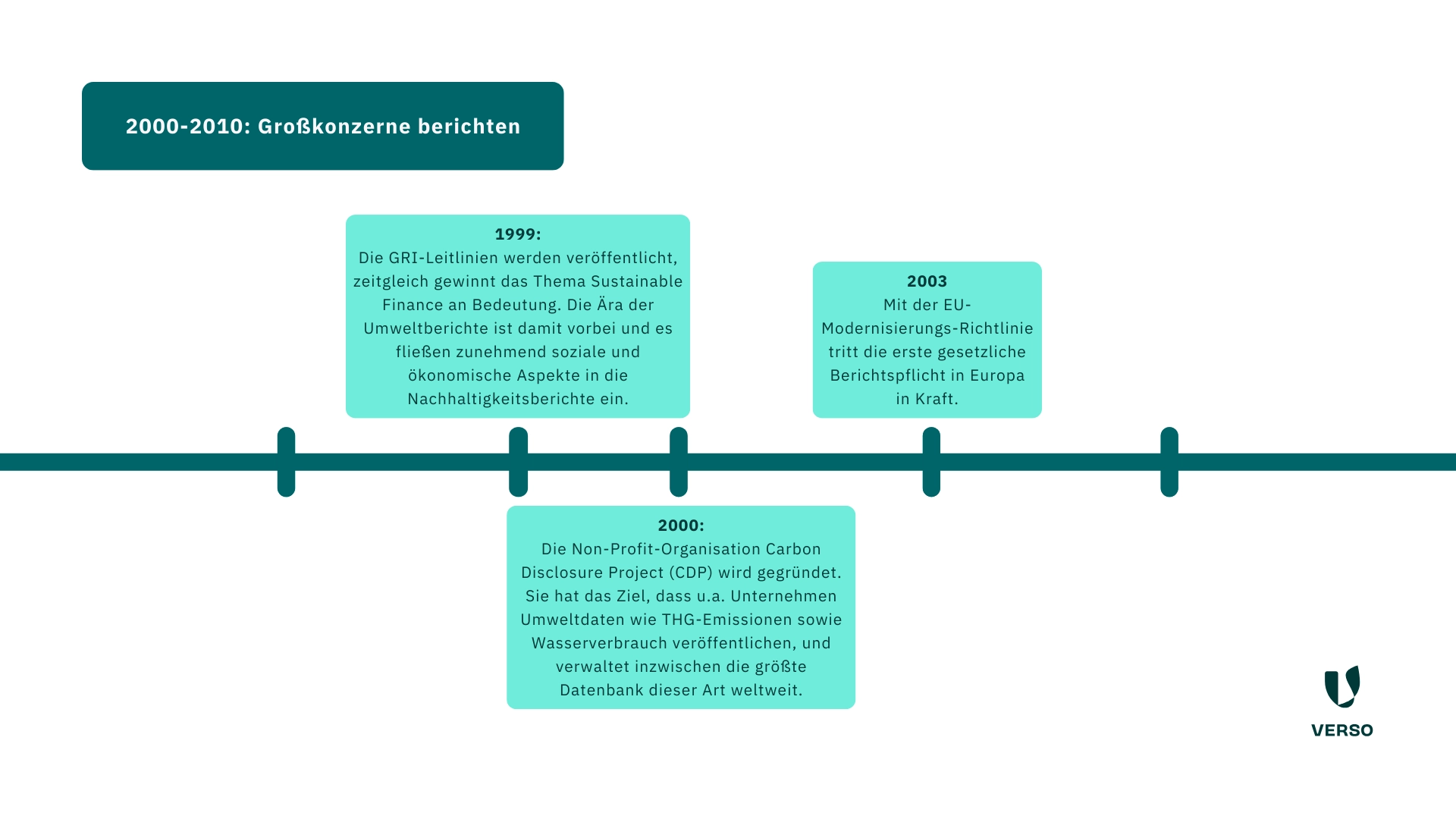
However, two events provided a significant impetus here. The Global Reporting Initiative (GRI) published its first guidelines. They provided companies with a framework for reporting on environmental, social and economic aspects. Over the years, the guidelines were further developed into the GRI Standards (from 2016). The topic of sustainable finance also emerged. Special indices were created with companies that act more sustainably. Before the history of sustainability reports really picks up speed, let’s take a look at the most important milestones from this period:

  • 1999: The GRI guidelines are published, at the same time the topic of sustainable finance gains in importance.
    The era of environmental reports is over and social and economic aspects are increasingly included in sustainability reports.
  • 2000: The non-profit organization Carbon Disclosure Project (CDP) is founded.
    Its aim is for companies to publish environmental data such as greenhouse gas emissions and water consumption, and it now manages the largest database of its kind in the world.
  • 2003: The first statutory reporting obligation in Europe comes into force with the EU Modernization Directive.

History of the sustainability report from 2014-2019: boom in frameworks

A veritable boom in ESG reporting regulations began in 2010. This was accompanied by the development of numerous reporting standards and frameworks that offered companies a standardized method for disclosing sustainability aspects.

As a result, reports became more standardized and clearer and transparency increased. A holistic view of sustainability was anchored in the standards. Typically, the environmental aspects were CO2 emissions, energy consumption and waste. Social aspects included working conditions, human rights and communities. Governance covered topics such as corporate management and ethical business practices. Companies began to define and measure their sustainability goals and progress more clearly. Many companies realized that sustainable practices are not only good for their image. They can also bring economic benefits, such as cost savings, risk reduction and an improved competitive position.

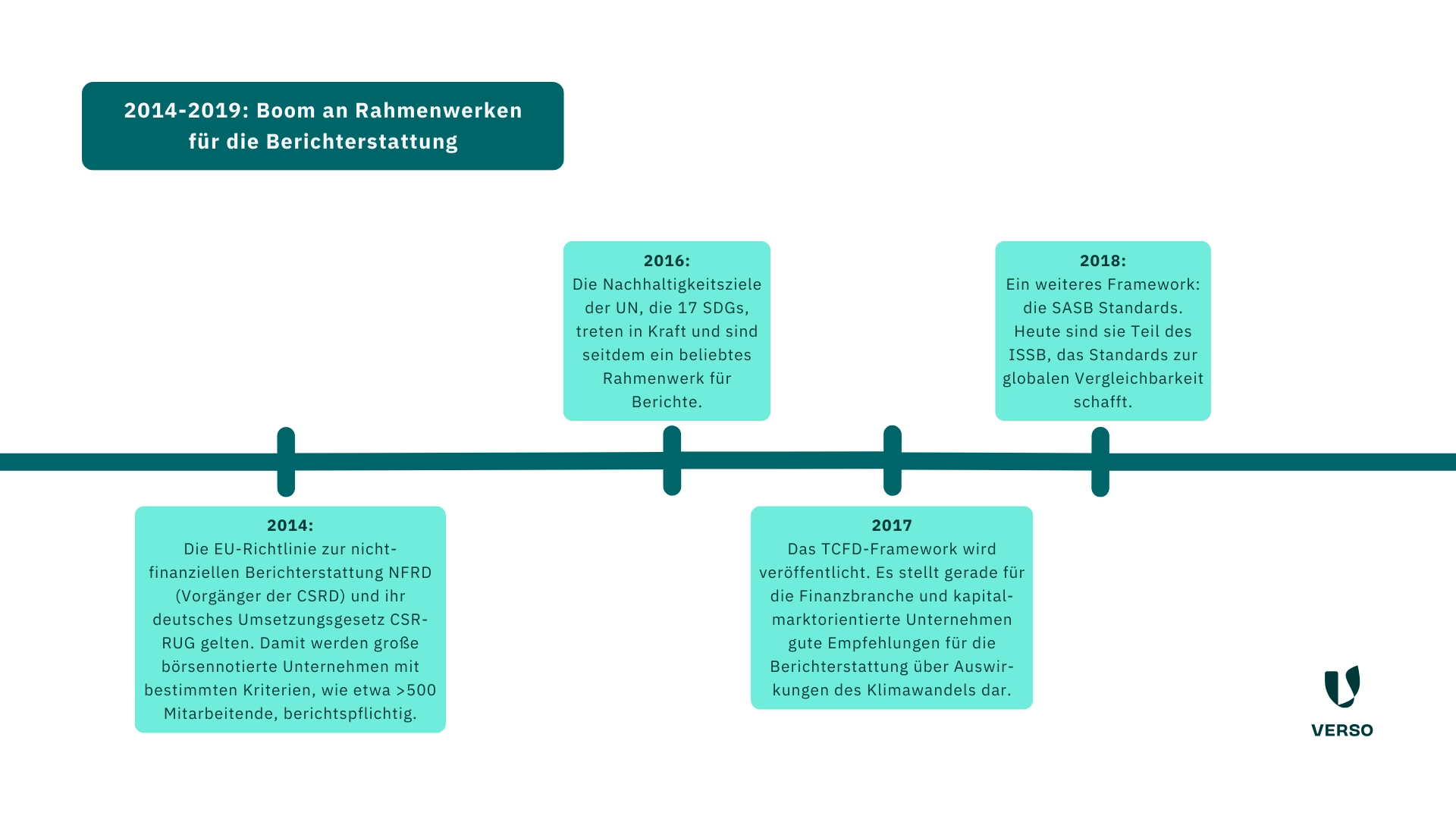
You can read about the business value that sustainability can bring in the blog post “Why is sustainability important for companies?”. As this decade draws to a close, we would also like to look at a few highlights. This time it’s about important frameworks and regulations:

  • 2014: The EU Non-Financial Reporting Directive NFRD (predecessor of the CSRD) and its German implementation law CSR-RUG (followed in 2017) come into force.
    This means that large listed companies with certain criteria, such as over 500 employees, are required to report.
  • 2016: The UN’s Sustainable Development Goals, the 17 SDGs, come into force and have been a popular framework for reports ever since.
  • 2017: The TCFD framework is published.
    It provides good recommendations for reporting on the effects of climate change, particularly for the financial sector and capital market-oriented companies.
  • 2018: Another framework: the SASB standards.
    Today, they are part of the ISSB, which creates standards for global comparability.

By the way: If you need an overview of standards and frameworks, take a look at our factsheet.

CSRD beyond bureaucracy: potential and opportunities

Even if the CSRD is primarily a bureaucratic obligation and entails many requirements, it also conceals valuable opportunities for business.
Read our blog article to find out what these are.

History of the 2019-2024 Sustainability Report: The EU and the Green Deal

The story of the sustainability report is now slowly coming to an end. But only in this blog post.
A lot will certainly happen in this area in the coming years.

However, we don’t want to speculate, but rather take a closer look at what has happened since 2019. The initial situation: there was a reporting obligation. However, this only affected around 500 companies in Germany. Companies had some freedom in the information they provided. The main criticism was the poor comparability. The new approach: With its Green Deal, the EU not only wanted to optimize and standardize ESG reporting, but also drive forward the entire sustainable transformation of the economy. The central goal: Europe will be the first climate-neutral continent by 2050.

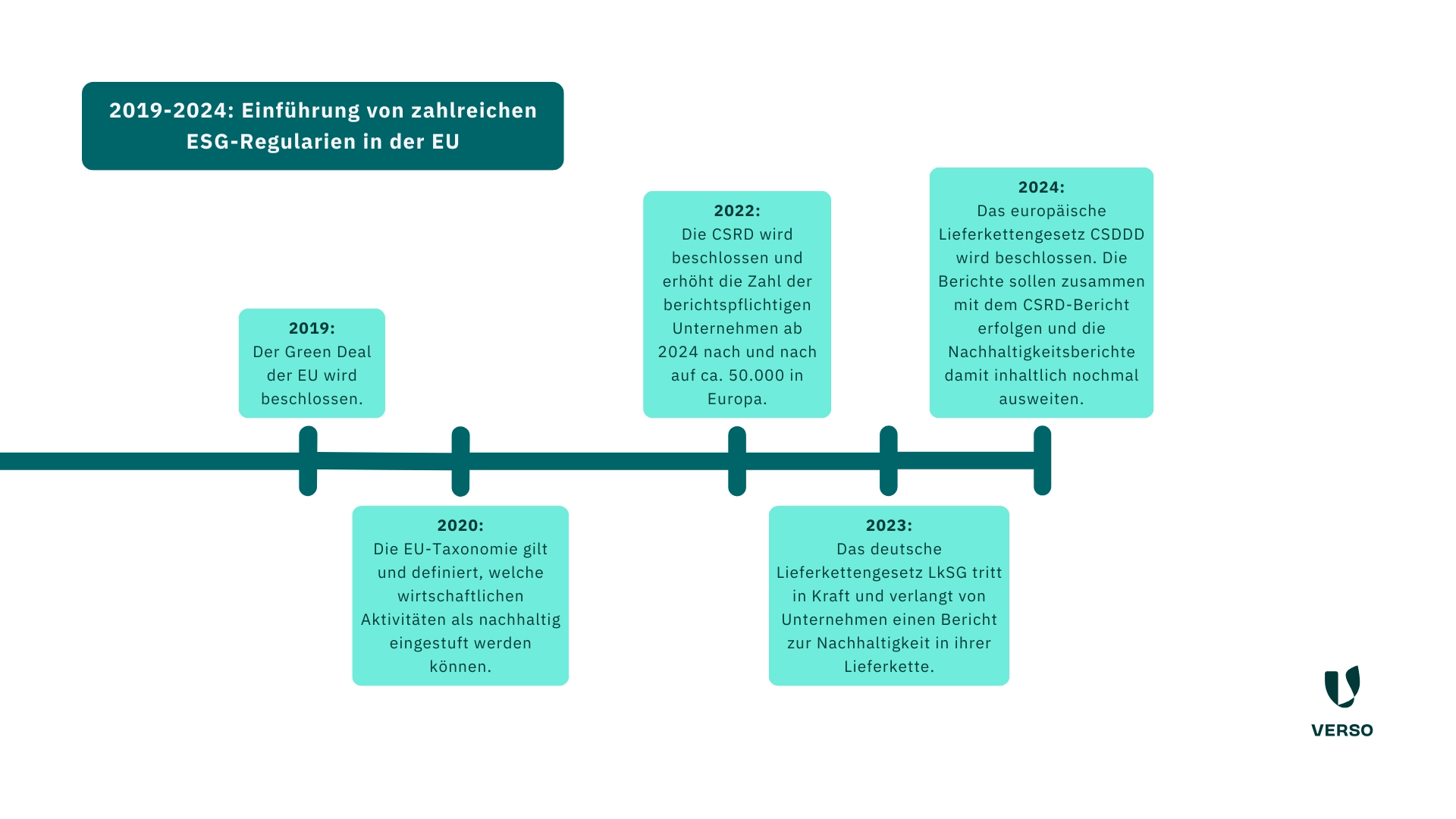
In order to implement this ambitious plan, the EU has put together a comprehensive package of directives and measures. These included, for example, the Corporate Sustainability Reporting Directive (CSRD) and the European Supply Chain Directive (CSDD). As part of the CSRD reporting obligation, a standardized European framework, the ESRS, was even developed for the first time, which provides companies with clear guidelines regarding content and form. Here is an overview of important regulations from recent years:

  • 2019: The EU Green Deal is adopted.
  • 2020: The EU taxonomy applies and defines which economic activities can be classified as sustainable.
  • 2022: The CSRD is adopted and gradually increases the number of companies subject to reporting requirements from 2024 to around 50,000 in Europe and around 15,000 in Germany.
  • 2023: The German Supply Chain Act LkSG comes into force and requires companies to submit a report on sustainability in their supply chain.
  • 2024: The European supply chain law CSDDD is passed.
    The reports are to be submitted together with the CSRD report, thus further expanding the content of the sustainability reports.
1980-2000: Die Ära der Umweltberichte
Bis 2010 haben dann hauptsächlich große Unternehmen berichtet, die bereits einen zunehmend Druck, sich des Themas Nachhaltigkeit langsam anzunehmen, verspürt haben. Daran war besonders stark die Global Reporting Initiative und das Aufkommen des Themas Sustainable Finance beteiligt. Die wichtigsten Meilensteine aus der Zeit:

1999: Die GRI-Leitlinien werden veröffentlicht, zeitgleich gewinnt das Thema Sustainable Finance an Bedeutung. Die Ära der Umweltberichte ist damit vorbei und es fließen zunehmend soziale und ökonomische Aspekte in die Nachhaltigkeitsberichte ein.
2000: Die Non-Profit-Organisation Carbon Disclosure Project (CDP) wird gegründet. Sie hat das Ziel, dass u.a. Unternehmen Umweltdaten wie THG-Emissionen sowie Wasserverbrauch veröffentlichen, und verwaltet inzwischen die größte Datenbank dieser Art weltweit.
2003: Mit der EU-Modernisierungs-Richtlinie tritt die erste gesetzliche Berichtspflicht in Europa
in Kraft.
Seit 2010 gibt es einen regelrechten Boom an Regularien, die Unternehmen dazu veranlassen, über Nachhaltigkeit in all ihren Aspekten zu berichten. Mit den Regularien wurden auch zahlreiche Standards und Frameworks entwickelt, die Unternehmen bei dem Projekt Nachhaltigkeitsbericht helfen. Wir haben einige wichtige Frameworks und Regularien herausgegriffen:

2014: Die EU-Richtlinie zur nicht- finanziellen Berichterstattung NFRD (Vorgänger der CSRD) und ihr deutsches Umsetzungsgesetz CSR-RUG gelten. Damit werden große börsennotierte Unternehmen mit bestimmten Kriterien, wie etwa >500 Mitarbeitende, berichtspflichtig.
2016: Die Nachhaltigkeitsziele der UN, die 17 SDGs, treten in Kraft und sind seitdem ein beliebtes Rahmenwerk für Berichte.
2017: Das TCFD-Framework wird veröffentlicht. Es stellt gerade für die Finanzbranche und kapitalmarktorientierte Unternehmen gute Empfehlungen für die Berichterstattung über Auswirkungen des Klimawandels dar.
2018: Ein weiteres Framework: die SASB Standards. Heute sind sie Teil des ISSB, das Standards zur globalen Vergleichbarkeit schafft.
Die Geschichte des Nachhaltigkeitsberichts – Zeitstrahl 2019-2024

    Subscribe to our newsletter!

    Sign up and receive regular news about:

    • Pragmatic all-in-one solution for ESG reporting, climate and supply chain management
    • Individual advice from the VERSO experts
    • Developed with expertise from 12+ years of sustainability management
    • Trusted by 250+ customers
    Nuvia Maslo im neuen Kurs der VERSO Academy, Fit for Sustainability
    09.07.2024

    What Specialists and Managers Should Know About Sustainability

    ESG regulations, sanctions and real environmental threats are putting companies under increasing pressure. This means that sustainability must now be implemented in companies.

    And in such a way that it does not become a bureaucratic monster. Because sustainability is not a spoilsport, but can create real business value. Read here to find out how this works and what you need to know as a specialist or manager.

    Sustainability starts with specialists and managers

    Sustainability ambitions must come from the management level.
    Then it can create real business value with competitive advantages, cost savings and resilience.
    At management level, the importance of the topic must be understood, priorities set and strategic decisions made for sustainability.
    For specialists and managers, this means getting to grips with the topic of sustainability, acquiring knowledge and at least understanding the basics.
    We give you 4 tips to help you successfully drive forward the sustainable transformation in your company.

    Training tip: The new ESG course “Fit for Sustainability”

    Learn everything that specialists and managers need to know about sustainability in our “Fit for Sustainability” online course.
    The early bird phase is currently still running – register here for a 25% voucher!

    4 tips for starting the sustainable transformation

    1. find out about the role of companies in sustainability

    Climate change is real.
    The first effects are already being felt.
    Extreme weather events are more extreme and occur more frequently.
    There is a lot to be done to ensure that this planet remains liveable for future generations.
    But what role do companies play in this?
    Where are the most serious problems and how can we solve them?
    You should be clear about this before you put sustainability on the agenda.
    Because only then will you be able to win over your employees to the issue and only then will you have the know-how to implement measures with real impact.

    2. familiarize yourself with the most important ESG regulations

    With the Green Deal, the EU is bringing many laws and directives to the table that oblige companies to be more sustainable.
    These include the CSRD reporting obligation, the CSDDD supply chain law and special regulations such as the EU Taxonomy, the SFDR regulation for the financial sector, the CBAM carbon border adjustment mechanism and the EUDR deforestation regulation.
    In addition, there are also laws in Germany that require companies to deal with sustainability at all ESG levels, such as the German Supply Chain Act LkSG.
    Of course, you don’t need to know all the directives and laws in detail.
    However, an overview of the implementation deadlines, what needs to be done and which roles are required in the company is essential.

    3. communicate sustainability transparently and without greenwashing

    Regardless of whether you have to publish a sustainability report due to the CSRD obligation or would like to report on your sustainability activities voluntarily: Communicating sustainability is a fine line between correct and misleading.
    What is communicated can quickly verge on greenwashing, and the CSRD also requires very comprehensive statements that have to be watertight.
    Successful and legally compliant communication requires a good understanding of sustainability, of the company’s own activities, of sustainability communication and of the regulatory framework.

    4. develop a sustainability strategy and use it to leverage potential for your company

    The topic of sustainability and the associated laws and guidelines are often referred to as a “bureaucracy monster”.
    But that doesn’t have to be the case: take a strategic approach to the topic and integrate sustainability firmly into your corporate strategy.
    This will open up real opportunities for your company.
    Because sustainable management makes your company resilient and fit for the future and opens up new business models and competitive advantages.

    How do you get started? With knowledge building!

    Now it’s time to get started!
    At the VERSO Academy, we have the ideal course for you to gain knowledge on all these topics: You will efficiently learn everything important that specialists and managers should know about sustainability in the shortest possible time – tailored to your needs and potential.
    After the training course, you can get started with the sustainable transformation straight away. Sounds good?
    Get the
    25 % Early bird discount – redeemable as soon as the course is bookable:

    * This information is summarized editorial content and should not be construed as legal advice. VERSO accepts no liability.

    Subscribe to our newsletter!

    Sign up and receive regular news about:

    • Pragmatic all-in-one solution for ESG reporting, climate and supply chain management
    • Individual advice from the VERSO experts
    • Developed with expertise from 12+ years of sustainability management
    • Trusted by 250+ customers

    Get to know the software!

    ESG-Ziele müssen auch von Führungs- und Kontrollorganen (Unernehmensführung, Vorstand, Aufsichtsrat) mitgetragen und erfüllt werden. Sonst drohen durch CSRD, LkSG, CSDDD und Co. empfindliche Strafen.
    08.05.2024

    ESG Regulations Oblige Executives: What Management Boards, Supervisory Boards and Management Should Do Now

    If companies want or need to tackle the issue of sustainability and ESG, it only makes sense to do so holistically. Holistic in the sense that the entire company must be behind it. First and foremost the managers and supervisory bodies. We explain the to-dos for the top management level.

    Why is it important for managers to take an in-depth look at ESG and sustainability?
    Firstly, so that the sustainability team has the backing and resources to implement effective measures.
    But ESG regulation also demands decisions and transparency on sustainability issues from management boards, supervisory boards and management.
    We will now delve deeper into the requirements that ESG regulation places on managers.

    Click here for 5 specific tips for compliance.

    This information is editorial content that should not be construed as legal advice. VERSO accepts no liability.

    Stress-free CSRD compliance

    Make CSRD as easy as possible: Our new CSRD Suite provides tools and support for every stage of CSRD compliance.

    Requirements, obligations and effects of ESG laws

    Several ESG laws and guidelines impose obligations on management boards when it comes to sustainability. The demands on the board level are similar in all cases. In short, this means that regardless of whether or when your company is affected by which ESG law, company management must now address ESG objectives. Here you will find an overview of the individual requirements that are relevant for management boards, supervisory boards and management in the currently applicable ESG laws.


    The Corporate Sustainability Reporting Directive (CSRD) with the ESRS

    Firstly, with its European Sustainability Reporting Standards (ESRS), the CSRD already places clear obligations on the management board level with regard to the review of the sustainability report:

    • Monitoring the reporting process
    • Ensuring the independence of the auditors
    • Forwarding of the audit result for the report to the Supervisory Board
    • Creation of capacity for new positions in the ESG team and the development of risk management
    • Enabling transparent data collection
    • Release of reports for handover to auditors

    So much for the review of the report at the end. But even during the reporting process, the Management Board is called upon to act – particularly in the ESRS 2 standard, which is mandatory for all companies and to which all strategic aspects of the topic standards are linked. The governance section of this standard is explicitly aimed at the management board and company management. The following are the To Dos that can be derived from this for the management level:

    Building ESG expertise:
    It is not only the ESG team that needs to be familiar with sustainability issues: The CSRD stipulates (ESRS GOV-1) that you must explain who among the executives and controlling bodies is responsible for ESG issues and oversight of the reporting process. The status of the expertise of these persons with regard to sustainability aspects is also queried.

    Integration of sustainability into the remuneration model:
    The company management must disclose in ESRS GOV-3 whether there are incentive systems for remuneration in the company, how these are structured and whether sustainability performance is integrated into them. So consider how you can adapt your remuneration policy to incentivize the long-term thinking and management of your colleagues.

    Integrate ESG into due diligence and risk management processes:
    Include ESG in all due diligence, corporate decision-making and risk management processes: This is because CSRD requires boards to set out how they inform themselves on ESG issues (including a list of risks, impacts and opportunities that senior management have addressed). They must also consider how they take these sustainability aspects into account in strategic decisions and due diligence and risk management processes. If managers and supervisory bodies fail to comply with their duties, this will not only result in reputational damage or subsequent filings: the CSRD can also impose fines.

    The ESRS standards at a glance

    With the CSRD, the EU is also introducing uniform European standards.
    The European Sustainability Reporting Standards (ESRS) are intended to make sustainability reports more meaningful and comparable.
    All information can be found in the whitepaper.

    The Supply Chain Due Diligence Act (LkSG)

    The German Supply Chain Act currently affects companies with 1,000 or more employees. Companies must prove that due diligence obligations are being complied with in their supply chain. For this purpose, a comprehensive report must be submitted to the Federal Office of Economics and Export Control (BAFA).

    The LkSG has a direct impact on the highest company levels. This is because it concerns risk assessment and risk minimization in a company’s supply chain. Decisions for or against business partners, suppliers, expansions into other countries – these are important strategic decisions that go beyond the remit of purchasing. They may not require the involvement of the board level at the beginning of the process – e.g. during risk analysis. However, later on – e.g. when it comes to risk minimization measures – the management, Executive Board and Supervisory Board are always required.

    After all, risk minimization also affects the company as a whole and ensures its future viability. Violations of the LkSG are punished as administrative offenses. This means that sanctions can be imposed not only on companies, but also on the individuals involved. The acting persons in the company are the management – they can therefore be held responsible. In addition, the supervisory board must also monitor LkSG compliance in its control and advisory function. If it fails to do so adequately, the supervisory board is also liable.

    The consequences are fines (depending on the violation and severity) of up to EUR 100,000, up to EUR 500,000 or up to EUR 800,000 per violation. In special cases, a stricter regulation, the turnover-based penalty, may also apply.

    Practical guide LkSG Compliance

    Everything you need to know about implementing the German Supply Chain Act: This practical guide covers all the recurring requirements of the LkSG, a large part of which is risk analysis.

    The European Supply Chain Directive (CSDDD)

    The Corporate Sustainability Due Diligence Directive (CSDDD) is the European equivalent of the German Supply Chain Act. It is currently envisaged that it will not have a greater impact on German companies than the German LkSG already does. Nevertheless, there are also requirements here that impose ESG obligations on the management board level: Accordingly, companies must disclose a strategy that is compatible with the 1.5°C target of the Paris Agreement.

    This ESG strategy should not only contribute to the climate targets on paper. It must be demonstrated that the variable remuneration of the Management Board is also dependent on the efforts to implement a climate plan. The regulation explicitly obliges management to act not only in the interests of the company, but also to take sustainability aspects into account. In addition, the CSDDD obliges the management to establish and monitor measures for the fulfillment of due diligence obligations. The management must then also report on this to the Executive Board.

    Factsheet on the European Supply Chain Act

    The EU Supply Chain Act (Corporate Sustainability Due Diligence Directive – CSDDD) is to become the European framework for the German Supply Chain Act (LkSG).
    In this factsheet, you will find out which companies are affected, what you can expect and what differences there are to the German Supply Chain Act (LkSG).

    Other ESG obligations

    Although the EU has recently passed some laws specifically in the area of sustainability, there are also other laws and voluntary commitments that require ESG commitment from board members and executives. Below you will find two specific examples:

    • Shareholder Rights Directive: According to the directive, the remuneration structure of the Management Board of listed companies must be geared towards the sustainable and long-term development of the company.
      The aim is for the Supervisory Board to also take social and ecological aspects into account when setting salaries.
    • German Corporate Governance Code: The GCGC is a voluntary commitment by the business community and provides listed companies with standards for good and responsible corporate governance.
      Here, too, the remuneration structures for Management Board members must be aligned with ESG aspects.

    5 Measures for management boards to prepare for ESG obligations

    You now know that the management board, supervisory board and managing directors must all take responsibility for sustainability in companies. There is a lot to do – to get you from reading to doing, here is a list of measures and topics that the management level should implement – regardless of which law the company is or will be affected by and when.

    1. get yourself (and your team) ready to go

    • Determine who on the Management Board is responsible for sustainability and set up internal committees to take sustainability aspects and requirements into account in your strategies.
    • Define the responsibilities for implementing the ESG strategy and ESG objectives.
      Form an ESG team.
      Equip it with the necessary knowledge for implementing the sustainability strategy and for reporting.

    2. carry out an ESG update of your corporate strategy

    • Integrate short and long-term ESG goals into the corporate strategy.
      This will prevent conflicts of interest and give the topic the importance it deserves.
      Ensure that sustainability is a fixed and central component of your corporate strategy.
      You will benefit from long-term business success.
    • Evaluate whether the company’s purpose, vision and values are in line with your sustainability strategy.
    • Discuss in the team whether the remuneration structures (especially for managers and supervisory bodies) should be aligned with sustainability aspects.
      On the one hand, this is required by all ESG regulations; at the same time, studies (Via Tomorrow) show that these practices are already widespread and highly effective.

    3. keep an eye on your ESG risks

    • Take a look around you: How are other companies or stakeholders dealing with ESG risks?
      What sustainability measures are they implementing?
      How does your company compare?
    • Carry out a materiality analysis with your ESG team. This will allow you to identify the opportunities, impact and risks of your company in terms of sustainability. Take the first countermeasures for the most urgent risks.
    • Identify your opportunities and position yourself for the future.
      Update your ESG risk and opportunity assessments regularly, just like other topics.
      Include sustainability aspects in your regular risk management.

    4. support your ESG team

    • Empower the team to set up the processes for reporting and control mechanisms.
    • Gain a rough overview of the frameworks, methods and EU regulations. This will enable you to make well-founded decisions for the implementation of the sustainability strategy.

    5. stay on the ball

    • Establish a process within top management to regularly reassess ESG issues and improve your strategy.
      Regularly coordinate ESG and sustainability issues within the board and management: ESG issues are related to financials.
      Establish a regular exchange between the operational ESG team and the management level.
    • Good sustainability management requires a lot of knowledge.
      Not only in the ESG team.
      As mentioned at the beginning, sustainability is an issue for the entire company.
      Therefore, make sure that all employees receive regular training on the ESG topics relevant to them and are integrated into the ESG processes and measures.
      After all, you can only make a difference if everyone is on board.
      And don’t forget the top level: management, the Executive Board and the Supervisory Board also need up-to-date sustainability knowledge – to comply with the law, but also to be able to make good corporate decisions.

    Meet your ESG obligations with VERSO

    Especially in the initial phase, it is not easy to get into action – too many unanswered questions, little efficiency in the processes, hardly any experience with sustainability in the team.
    What are sensible measures?
    What exactly should a sustainability strategy look like?
    How do we approach the materiality analysis efficiently?
    Trust us, we have been doing this for a long time – for more than 10 years to be precise.

    Subscribe to our newsletter!

    Register now to arrange a free demo appointment and get to know our solutions at first hand.

    • Pragmatic all-in-one solution for ESG reporting, climate and supply chain management
    • Individual advice from the VERSO experts
    • Developed with expertise from 12+ years of sustainability management
    • Trusted by 250+ customers

    Get to know the software!

    CO2-Bilanz, Klimaziele, Net-Zero: Hinter all diesen Begriffen steckt die Dekarbonisierungsstrategie bzw. die Klimastrategie von Unternehmen. Die ganzheitliche Erarbeitung einer solchen Strategie hat viele Vorteile. Welche Chancen dahinter stecken, lesen Sie hier.
    08.04.2024

    5 Advantages of A Decarbonization Strategy: Why it Is Important for Companies

    Carbon footprint, climate targets, net zero: behind all these terms lies the decarbonization strategy or the climate strategy of companies. The holistic development of such a strategy has many advantages. You can read about the opportunities behind it here.

    Despite the Paris Climate Agreement, the Green Deal and national laws: The amount of greenhouse gases (GHG) in the atmosphere continues to rise.
    And industry is the second largest contributor to these emissions after the energy sector.
    As a result, the pressure on companies to focus on their environmental performance, invest in climate protection and reduce their GHG emissions continues to grow.
    You may already be facing requirements such as carbon footprinting, meeting climate targets or, more recently, a climate transition plan required by the CSRD.
    All of these topics are part of the holistic climate strategy that we are talking about here.

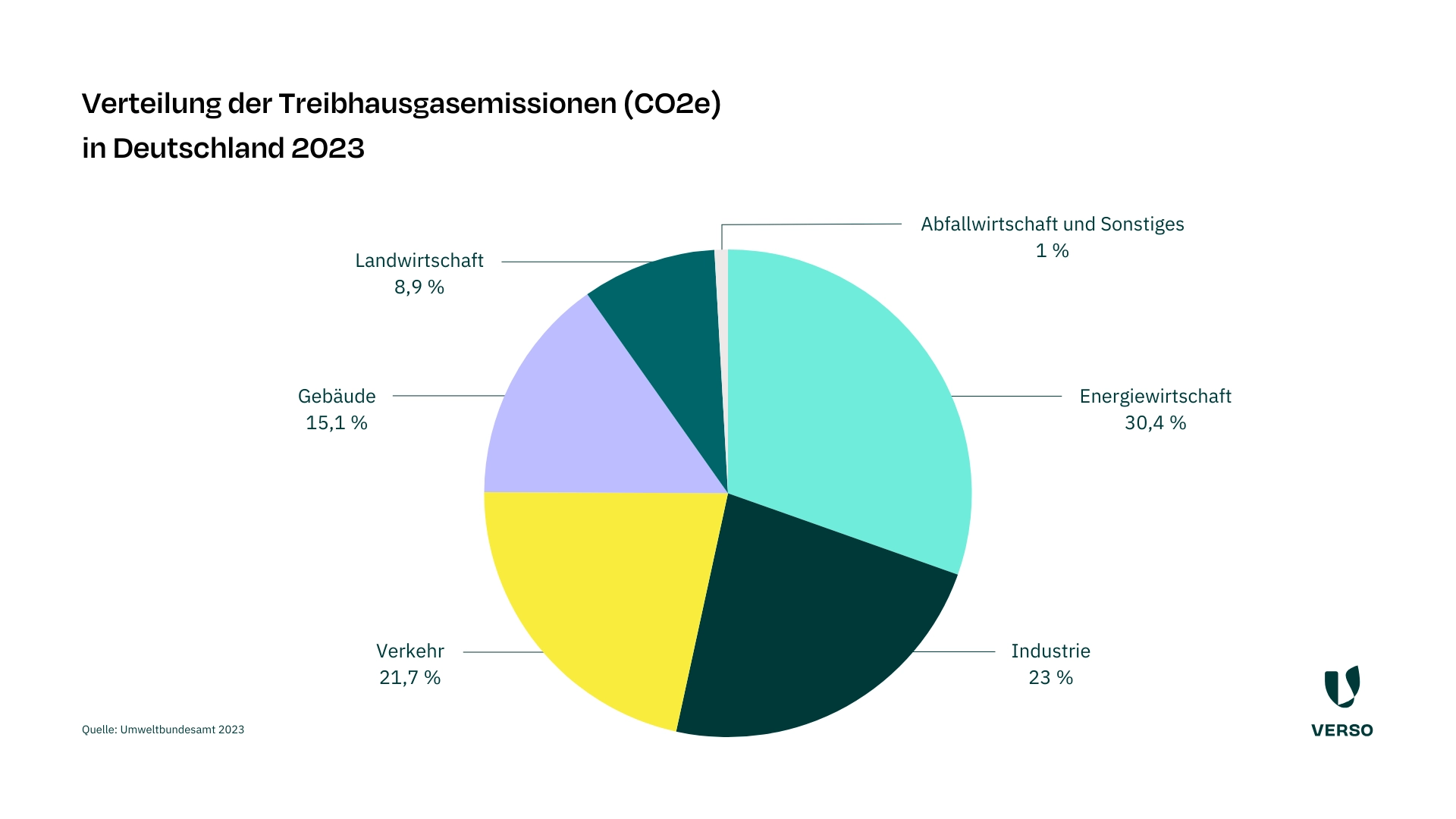
    Laut Umweltbundesamt wurden im Jahr 2023 in Deutschland die meisten Treibhausgasemissionen (CO2e) in den Sektoren Energiewirtschaft und Industrie ausgestoßen.

    What is a decarbonization strategy?

    A decarbonization strategy can be thought of as a cycle: It comprises six steps that you go through in sequence.
    After the sixth step, you start again at number one.
    With each step, you look at your challenges in more detail and continue to optimize your processes.
    You can manage your goals, adapt measures, reduce emissions further and further – and get closer and closer to your Net Zero goal.
    These are the 6 steps of the decarbonization strategy:

    1. Development and recognition of challenges
    2. Preparation of a greenhouse gas balance sheet to determine the status quo
    3. Definition of measurable climate targets and measures
    4. Reducing GHG emissions as far as possible
    5. Offsetting residual emissions through certified projects from e.g. Climate Grid
    6. Transparent communication of successes and potential for improvement

    Before you go through the process for the first time, we recommend that you introduce a data and process management tool such as VERSO’s Climate Hub into your company.
    Important for the decarbonization plan: The software should not only cover the calculation of the carbon footprint, but also enable proper climate management including KPI tracking, target tracking, creation of measures as well as internal and external collaboration options.

    The 5 advantages of a decarbonization strategy

    In 2023, the opinion research institute Forsa asked German SMEs that will fall under the new CSRD about their status quo with regard to sustainability and climate reporting: 52% are currently working on a climate strategy, 40% have already formulated a concrete strategy and 9% do not yet see a need for one.
    We have here Five advantages that a climate strategy entails for your company:

    1. be prepared for regulatory pressure

    In Germany and the EU, the laws resulting from the European Green Deal in particular are calling on companies to decarbonize and operate in a more environmentally conscious manner.
    Examples of legal requirements:

    • The CSRD’s ESRS E1 reporting standard alone requires an entire climate transition plan – in addition to the carbon footprint and disclosure of specific climate targets.
    • The CSRD is also linked to the EU taxonomy, which requires companies to disclose how sustainable their business activities are according to strict criteria.
    • The CBAM will be of interest to companies that import goods from non-EU countries, as the CO2 border adjustment mechanism will in future oblige companies that import emission-intensive goods to purchase certificates to offset the emissions emitted.

    At the latest when your company is affected by these regulations, you should have a decarbonization plan up your sleeve – otherwise legal consequences are possible.
    However, there are also advantages to starting the project before the law takes effect.
    You can then pay attention to limit values and risks as early as the target setting stage, collect the data required for legal compliance during data collection and have the relevant disclosure requirements ready in the right form.
    This will save you stress and you will not be surprised by requirements that you cannot fulfill.

    2. avoid the risk of greenwashing accusations

    Simply calling yourself “green” is a thing of the past.
    With the Green Claims Directive the EU is specifying what is greenwashing and what is not.
    Soon, companies will have to prove the accuracy of their environmental claims in a scientifically verified manner.
    If they fail to do so, they will not only face damage to their image, but also real legal and financial consequences.
    They are certainly not deliberately greenwashing – but it can easily happen unknowingly, as many greenwashing accusations originate from marketing activities that portray the company in too good a light.
    This happens above all when the company’s sustainability data is not transparent.
    However, transparent sustainability communication can succeed with a climate strategy: The number-based strategy, KPI tracking and carbon footprint allow you to communicate comprehensible facts, figures and targets.

    Your overview of the new Green Claims Directive

    With the Green Claims Directive, the EU now provides a clear framework for sustainability claims.
    Get a clear overview of the new Green Claims Directive and its consequences for your company in this factsheet!

    3. identify the risks and potential of climate issues

    A decarbonization strategy can make a significant contribution to the future viability of your company.
    It reveals risks and potential. Risks By collecting detailed data, you can identify risks that often go unnoticed in day-to-day business.
    How much electricity do we actually consume?
    Which bottlenecks in our production lead to increased CO2 consumption?
    You receive figures and comparative values for areas where there was often little clarity before.
    Identifying climate risks makes your overall risk management more meaningful.
    It helps you to plan more reliably and calculate costs correctly. Potentials In addition, your potentials become visible, such as the environmental commitment of your suppliers, energy savings or the use of renewable energies.
    You can measure progress and see which measures may have less impact than expected and where you can actually make a difference.
    Ultimately, you can also save costs and increase your efficiency.  

    4. advantages with stakeholders for loans, investments and tenders

    If you have a decarbonization plan ready, you will make yourself popular with your stakeholders.
    After all, they are increasingly asking about a company’s commitment to climate protection.
    Which stakeholders are you talking about in particular?

    • Business partners in tenders: Other companies – especially OEMs – are also affected by statutory ESG requirements.
      As a result, they naturally do not want to take on any additional risk and also pay attention to ESG criteria in tenders.
      If you already have a solid decarbonization plan in place, this puts you in a better position in the tendering process.
    • Banks for loans: Banks also face ESG requirements.
      In practice, this means that your borrowing costs also depend on your ESG rating: Better rating, cheaper loan.
      And your strategy naturally has an impact on your rating.
    • Investors: The same applies here – investors also include ESG criteria in their investment ratings.
      With a decarbonization strategy, a lot of things can be ticked off the list.
      And not to forget: The strategy gives investors insights into your company’s potential and options for action.
      You can authentically demonstrate how you want to ensure the future viability of your company in harmony with the environment.
    • Customers: 79% of consumers change their purchasing behavior based on sustainability considerations(study by Capgemini).
      This means that you have a competitive advantage if you can make transparent how your company is committed to climate protection and decarbonization.
      Consumers now look closely at sustainability communication and are quickly suspicious of general sustainability claims.
      You score points with your climate strategy because you can also back up your communication with figures and transparently show your improvement potential and strategy.

    5. strengthen supply and business relationships

    Companies with which you have a business or supply relationship may also be affected by the CSRD or the German Supply Chain Act, the LkSG.
    You now need ESG transparency throughout your supply chain – including climate and CO2 data.
    With your climate strategy, you are already prepared for the questionnaires from your business partners.
    If you have nothing to show, business relationships may be on the brink of collapse.

    How VERSO supports you with your decarbonization strategy

    If you want to take a strategic approach to decarbonization, we will be happy to support you: The VERSO Climate Hub, combined with the VERSO ESG Hub, enables you to achieve holistic climate management.
    We are also happy to support you with our consulting team: many questions arise, especially in the first year of balancing or strategy development, and it takes some time to familiarize yourself with the topic.
    We support you in integrating the processes in your company, in correctly preparing the first carbon footprint and in developing sensible targets, measures and strategies to reduce your emissions.
    With this support, we enable you to subsequently implement your climate strategy on your own responsibility.
    Does that sound like what you’re looking for?
    Please feel free to contact us.

    * This information is summarized editorial content and should not be construed as legal advice. VERSO accepts no liability.

    Subscribe to our newsletter!

    Sign up and receive regular news about:

    • Pragmatic all-in-one solution for ESG reporting, climate and supply chain management
    • Individual advice from the VERSO experts
    • Developed with expertise from 12+ years of sustainability management
    • Trusted by 250+ customers

    Get to know the software!

    Stakeholder-Anforderungen von ESG-Informationen an KMU
    12.02.2024

    5 Reasons Why A Sustainability Report Is Also Worthwhile for SMEs

    Many companies – large and small – are affected by sustainability regulations such as the CSRD, the LkSG or the European supply chain law CSDDD. But what about those that are not subject to these regulations? Are they exempt from reporting?

    Watch out: Not being directly affected does not mean that you do not have to deal with sustainability! We explain here why SMEs also have to provide sustainability data and what information is required.

    Which stakeholders request ESG data from SMEs

    1. business partners create transparency in the supply chain

    Are you a supplier to another company? Many SMEs supply larger companies that fall under the LkSG (Lieferkettensorgfaltspflichtengesetz) and are or will be affected by the EU CSRD (Corporate Sustainability Reporting Directive) and CSDDD (Corporate Sustainability Due Diligence Directive).

    Large companies not only have to make their own ESG information transparent, but also that of their suppliers.

    This means that you are also affected by the requirements of the regulations and will be asked by your customers for comprehensive sustainability information.

    As a result, you have to undergo extensive due diligence checks, such as the EcoVadis sustainability assessment, which identifies potential risks for people and the environment in the supply chain.

    Incidentally, it is not only you as a supplier who must provide evidence, but often also sub-suppliers.

    Your customers are also bound by industry-specific guidelines and laws.
    Sustainability information from the supply chain is also required from this side.
    Examples of this include the Agricultural Organizations and Supply Chain Act (AgrarOLkG), the chemical industry standard or the industry-specific guidelines of the OEC.

    2. financial sector pays more attention to sustainable investments

    SMEs that are supported by investors or have received project-related investments should definitely be prepared for ESG inquiries.
    The reasons for this:

    • Due to the SFDR (Sustainable Finance Disclosure Regulation), financial market players and financial advisors are obliged to provide ESG information on financial products and services.
    • Investors are themselves capital market participants and must report on sustainability goals and positioning within the financial sector.
    • Rating agencies now also include ESG criteria in their investment ratings.
    • Prior to the final M&A transaction, the sustainability strategy is reviewed – if not already requested in advance, measurable sustainability indicators are required from you by then at the latest.

    All information about the SFDR

    The Sustainable Finance Disclosure Regulation (SFDR) is one of the EU’s levers for promoting a sustainable economy. Get an overview of the SFDR, the categorization of financial products and the disclosure requirements.

    3. banks require ESG disclosures in loan and funding procedures

    If you want to apply for a loan or a grant from the bank, you will need a number of documents.
    In the past, it was mainly about creditworthiness, business concept, collateral and the like.
    Today, the issue of sustainability also plays a decisive role.

    This is because banks need sustainability information from you when granting loans in order to meet the requirements of the European Banking Authority (EBA) and the German Federal Financial Supervisory Authority (BaFin).

    In addition, banks are increasingly adhering to self-imposed frameworks and sustainable finance targets.

    In practice, this means that lending costs are directly influenced by your ESG rating: better rating, cheaper loan.

    This data decides on loans

    Read this article to find out how ESG data affects financing and what data companies need to provide now to ensure their loan applications continue to be approved.

    4. insurance companies also include ESG risks in their financial statements

    Insurance companies also rely on and request ESG data from customers. Two perspectives need to be understood here: Firstly, (re)insurers also fall under the CSRD reporting obligation.

    They must therefore report on the status quo of their sustainability ambitions themselves.
    This also includes the customer area, for which your insurer naturally needs information from you as a customer.

    The second perspective is about the insurance risk when you want to take out a new insurance policy.

    It is common practice here to first assess the risk potential of an insured person. Sustainability risks are now also taken into account. Anyone who does not have this issue on their radar may be classified as having a higher insurance risk and lower insurance benefits.


    5. customers and partners expect proof of ESG efforts

    New partnerships, collaborations and tenders are increasingly demanding certifications that prove a company’s sustainability ambitions.

    When you enter into negotiations, you need to be well prepared:

    • No Open Doors without ESG certifications: In addition to known information security standards, for example, certifications from the ESG sector are increasingly a prerequisite for a serious discussion.
      Go through the assessments at an early stage – they are often lengthy and cannot be “handed in quickly”.
    • Sustainability and ESG criteria in the tendering process: If there is a tender, your company could fall out of the selection process due to a missing or unsound sustainability strategy.
      You can prove this with recognized ESG certificates, among other things.
      With sustainability and ESG criteria in tendering processes, companies want to ensure that ecological and social standards are adhered to in the supply chain right from the start.

    In addition to special ESG certifications, ESG criteria are also asked for in other quality standards that have a high priority in the industry and are actually “only” concerned with corporate processes:

    • Fairtrade
    • Organic certifications
    • Employer rankings
    • ISO standards
    • …

    CSRD compliance made easy

    From the CSRD basics to the finished report: Our practical software package guides you step by step to CSRD compliance!

    How do SMEs best prepare for sustainability requirements from stakeholders?

    As you can see, sustainability issues come from every corner. You not only have to collect and communicate ESG data to fulfill legal requirements – keyword: LkSG, CSDDD and CSRD-compliant.

    Your stakeholders also ask for this data for a variety of reasons. The problem with these queries is that if SMEs are affected by one or more of these scenarios and are not prepared for them, this usually means a lot of work. This is because very different information is required from different stakeholders. They are confronted with different reporting standards and find themselves in a flood of questionnaires.

    However, you can avoid these problems with a voluntary sustainability report.
    It is best to report in accordance with a recognized standard that is suitable for your company, such as the DNK, the GRI Standards or the ESRS – the latter will enable you to meet the regulatory requirements of the CSRD in the future. Frameworks such as the SDGs or the UN Global Compact also form a good basis for the sustainability report.

    EFRAG is currently also working on its own voluntary standards(VSME) for SMEs, which are adapted to the size, resources and needs of these companies.
    The advantages of a voluntary report in a nutshell:

    • As a rule, you already collect all the important data that you also need for other purposes.
      In the best case even in a single tool, in which you can also control measures and write the report.
    • In the case of inquiries, the report already contains most of the required information, giving you more time for detailed questions.
    • If you do have to report later, you are already optimally prepared for CSRD, LkSG and CSDDD!
    • Although this may sound like a lot of effort at first, the introduction of ESG structures brings with it great opportunities: innovation and long-term growth are promoted, risks are minimized and, not to forget, you also consolidate and strengthen relationships with your customers.

    Step-by-step to the sustainability report

    A meaningful sustainability report can be quite a challenge. Where do you start? What data is important? And how should the CSR report be published? Our practice-oriented playbook answers your questions.

    Do you want to be prepared for the next request?

    The voluntary sustainability report puts you ahead of the game!
    If you have any questions about the sustainability report or the legal requirements, we are here for you – with over 12 years of experience in sustainability management.

    * This information is summarized editorial content and should not be construed as legal advice. VERSO accepts no liability.

    Subscribe to our newsletter!

    Sign up and receive regular news about:

    • Pragmatic all-in-one solution for ESG reporting, climate and supply chain management
    • Individual advice from the VERSO experts
    • Developed with expertise from 12+ years of sustainability management
    • Trusted by 250+ customers

    Get to know the software!

    Dominosteine, die beim Fallen gestoppt werden – Symbolbild für 5 Nachhaltigkeitsmaßnahmen mit echtem Impact
    24.05.2023

    5 Sustainability Measures with Real Impact

    5 ESG measures with real impact

    Many companies have already recognized that sustainability is no longer a trend, but a necessity.
    Customers, investors and other stakeholders expect companies to treat their employees fairly and do their bit to protect the environment.
    In short: implement ESG issues within the company.
    However, instead of seeing sustainability as a sincere task, some companies unfortunately see their sustainability efforts primarily as “green” marketing.
    In particular, the purchase of CO2 certificates to minimize their own CO2 footprint, which is subject to criticism, harbours the risk of greenwashing.
    Measures that minimize or prevent emissions are more effective than compensating for them afterwards.
    In this blog article, we present five ESG measures that have a real impact – for your sustainability and your company.

    How do I create a sustainability report?

    Creating a meaningful sustainability report can be quite a challenge.
    It’s easier with our practice-oriented playbook “7 steps to a sustainability report”.

    Make your business operations energy-efficient

    Focus on energy efficiency to reduce your environmental footprint.
    Start by developing an energy concept: examine existing lighting, heating and cooling systems in your building and look for energy efficiency labels when selecting IT hardware and other equipment.
    Even with external data centers that host your software or website, for example, you can save a lot on emissions by choosing energy-efficient providers.

    Adopt a circular economy approach

    Design your products so that they are durable, can be repaired and recycled at the end of their life cycle.
    You can introduce recycling programs for your products and inform your customers about the entire product life cycle.
    Product instructions can also include repair instructions and alternative reuse options to limit the throw-away mentality.

    CSRD: New requirements for sustainability reports

    As part of the Green Deal, the EU is driving forward numerous measures for sustainable transformation – including the CSRD.
    You can find all the details in our factsheet.

    Invest in the satisfaction of your employees

    Sustainability is a multifaceted issue that is often associated with climate protection.
    However, we must not neglect the social aspect.
    An important component of sustainability lies in the satisfaction of the workforce, because satisfied employees who are treated fairly stay with the company longer and are more motivated.
    Offer fair pay, attractive employee benefits and opportunities for further training.
    A healthy work-life balance, a good error culture and opportunities for co-determination help to create a positive working environment and allow your employees to develop their full potential.
    In order to build a diverse and inclusive workforce, diversity and inclusion should be part of your company’s identity and part of the recruitment process.

    Optimize your supply chain

    For many companies, the supply chain is a black box.
    However, a sustainable supply chain is crucial to achieving your corporate ESG goals.
    Choose responsible suppliers and partners who adhere to high ethical and sustainable standards.
    Where possible, give preference to regional suppliers to reduce transportation distances and support the local economy.
    Due to often globally networked supply chains, this is no easy task.
    With the VERSO Supply Chain Hub, you can create transparency in your supply chain.

    The ESRS standards at a glance

    With the new CSRD reporting obligation, the EU is also introducing uniform European standards for ESG reports – the ESRS.
    Get an overview in the factsheet.

    Demonstrate transparency and accountability

    Talk openly about your sustainability efforts, set yourself concrete, ambitious goals and remain open to continuous improvement.
    It is important to put your money where your mouth is and communicate the results transparently.
    Publish your ESG data, targets and measures in a regular sustainability report to keep your stakeholders informed and document your progress.   Our conclusion: Every step towards sustainability is a step in the right direction, but true sustainability requires a comprehensive rethink and the integration of sustainable principles into all aspects of the company.
    Remember that sustainability is an ongoing process and take the time to evaluate and continuously improve your strategy.
    The VERSO team will be happy to support you on your path to sustainability with our ESG software and advice from our sustainability experts.

    * This information is summarized editorial content and should not be construed as legal advice. VERSO accepts no liability.

    Subscribe to our newsletter!

    Sign up and receive regular news about:

    • Pragmatic all-in-one solution for ESG reporting, climate and supply chain management
    • Best practices in the areas of ESG and sustainable supply chains
    • Developed with expertise from 12+ years of sustainability management
    • Sustainability events and much more.

    Get to know the software!

    In 10 Schritten auf das Lieferkettengesetz vorbereiten
    30.09.2022

    Prepare for the Supply Chain Act in 10 steps

    The Supply Chain Duty of Care Act, or Supply Chain Act (LkSG) for short, has been in force since January 1, 2023. We have answered some important questions for you.

    Since January 1, 2023, the Supply Chain Due Diligence Act, or Supply Chain Act (LkSG) for short, has been in force to regulate corporate responsibility for compliance with human rights in supply chains for the first time. To help you navigate and prepare for the regulatory developments surrounding the LkSG, we have answered some important questions for you.

    Questions and answers on the Supply Chain Act

    1. Why does Germany need a supply chain law?

    In the course of globalization, German companies source raw materials and products from all over the world. In addition, investments are made in foreign production and distribution facilities and goods are exported worldwide. In the process, human rights and environmental protection violations are occurring more and more frequently. These have their origins in the constantly increasing competitive and price pressure to which globally active companies are exposed. Up to now, companies have only borne minimal responsibility for the impact of their business activities abroad. Attempts to voluntarily implement protective measures against human rights and environmental protection violations have failed miserably. A binding framework is therefore needed to oblige companies to take greater care with regard to these issues.

    2. which human rights and environmental standards must be taken into account by companies in this context?

    The Supply Chain Due Diligence Act obliges German companies to comply with internationally recognized human rights abroad as well. This includes, for example, the right to physical integrity, the prohibition of forced and child labor and the right to health. With regard to the environmental standards to be observed, the locally applicable regulations on environmental protection and individual environmental standards from international agreements apply.

    3. which companies are affected by the Supply Chain Act?

    The law will be introduced in stages, starting on 01.01.2023. Initially, German companies with more than 3000 employees will be affected. From 01.01.2024, the scope will be extended to companies with more than 1000 employees. Even if smaller companies (SMEs) are not yet directly covered by the Supply Chain Act, they can be required to implement due diligence obligations as suppliers to affected companies.

    Risk management in the supply chain

    Implement the Supply Chain Act in a future-proof way: with a holistic, risk-oriented approach. Find out more in the whitepaper.

    4. What are companies liable for?

    Companies should not only take responsibility for damage caused by themselves, but also for damage caused along the supply chain by subsidiaries, important business partners or suppliers. Transparency within the supply chain is therefore more important than ever before. In principle, however, companies are only liable for damage where they have acted negligently or deliberately breached their duty of care.

    5. must business relationships be terminated in the event of violations?

    That is not the goal. The primary aim is to permanently anchor awareness of human rights and environmental protection measures within the supplier companies. Business relationships are only to be terminated completely if a serious human rights violation has been identified that persists even after a deadline has been set.

    6. What does the Supply Chain Act mean for the competitiveness of affected companies?

    The Supply Chain Act will bring more fairness to competition. At present, companies that act conscientiously are at a competitive disadvantage compared to companies that act irresponsibly due to higher costs. This is to be prevented with uniform rules for all.

    7. What impact can the LkSG have in the producing countries?

    The Supply Chain Act is primarily intended to protect local people. The legislation is intended to improve working conditions for employees in production facilities, as companies are then obliged to comply with social and environmental standards. Residents living in the vicinity of the factories will also benefit if, for example, they are no longer allowed to exceed certain exhaust emission values.

    Factsheet: EU Supply Chain Act vs. LkSG

    The EU Supply Chain Act (en. Corporate Sustainability Due Diligence Directive (CSDDD)) is to become the European framework for the German Supply Chain Act. You can find everything you need to know in the factsheet.

    8. Who controls the law?

    Compliance with and implementation of the law is monitored by the Federal Office of Economics and Export Control (BAFA). Companies are obliged to submit their report at least four months after the end of the financial year. In addition, the authority has the possibility, among other things, to specify concrete actions to companies, summon persons, demand information and impose fines of up to EUR 50,000 for enforcement.

    9. What penalties do companies have to fear?

    Failure to comply with the legal obligations could result in fines of up to 8 million euros, or 2% of annual global turnover for companies with an annual turnover of more than 400 million euros. For the time being, the German law does not provide for civil liability, although this is likely to change with legislation at European level.

    10. how can the VERSO Supply Chain Platform simplify the implementation of the LkSG?

    Recurring requirements such as risk analyses, implementation of preventive measures or the annual reporting obligation are effort drivers for purchasing, as they require the collection and evaluation of supplier data. With the automation of the VERSO Supply Chain Platform, considerable resources can be saved and an efficient, holistic implementation of the LkSG and all ESG topics can be guaranteed. The VERSO Supply Chain Platform enables a future-proof approach with which purchasing organizations are also optimally prepared for future requirements such as the CSRD and the EU Supply Chain Act. Contact us to find out how VERSO can help you capture the necessary data in your supply chain, qualify suppliers and provide the necessary reporting metrics with minimal effort.


    * This information is summarized editorial content and should not be construed as legal advice. VERSO accepts no liability.

    Book a demo!

    Register now to arrange a free demo appointment and get to know our solutions at first hand.

    • Pragmatic all-in-one solution for ESG reporting, climate and supply chain management
    • Individual advice from the VERSO experts
    • Developed with expertise from 12+ years of sustainability management
    • Trusted by 250+ customers

    Get to know the software!