
 Login
Login Contact us
 Become a partner
EUDR Explained: Key Requirements, Deadlines, and Compliance Guide for Companies
The EUDR aims to strictly regulate trade in products contributing to deforestation. But what exactly does this mean for affected companies, and how can you prepare? In this article, we answer the most important questions about the EUDR and share practical tips for implementation.
What is the EUDR? A brief overview
The EUDR introduces extensive due diligence obligations. Companies must ensure their products are deforestation-free. The focus is on transparency and traceability throughout the supply chain — businesses must be able to track a product’s journey from origin to market without gaps.
The EUDR requires companies to collect detailed data. As Klaus Wiesen, our supply chain expert, explains: “Given the complexity, it’s clear that software is a must for implementation. That already applies to the LkSG, but even more so for the EUDR — a pragmatic approach is nearly impossible without digital tools.”
When will the EUDR come into force?
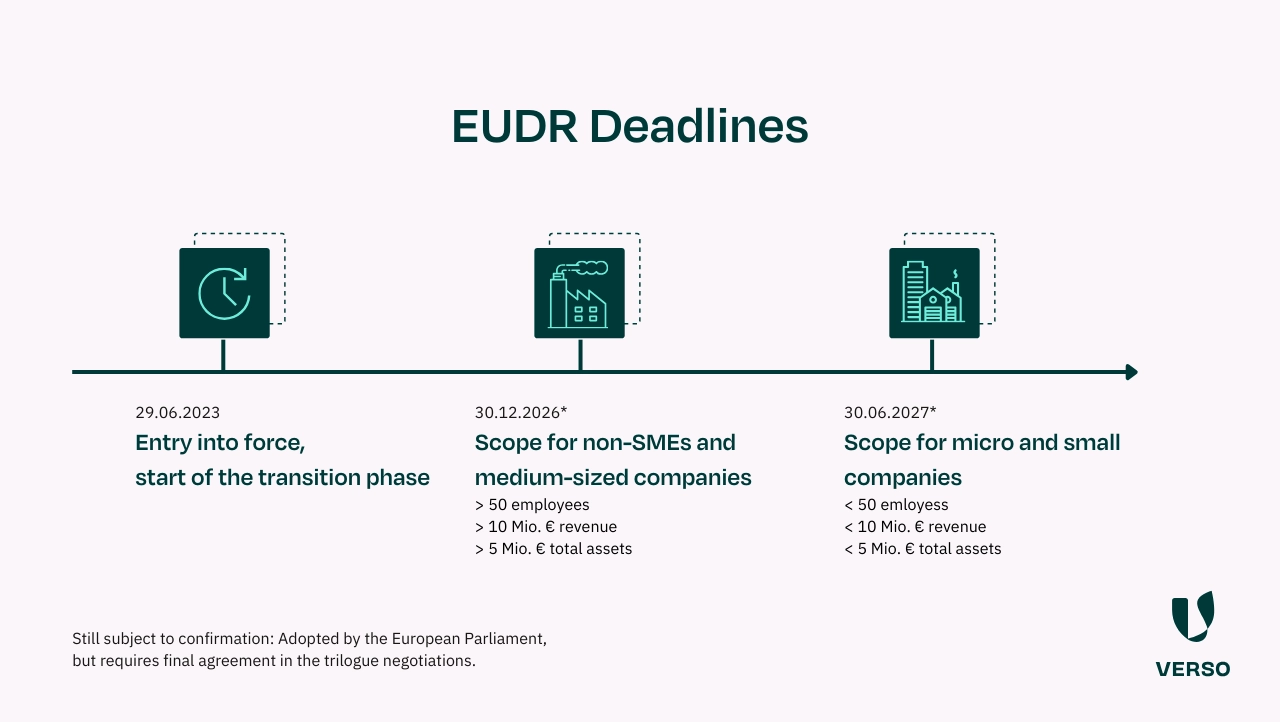
Starting December 30, 2026, the EUDR enters its application phase for large and medium-sized companies. Small companies have until June 30, 2027 to implement the regulation.
| Starting December 30, 2026* | Starting June 30, 2027* |
|---|---|
| Large and medium-sized companies meeting at least two of these criteria:
– More than 50 employees – More than €10 million revenue – More than €5 million balance sheet total |
Small and micro-enterprises meeting at least two of these criteria:
– Fewer than 50 employees – Less than €10 million revenue – Less than €5 million balance sheet total |
*Note: The dates are based on the current proposal by the European Parliament, which is still subject to agreement in the trilogue negotiations.
Who is affected by the EUDR?
The EUDR is product-based and applies to all companies trading EUDR-relevant commodities and products derived from them.
The regulation differentiates between roles within the market, which determines specific obligations — see Determine your EUDR market role below.
| Operator | Trader |
|---|---|
| Companies placing EUDR-relevant products on or exporting from the EU market for the first time | Companies making EUDR-relevant products available on the EU market |
Which products are covered by the EUDR?
The regulation applies to the following commodities and their derived products:
- Wood
- Palm oil
- Coffee
- Cocoa
- Cattle
- Soy
- Rubber
There are no thresholds or volume limits. The list of covered commodities is expected to expand over time.
Exemptions:
- 100% recycled materials
- Packaging materials solely used for support, protection, or transportation
- User manuals
- Bamboo products
- Products manufactured before the EUDR’s reference date (June 29, 2023), except for wood products

What conditions must products fulfill under the EUDR?
Starting with the implementation phase: Import, trade and export of the above-mentioned raw materials and their derived products on the EU internal market are only permitted, if these three conditions are met:
- Deforestation-free: The products were manufactured without converting natural forest into agricultural land or tree plantations after 31.12.2020. This also applies if deforestation was considered legal in the country of origin!
- Production in accordance with the relevant rights of the country of origin: This concerns both environmental protection and human rights. Species protection measures, anti-corruption measures, labor rights, the UN Declaration on the Rights of Indigenous Peoples, trade law, etc. have been complied with.
- Due diligence declaration available: A risk assessment has been carried out for the product, the due diligence obligations have been complied with and there is no or only a negligible risk of deforestation.
What requirements apply to the different market roles?
The EU Deforestation Regulation categorizes affected companies as Traders and Operators, and as SMEs and non-SMEs (note: the EUDR uses its own criteria for this).
This leads to different requirements – for example:
- Operators are required under the EUDR to conduct a risk assessment, mitigate risks, and submit a due diligence statement through the EU system “TRACES.”
- Traders may rely on this due diligence statement. Large traders must additionally verify the completed risk assessment on a sample basis.
- The EUDR also introduces documentation and reporting obligations.
- For SMEs (according to the EUDR definition), implementation is simplified through a reduced set of obligations. They must provide fewer details on their upstream and downstream supply chain and are not required to submit a public EUDR report.
The current proposal by the European Parliament now includes several changes to these roles. If adopted, the following new requirements would apply:
- Downstream Operators or Traders as a new category with simplified obligations: First downstream Operators and Traders no longer need to conduct due diligence validation of their upstream suppliers and do not need to prepare their own due diligence statements (DDS). They must continue to collect and retain the DDS of their suppliers, but they are not required to pass these statements on to further downstream Operators or Traders (their customers).
- Small and micro primary Operators in low-risk countries (e.g., small forest owners in the EU): This would also be a new category with simplified rules. A one-time simplified declaration is possible – without geolocation data, only stating a postal address. The goal is to reduce the burden on small farmers within the EU.
- For Operators importing products (first placers on the market), nothing would change.
Use our free check to quickly determine which category your company falls into and which obligations apply to you.
How can importers prepare? Practical steps for EUDR implementation
Step 1: Collect EUDR data
Gather detailed information about your products and raw materials — including descriptions, volumes, suppliers, and countries of origin.
The EUDR requires geo-location data for every plot where relevant commodities are produced, including production dates — retroactively from December 31, 2020.
Ensure proof that all legal rights are respected in the country of origin.
Step 2: Conduct risk assessment
Evaluate the deforestation risk for any new product or commodity.
Factors include:
- Country of origin
- Deforestation trends
- Political and social conditions
- Supply chain complexity
The EU will provide a benchmarking system categorizing countries by risk level. Only products with no or negligible risk may enter the EU market.
Step 3: Mitigate risks
If risks are identified, work with suppliers to reduce them. Develop new codes of conduct, strategies, and control measures. Verify compliance via supplier audits or documentation
Step 4: Document and report
Companies must maintain detailed records and submit reports.
For every batch, a due diligence statement or EUDR compliance confirmation must be included — customs will verify compliance based on risk assessments.
Except for SMEs, companies must also publicly report on risk assessments, due diligence processes, and mitigation measures. If your company is subject to the CSRD, you can integrate EUDR reporting into your sustainability report.
What are the EUDR sanctions?
Violations or non-compliance may result in:
- Confiscation of unlawful profits
- Fines proportional to the damage caused, minimum 4% of annual turnover
- Seizure of goods or products
- Temporary import bans
- Exclusion from public funding or tenders
- Public naming and shaming of the company and its violation
Background on the EUDR
In the past 30 years, global deforestation has wiped out an area larger than the EU. Forest loss accelerates climate change and biodiversity loss.
The EUDR follows the EU Timber Regulation (EUTR) from 2013, which was criticized for weak enforcement. As part of the European Green Deal, the EUDR strengthens these efforts.
From 2025 onwards, it will be prohibited to place, make available, or export certain products in the EU market if they are linked to deforestation or forest degradation since January 2021 — regardless of whether the forest is in Germany, Romania, or Brazil.
*This information is summarized editorial content and should not be considered legal advice. VERSO assumes no liability.
Subscribe to our newsletter!
Sign up and receive regular news about:
- Pragmatic all-in-one solution for ESG reporting, climate and supply chain management
- Best practices in the areas of ESG and sustainable supply chains
- Developed with expertise from 12+ years of sustainability management
- Sustainability events and much more.