
Dominosteine, die beim Fallen gestoppt werden – Symbolbild für 5 Nachhaltigkeitsmaßnahmen mit echtem Impact
24.05.2023

5 sustainability measures with real impact

5 ESG measures with real impact

Many companies have already recognized that sustainability is no longer a trend, but a necessity.
Customers, investors and other stakeholders expect companies to treat their employees fairly and do their bit to protect the environment.
In short: implement ESG issues within the company.
However, instead of seeing sustainability as a sincere task, some companies unfortunately see their sustainability efforts primarily as “green” marketing.
In particular, the purchase of CO2 certificates to minimize their own CO2 footprint, which is subject to criticism, harbours the risk of greenwashing.
Measures that minimize or prevent emissions are more effective than compensating for them afterwards.
In this blog article, we present five ESG measures that have a real impact – for your sustainability and your company.

How do I create a sustainability report?

Creating a meaningful sustainability report can be quite a challenge.
It’s easier with our practice-oriented playbook “7 steps to a sustainability report”.

Make your business operations energy-efficient

Focus on energy efficiency to reduce your environmental footprint.
Start by developing an energy concept: examine existing lighting, heating and cooling systems in your building and look for energy efficiency labels when selecting IT hardware and other equipment.
Even with external data centers that host your software or website, for example, you can save a lot on emissions by choosing energy-efficient providers.

Adopt a circular economy approach

Design your products so that they are durable, can be repaired and recycled at the end of their life cycle.
You can introduce recycling programs for your products and inform your customers about the entire product life cycle.
Product instructions can also include repair instructions and alternative reuse options to limit the throw-away mentality.

CSRD: New requirements for sustainability reports

As part of the Green Deal, the EU is driving forward numerous measures for sustainable transformation – including the CSRD.
You can find all the details in our factsheet.

Invest in the satisfaction of your employees

Sustainability is a multifaceted issue that is often associated with climate protection.
However, we must not neglect the social aspect.
An important component of sustainability lies in the satisfaction of the workforce, because satisfied employees who are treated fairly stay with the company longer and are more motivated.
Offer fair pay, attractive employee benefits and opportunities for further training.
A healthy work-life balance, a good error culture and opportunities for co-determination help to create a positive working environment and allow your employees to develop their full potential.
In order to build a diverse and inclusive workforce, diversity and inclusion should be part of your company’s identity and part of the recruitment process.

Optimize your supply chain

For many companies, the supply chain is a black box.
However, a sustainable supply chain is crucial to achieving your corporate ESG goals.
Choose responsible suppliers and partners who adhere to high ethical and sustainable standards.
Where possible, give preference to regional suppliers to reduce transportation distances and support the local economy.
Due to often globally networked supply chains, this is no easy task.
With the VERSO Supply Chain Hub, you can create transparency in your supply chain.

The ESRS standards at a glance

With the new CSRD reporting obligation, the EU is also introducing uniform European standards for ESG reports – the ESRS.
Get an overview in the factsheet.

Demonstrate transparency and accountability

Talk openly about your sustainability efforts, set yourself concrete, ambitious goals and remain open to continuous improvement.
It is important to put your money where your mouth is and communicate the results transparently.
Publish your ESG data, targets and measures in a regular sustainability report to keep your stakeholders informed and document your progress.   Our conclusion: Every step towards sustainability is a step in the right direction, but true sustainability requires a comprehensive rethink and the integration of sustainable principles into all aspects of the company.
Remember that sustainability is an ongoing process and take the time to evaluate and continuously improve your strategy.
The VERSO team will be happy to support you on your path to sustainability with our ESG software and advice from our sustainability experts.

* This information is summarized editorial content and should not be construed as legal advice. VERSO accepts no liability.

Subscribe to our newsletter!

Sign up and receive regular news about:

  • Pragmatic all-in-one solution for ESG reporting, climate and supply chain management
  • Best practices in the areas of ESG and sustainable supply chains
  • Developed with expertise from 12+ years of sustainability management
  • Sustainability events and much more.

Get to know the software!

Wander-Wegweiser als Symbolbild für den Vergleich verschiedener Nachhaltigkeits-Standards
10.08.2022

Sustainability report: What standards are there?

The new CSRD reporting obligation means that around 15,000 companies in Germany are required to report. What is the right standard for your CSR report? To make it easier for you to choose, we present the most important standards. You will also find a factsheet at the end of this blog post showing you which standard is suitable for which company.

UN Global Compact: Suitable for beginners, only minimum requirements

The United Nations Global Compact, or UNGC for short, was founded by Georg Kell in 2000 on the initiative of former United Nations Secretary-General Kofi Annan. The aim was and is to shape globalization in a fair, environmentally and socially responsible way. The UNGC is the world’s largest and most important initiative for sustainable and responsible corporate governance. Over 19,000 companies and organizations have signed it – including more than 800 in Germany. The framework formulates ten social and ecological principles in the areas of human rights, labour, environmental protection and anti-corruption, to which the participating companies and organizations are committed. In addition, the UN Global Compact is based on the 17Sustainable Development Goals (SDGs) of the United Nations.

SFDR – the standard for the financial sector

The EU has developed the Sustainable Finance Disclosure Regulation (SFDR) specifically for the financial services sector – but some companies are also affected. Our factsheet tells you how.

DNK: Good introduction, easy to use, for German-speaking countries

The German Sustainability Code (DNK) was introduced in 2011. The aim is for companies to provide information about their sustainability performance and thus create comparability. Around 800 companies have now published a DNK declaration. The standard comprises 20 criteria that must be reported on. They are divided into the subject areas of strategy, process management, environmental issues and society. When reporting, companies can select either the GRI (Global Reporting Initiative) or EFFAS (European Federation of Financial Analysts Societes) performance indicator set.

GRI: Most established internationally, high effort

The Global Reporting Initiative (GRI) is a foundation that was established in 1997. The GRI guidelines are considered the most important standard for sustainability reports worldwide. The aim of the global standards is to make sustainability reports more comparable through uniform requirements. The guidelines are continuously developed in a dialogue process with companies and civil society organizations. Companies that prepare their sustainability report in accordance with the GRI standards must provide extensive information about the company, the management approach and economic, ecological and social standards. The Global Reporting Initiative has now updated its standards once again. The latest changes apply to all reports published from January 1, 2023.

SDG: Framework with the 17 UN Sustainable Development Goals

The member states of the United Nations adopted the 2030 Agenda for Sustainable Development in September 2015. It includes the 17 UN Sustainable Development Goals, or SDGs for short, which cover all three dimensions of sustainability: Environmental, social and economic. The global goals are to be achieved by all countries by 2030 in order to make the world fairer, healthier, more peaceful and more social. The SDG framework serves as a guide for companies that want to report on their sustainability performance. Guidelines such as the Global Reporting Initiative (GRI) and the UN Global Compact are available to help companies implement the 17 Sustainable Development Goals and the sub-goals in their supply chains. Both guidelines propose indicators and key figures for measuring the sustainability performance of companies for the individual SDGs.

ISSB: global standard for capital market-oriented companies, under development

The International Financial Reporting Standards Foundation is currently developing global standards for the sustainability report of capital market-oriented companies. To this end, the non-profit IFRS Foundation established the International Sustainability Standards Board (ISSB) in Frankfurt. The future standard has great potential to become the leading international framework. The aim of the ISSB is to define minimum standards for credible, transparent and comparable reporting in the area of ESG criteria (environmental, social and governance). For example, companies should specify which key figures they use to measure and monitor sustainability-related risks and opportunities and which strategy they intend to use to manage them.

How do I create a sustainability report?

Creating a meaningful sustainability report can be quite a challenge.
It’s easier with our practice-oriented playbook “7 steps to a sustainability report”.

ESRS: uniform European standard, being developed as part of the CSRD

As part of the new CSRD (Corporate Sustainability Reporting Directive) reporting obligation, a uniform standard is also being introduced. This should make the reports more meaningful and comparable. However, this also increases the amount of work involved. The European Financial Reporting Advisory Group, EFRAG for short, has been tasked with drawing up the European Sustainability Reporting Standards (ESRS). All information on the ESRS can be found in our factsheet.

CSRD compliance made easy

From the CSRD basics to the finished report: Our practical software package guides you step by step to CSRD compliance!

ISO 14001: good standard for environmental management

ISO 14001 is a globally recognized standard for environmental management systems that was published in 1996. The aim of the international standard is for companies to improve their environmental performance and achieve environmental targets. Around 300,000 companies worldwide are certified to ISO 14001 – around 8,000 of them in Germany. The environmental management system is based on four pillars: the planning of environmental targets, the implementation of the defined measures, monitoring and improvement.

ISO 26000: Guidelines for socially responsible behavior

ISO 26000 was published in 2010 and is a guideline that defines socially responsible behavior. As the standard does not provide for certification, it is not as widely used as ISO 14001, for example. The standard formulates numerous recommendations for action on core issues of social responsibility. These include the environment, human rights, employee rights, customer rights and society.

EMAS: more complex standard for environmental management

The Eco-Management and Audit Scheme, EMAS for short, was developed by the European Union and introduced in Germany in 1995. It is a joint system of environmental management and environmental auditing. The aim is to help companies that want to improve their environmental performance. In Europe, around 4000 organizations are registered under EMAS – over 1100 of them are from Germany. Companies must publish an environmental statement in which they disclose, among other things, their impact on the environment, their environmental performance and their environmental objectives. Employees must be involved in this process. EMAS covers the contents of ISO 14001 and goes even further.

TCFD: Recommendations to the financial sector and capital market-oriented companies

In 2017, the Task Force on Climate-related Financial Disclosures (TCFD), founded on the initiative of the G20 countries, drew up recommendations for voluntary and consistent reporting on the effects of climate change. The recommendations are aimed at the financial sector and capital market-oriented companies. Over 1000 companies worldwide have committed to implementing them. The aim is to provide companies and investors with decision-relevant information on material climate-related financial risks and opportunities. According to the recommendations, information should be provided on governance, strategy, risk management, key figures and targets.

Which standard for which company?

In the factsheet, we have briefly summarized which standard is suitable for which company.

We help you with your sustainability report

The first sustainability report is a challenge, not everything will go smoothly straight away. It is important that you take the first steps and continue to develop with the relevant standards. We will accompany you on this path. We help you to set up a sustainability strategy and with reporting. With our CSR management software , you can collect all relevant sustainability data quickly and clearly. And with our training courses, you can gain new input and become a CSR professional.

* This information is summarized editorial content and should not be construed as legal advice. VERSO accepts no liability.

Subscribe to our newsletter!

Register now to arrange a free demo appointment and get to know our solutions at first hand.

  • Pragmatic all-in-one solution for ESG reporting, climate and supply chain management
  • Best practices in the areas of ESG and sustainable supply chains
  • Developed with expertise from 12+ years of sustainability management
  • Sustainability events and much more.

Get to know the software!

Gespiegelte Blätter – Symbolbild für die doppelte Wesentlichkeit
23.05.2022

What does double materiality mean?

The EU has introduced the CSRD (Corporate Sustainability Reporting Directive). 15,000 companies in Germany must now prepare sustainability reports. Their content is determined by the principle of materiality. The introduction of the CSRD enshrines dual materiality. Read what’s behind it.

Definition: Was bedeutet doppelte Wesentlichkeit?

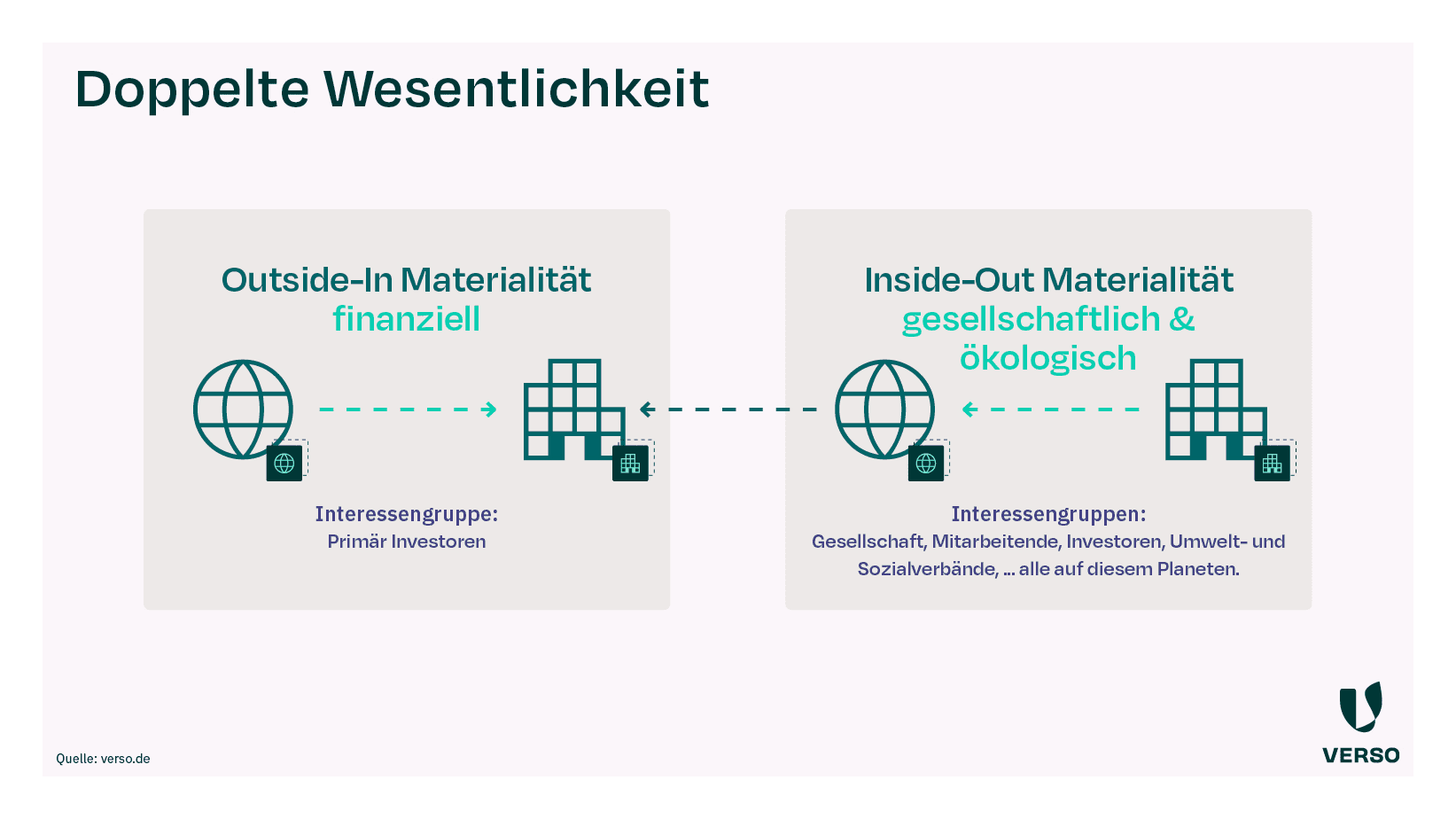
Double materiality means: it must be stated
how sustainability aspects affect the company (outside-in perspective)
AND
how the company affects society and the environment (inside-out perspective). The dual materiality will change the materiality principle used in Germany in particular and lead to significantly more information being relevant to reporting and CSR reports becoming more meaningful as a result. In future, companies will have to state both perspectives – independently of each other – in the sustainability report. Previously, both aspects had to be fulfilled at the same time. In the case of the outside-in perspective (“financial materiality”), disclosures must be made that are necessary for an understanding of the company’s business performance, results or position. Particularly in the world of finance, this perspective is often the only one considered today and referred to as “ESG” or “ESG-related risks” – in other words, only the risk perspective is considered from a sustainability perspective. With the inside-out perspective (“environmental and social materiality”), information must be provided that is necessary for an understanding of the impact of business activities on sustainability aspects. In short, it must be explained: What impact does my company have on the planet and society?

Infografik: Erklärung doppelte Wesentlichkeit der CSRD

The ESRS standards at a glance

With the new CSRD reporting obligation, the EU is also introducing uniform European standards for comparable sustainability standards – the ESRS. Get an overview in the factsheet.

The outside-in perspective

Many companies have so far focused on the outside-in perspective, as it represents a form of risk management. This field will also be covered in the future. The information is primarily aimed at investors. From the outside-in perspective, companies must disclose the following information:

  • How do external developments affect the business model, strategy and sales, among other things? External developments include unexpected weather events, for example, but also stricter regulatory requirements.
  • Industry-specific topics also play a role: Are there sustainability aspects that have already been identified by competitors, customers or suppliers?
  • What are the main risks for the company, a product or a service? And how are they managed or mitigated?

How do I create a sustainability report?

Creating a meaningful sustainability report can be quite a challenge. It’s easier with our practice-oriented playbook “7 steps to a sustainability report”.

The inside-out perspective

The inside-out perspective significantly broadens the view. Contact persons are not only investors, but also employees, consumers and environmental and social organizations. From the inside-out perspective, companies must disclose how their activities affect society and the environment. The impact of products, services and business relationships (including the supply chain) should also be mentioned here. Information is required on, among other things

Environmental issues:

  • Climate impact
  • Prevention and reduction of environmental pollution
  • Environmental impact of energy use
  • Biodiversity

Social:

  • Health and safety in the workplace
  • Diversity and equal treatment
  • Human rights
  • Social commitment

Governance:

  • Management and control processes
  • Combating corruption and bribery

Additional information also in the VERSO Academy

In 12 Wochen zum/zur ESG-Manager:in – die VERSO Academy führt Sie durch den kompletten ESG-Managementbericht. Von Standards bis doppelte Wesentlichkeit.

The goal of dual materiality

With the introduction of the new CSR reporting obligation CSRD, the European Union wants to increase the scope of sustainability disclosures. This will make CSR reports more meaningful and comparable. The impact of the sustainability report will also be increased because the dual materiality contributes to a shift from a shareholder perspective to a stakeholder perspective. The CSR report is aimed at investors, but also at employees, customers and society.

We help you with your sustainability report

The new CSR reporting obligation CSRD will not only affect more companies. They will also face a major challenge due to the double materiality. VERSO will guide you through the report.

* This information is summarized editorial content and should not be construed as legal advice. VERSO accepts no liability.

Subscribe to our newsletter!

Sign up and receive regular news about:

  • Current ESG topics and legislative changes
  • Best practices in the areas of ESG and sustainable supply chains
  • News about VERSO
  • Sustainability events and much more.
Sign up now!

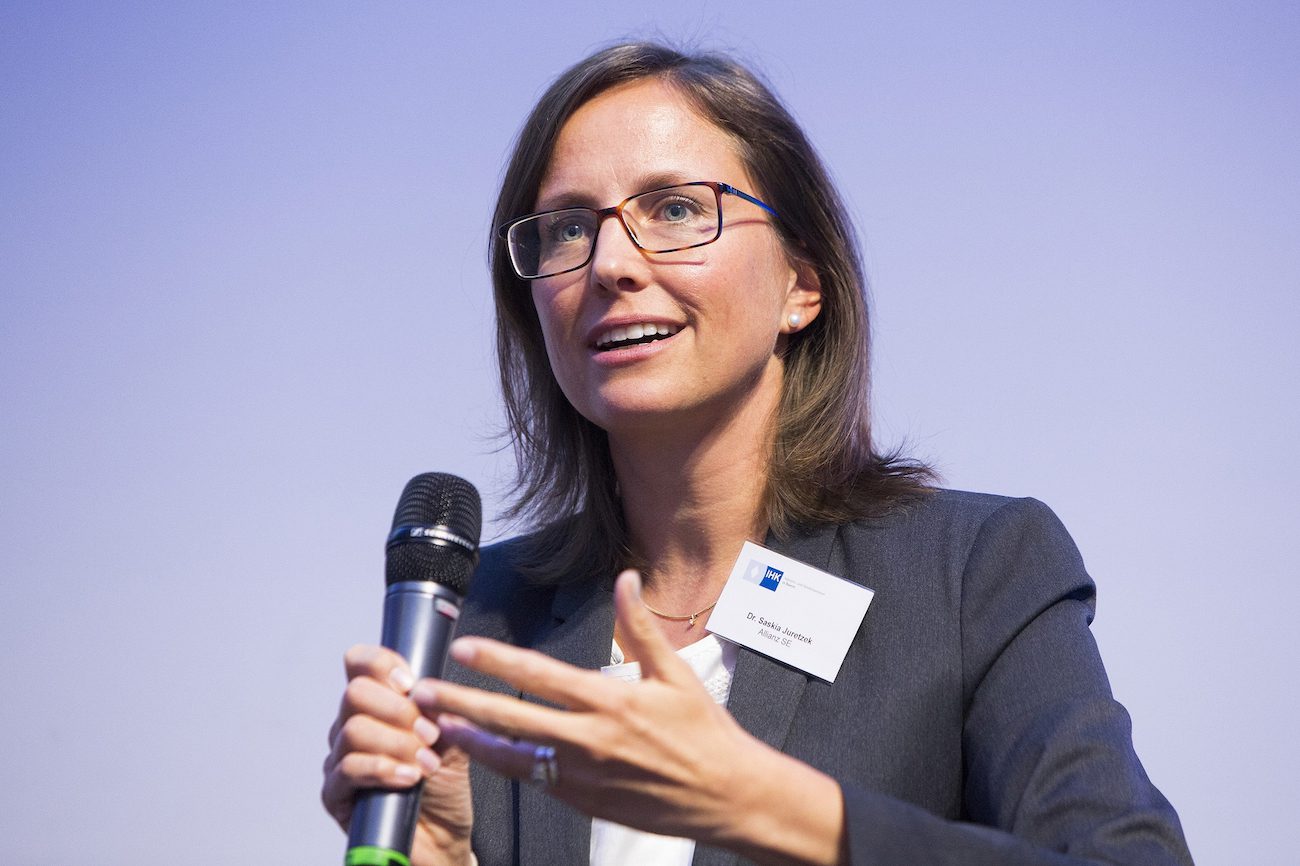
Dr. Saskia Juretzek,
12.12.2020

Dr. Saskia Juretzek: Nachhaltigkeit bringt viele Vorteile

Im Interview spricht die CSR-Expertin über ihre Definition von Nachhaltigkeit, ihren Werdegang sowie geschäftliche Vorteile von CSR. Außerdem erklärt Sie, für welche Art von Unternehmen Nachhaltigkeit überhaupt eine Rolle spielen kann.

Warum hast Du dich dafür entschieden, dich dem Thema zu widmen, woher kommt deine Leidenschaft dafür? Und warum findest Du unternehmerische Nachhaltigkeit wichtig?

Saskia Juretzek: Als Kind war ich mit meiner Familie viel im Wald unterwegs, wie auch auf Bauernhöfen, so dass mir Natur und Tiere immer sehr nah waren. Noch heute ist ein Spaziergang in einem naturnahem Wald für mich die totale Erholung. Ich stamme insgesamt aus einem umweltbewussten Haushalt und habe schon früh mitbekommen, wie wichtig Umweltschutz ist. Die Idee, mich mit dem Thema auch beruflich zu beschäftigen, entwickelte sich mit der Zeit und den beruflichen Möglichkeiten. Während meiner Zeit bei Accenture wurde ich Teil der neugegründeten Arbeitsgruppe für Nachhaltigkeit. Das Thema hat mich sofort angezogen, ohne genau zu wissen, was da dahinter steckt.

Um mein Wissen in diesem Bereich zu erweitern und mich beruflich darauf zu fokussieren, entschied ich mich, an der Leuphana Universität Lüneburg zu promovieren. Gleichzeitig startete ich in der Corporate Responsibility Abteilung der Telefonica Deutschland mit Fokus auf die Nachhaltigkeitsstrategie, das Reporting und die Kommunikation. Im Anschluss an die  Doktorarbeit ging ich zur Allianz SE, der Zentrale der Allianz Gruppe und beschäftige mich dort mit Strategieentwicklung, den SDGs und Berichterstattung. Für mich persönlich haben gerade große internationale Unternehmen durch ihre Reichweite die Möglichkeit, die Gesellschaft wesentlich positiv zu beeinflussen, Best Practices zu gestalten und das Umfeld zum Nachahmen anzuregen. Das sehe ich auch als eine Pflicht an. Es begeistert mich, Teil der Nachhaltigkeitsbewegung zu sein und diese aktiv mitgestalten zu können.


Immer wieder hört man die Frage „Was ist Nachhaltigkeit eigentlich genau?“
Gibt es die perfekte Corporate Responsibility-Definition?

Die perfekte Corporate Responsibility Definition gibt es aus meiner Sicht nicht bzw. gibt es auch keine einheitliche Definition, die jedem geläufig ist. Ich persönlich bin kein Fan vom Begriff Corporate Social Responsibility, da er rein sprachlich auf „Social“ fokussiert (wenn er auch bspw. durch die EU breiter definiert wird). Corporate Responsibility und Sustainability sind weiter gefasste Begriffe, die soziale, ökologische und ökonomische Aspekte umfassen.

Im Kern geht es darum, den sozialen, ökologischen und ökonomischen Herausforderungen zu begegnen, negative Auswirkungen der Unternehmenstätigkeit zu minimieren und positive zu erhöhen. Wesentlich für Unternehmen ist es, Nachhaltigkeit intern klar zu definieren und ein einheitliches internes Verständnis zu haben.

In jeder Branche kann CR etwas anderes bedeuten – in der Versicherung geht es bspw. um nachhaltige Produktlösungen und nachhaltige Anlagekriterien für Kundengelder, im produzierenden Gewerbe gegebenenfalls um die Arbeitsbedingungen in der Lieferkette und den Energieverbrauch in der Produktion.


Unternehmerische Nachhaltigkeit ist gesamtgesellschaftlich gesehen unbestritten ein absolutes Kernthema für unsere Zukunftsfähigkeit. Für das einzelne Unternehmen steht jedoch häufig die Gewinnerzielungsabsicht über allen anderen Zielen.

Daher provokant gefragt: Kostet Nachhaltigkeit nur, oder gibt es auch ökonomische Vorteile sich als Unternehmen einer Nachhaltigkeitsstrategie zu verschreiben?

Saskia Juretzek: Provokant geantwortet – betrachtet man Nachhaltigkeit mittel- bis langfristig gibt es nur Vorteile. Es hängt also von der Betrachtungsweise ab, vor allem von der zeitlichen. Klassischerweise treten „trade-offs“ (Zielkonflikte) auf, wenn es um langfristige Investitionen, aber um kurzfristige Renditen geht.

Viele Investitionen in Nachhaltigkeit rechnen sich mittel- bis langfristig, verursachen aber heute Kosten. Kurzfristiges Renditedenken, getrieben von Shareholder-Erwartungen steht hier der Langfristigkeit nachhaltiger Entwicklung entgegen. Natürlich gibt es auch kurzfristige Vorteile und auch Win-Win-Situationen, aber sie sind eben nicht zwangsläufig die Regel.

Neben dem aktuellen Geschäftserfolg sollte ein Unternehmen seine langfristige Geschäftsbasis sichern. Wenn ich bspw. heute meine Böden so auslauge, dass ich sie in zehn Jahren nicht mehr nutzen kann, bringt mich das auf Dauer nicht weiter. Für eine ernsthafte und erfolgreiche Auseinandersetzung mit CR ist eine langfristige Perspektive unabdingbar und auch für ein dauerhaft erfolgreich bestehendes Unternehmen wesentlich.

Nachhaltigkeit steht ökonomischen Vorteilen also nicht entgegen, sondern ist die Basis für erfolgreiches unternehmerisches Handeln.


Unternehmen sind ja bekanntermaßen unheimlich unterschiedlich. Von Ein-Mann-Handwerksbetrieben, über den produzierenden Mittelstand, bis hin zu Großkonzernen, wie der Allianz.

Ist Nachhaltigkeit für alle wichtig, oder reicht es vielleicht sogar, wenn die „Großen“ sich um Zukunftsfähigkeit in ökonomischen, ökologischen und sozialen Aspekten kümmern?

Saskia Juretzek: Die Antwort ist für mich recht klar. In Deutschland liegt die Anzahl kleinerer und mittlerer Unternehmen bei mehr als 99%. Es braucht daher alle Akteure, um einen entscheidenden positiven Beitrag zur ökonomischen, ökologischen und gesellschaftlichen Zukunftsfähigkeit zu leisten.

Aber natürlich spielt die Größe eines Unternehmen eine Rolle. In Großunternehmen stehen mehr Kapazitäten zur Verfügung, der Hebel ist größer und häufig gibt es eigenständige CR-Abteilungen. Letzteres ist sicherlich in einem Zehn-Mann-Betrieb nicht sinnvoll oder umsetzbar. Dennoch können hier Mitarbeiter zusätzliche Aufgaben, beispielsweise rund um Umweltschutz, übernehmen. Die Themen an sich ändern sich nicht zwangsläufig, aber natürlich die Ressourcen, die ich zur Verfügung habe.

Als nicht börsennotiertes Unternehmen habe ich im positiven Sinne mehr Freiraum und kann langfristiger planen als ein quartalsgetriebenes, börsennotiertes Unternehmen. Viele Familienunternehmen sind Nachhaltigkeitsvorreiter, sie denken und planen sehr langfristig, so dass Nachhaltigkeit leichter integrierbar ist – es kommt zu weniger Zielkonflikten zwischen ökologischen, sozialen und ökonomischen Zielen.

Dr. Saskia Juretzek

ist Head of Sustainability bei der Tengelmann-Gruppe. Seit über zehn Jahren ist sie als CSR-Managerin in Nachhaltigkeitsabteilungen von Großkonzernen aktiv. Sie hat im Bereich Nachhaltigkeit promoviert und bringt sich an diversen Hochschulen und Universitäten in die Lehre ein. Dr. Saskia Juretzek ist darüber hinaus Mitgründerin der Initiative „futurewoman“, die Frauen im  Nachhaltigkeitsbereich vernetzt. Außerdem gibt sie in der VERSO Academy ihr umfangreiches Wissen weiter und spricht als Referentin über die Themen CSR-Strategie und CSR in der Organisation.

Dr. Saskia Juretzek

Abonnieren Sie unseren Newsletter!

Tragen Sie sich ein und erhalten Sie regelmäßig Neuigkeiten zu:

  • Aktuellen ESG-Themen und Gesetzesänderungen
  • Best Practices aus den Bereichen ESG und nachhaltige Lieferketten
  • News zu VERSO
  • Sustainability Events uvm.

Jetzt anmelden!

Sustainable Development Goals
06.07.2020

SDG: Das Rahmenwerk für Nachhaltigkeit und CSR-Management der UN

In diesem Überblick erfahren Sie in sieben kurzen Punkten alles was Sie wissen müssen, um die Entwicklungsziele (SDG) für Ihr Unternehmen einzuordnen.

Licence to Operate

Kunden, Mitarbeiter und andere Interessengruppen fragen nach gesellschaftlichen, sozialen und ökologischen Auswirkungen Ihrer Geschäftstätigkeit. Es ist zunehmend klar, dass Nachhaltigkeit im Unternehmen zur „Licence to Operate“ wird. Das CSR-Management (Corporate Social Responsibility) soll also strategisch(er) oder sogar erstmals angegangen werden. Wie das SDG-Rahmenwerk Ihnen dabei helfen kann, erfahren Sie im Artikel.

Wenn heute über die Umsetzung von Nachhaltigkeit in den Unternehmen gesprochen wird, sind die Sustainable Development Goals (SDG) der Vereinten Nationen fester Bestandteil der Agenda. Das Rahmenwerk hilft, CSR Management strategisch im Unternehmen zu gestalten. Allerdings ist am Anfang oft unklar, wie sich die SDGs nun konkret operationalisieren und in die Nachhaltigkeitsstrategie der Unternehmen einbinden lassen.

In unserem Überblicksartikel erfahren Sie in sieben kurzen Punkten alles was Sie wissen müssen, um die Entwicklungsziele (SDG) für Unternehmen erstmalig einordnen zu können. Den Ursprung der SDG stellen wir ebenso vor, wie die Rolle von Unternehmen, die deutsche Nachhaltigkeisstrategie und den Umsetzungsstatus. Vor allem geben wir Ihnen jedoch Antworten auf die Frage: Wie können Sie mit ihrem Unternehmen ein proaktiver Teil der nachhaltigen Entwicklung werden? Aber lassen Sie uns von vorne beginnen.

Die Wurzeln der SDG (Sustainable Development Goals)

Die Diskussion um eine nachhaltigen Entwicklung von Gesellschaft, Wirtschaft und Umwelt, die mit der Veröffentlichung des so genannten Brundlandt-Reports „Our Common Future“ im Jahr 1987 die breitere Öffentlichkeit erreicht hat (World Commission on Environment and Development), ist in der heutigen Zeit ungebrochen aktuell. In mehreren Entwicklungsschritten haben die globalen Zielsetzungen dieser Diskussion Eingang in die von den Vereinten Nationen veröffentlichten Development Goals (SDG) gefunden.

Die Rolle von Unternehmen im SDG Framework

Dabei wird auch ein Rahmenwerk aufgespannt, dass die Unternehmen als wichtige Akteure der nachhaltigen Entwicklung definiert und ihnen Hilfestellungen bei der Umsetzung von Maßnahmen auf der regionalen und betrieblichen Ebene anbietet. Die SDG betonen die Notwendigkeit der aktiven Beteiligung privater Unternehmen und appellieren an deren Kreativität und Innovation, um Werte für das Gemeinwohl zu schaffen. Dazu gehört zum Beispiel die Verringerung der Armut, die Ausmerzung des Hungers und den Schutz der biologischen Vielfalt.

Die Agenda 2030 der Vereinten Nationen und ihre 17 nachhaltigen Entwicklungsziele stellen die Unternehmen vor die neue Herausforderung, ihre Operationen und Strategien auf die Anforderungen der SDGs abzustimmen.

17 übergeordnete Nachhaltigkeitsziele und Deutschlands Beitrag

Die Agenda 2030 der Vereinten Nationen „Transforming Our World: The 2030 Agenda for Sustainable Development“ umfasst 17 globale Ziele (UN SDG) für eine nachhaltige Entwicklung. Die Agenda trat am 01. Januar 2016 mit einer Laufzeit von 15 Jahren in Kraft. Die Ziele umfassen verschiedene Themen, die wichtige Aspekte der Nachhaltigkeit sind, wie zum Beispiel Armut, Diskriminierung, Klimawandel, Schutz der natürlichen Umwelt, Bildung und Arbeitsfragen. Basis für die Umsetzung der SDG in Deutschland ist die im Januar 2017 (Neuauflage 2018) von der Bundesregierung verabschiedete Deutsche Nachhaltigkeitsstrategie.

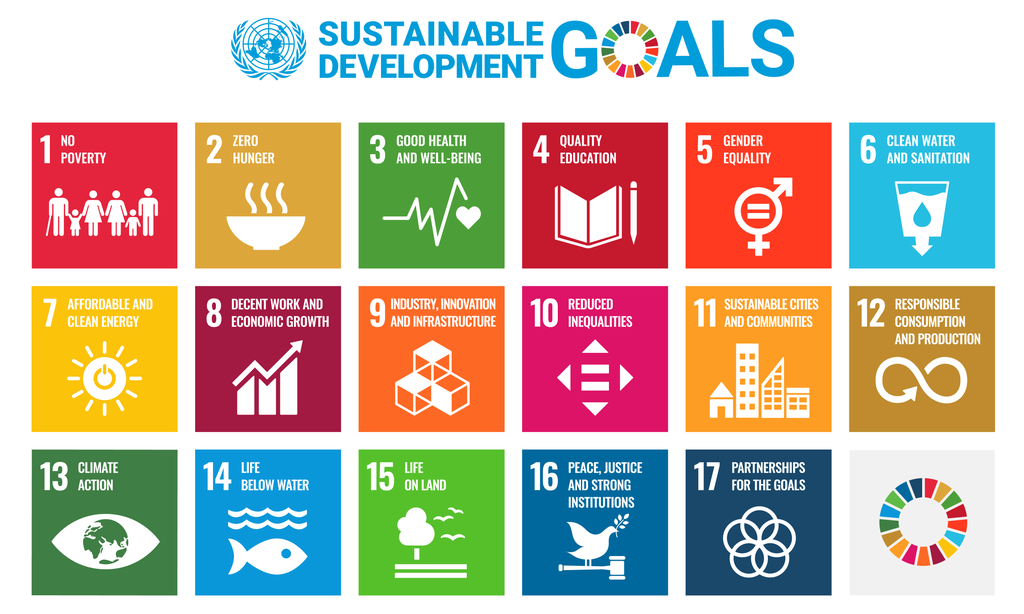
Die 17 übergeordneten Nachhaltigkeitsziele sind die Folgenden:

  1. Keine Armut
  2. Kein Hunger
  3. Gesundheit und Wohlbefinden
  4. Hochwertige Bildung
  5. Geschlechtergleichheit
  6. Sauberes Wasser und Sanitäreinrichtungen
  7. Bezahlbare und saubere Energie
  8. Menschenwürdige Arbeit und Wirtschaftswachstum
  9. Industrie, Innovation und Infrastruktur
  10. Weniger Ungleichheiten
  11. Nachhaltige Städte und Gemeinden
  12. Nachhaltiger Konsum und Produktion
  13. Maßnahmen zum Klimaschutz
  14. Leben unter Wasser
  15. Leben an Land
  16. Frieden, Gerechtigkeit und starke Institutionen
  17. Partnerschaften zur Erreichung der Ziele

Zu diesen übergeordneten Zielen werden in der Agenda 2030 169 Unterziele vorgeschlagen, um die Länder bei der Überwachung ihres Beitrags zu den 17 UN SDG zu unterstützen. Eine wesentliche Rolle, um die Ziele zu erreichen, spielt hierbei der Beitrag von Unternehmen.

Sustainable Development Goals

Zwei wesentliche Richtlinien zur Umsetzung der SDG in Unternehmen

Um die Implementierung der SDG und der Unterziele in die Lieferketten der Unternehmen zu erreichen, stehen verschiedene international anerkannte Richtlinien, wie die Global Reporting Initiative (GRI) und der UN Global Compact zur Verfügung.  Beide Richtlinien schlagen Indikatoren und Kennzahlen zur Messung der Nachhaltigkeitsleistung von Unternehmen für die einzelnen UN SDGs vor.

Eine Annäherung an die Umsetzung der globalen Entwicklungsziele können Unternehmen also über den Umweg der Implementierung der GRI-Indikatorik erreichen.

Wie sich den SDG als Unternehmen also widmen?

Was brauchen Sie nun konkret, um sich den SDG und Nachhaltigkeit im Allgemeinen sinnvoll zu widmen? Maßgeblich sind erst einmal zwei Basispfeiler: Einerseits eine organisatorische und inhaltliche Verantwortung bei einer oder einem CSR-Beauftragten. Die zweite wichtige Voraussetzung ist ein Ort zur Bündelung aller nachhaltigkeitsrelevanter Daten. Ohne diese beiden Grundvoraussetzungen ist es quasi nicht möglich sich als Organisation dem Thema weiter zu nähern.

Doch auch mit klarer inhaltlicher Verantwortung und Datenbündelung ist es, je nach Unternehmensgröße, Branche und Interessengruppen, eine nicht zu unterschätzende und sehr individuell zu gestaltende Aufgabe, die SDG strategisch anzugehen.

Beratungsunternehmen aus dem Bereich der Nachhaltigkeit und des Nachhaltigkeitsreportings, wie auch wir bei VERSO, stehen Unternehmen und CSR-Manager:innen deshalb bei der Umsetzung mit Rat und Tat zur Seite.

Dass externe Unterstützung aufgrund der Komplexität der verschiedenen Richtlinien lohnenswert ist, zeigt unter anderem eine Studie von Van der Waal und Thijssens (2020). Diese bringt Licht in das „unentdeckte Terrain“ der SDG-Beteiligung von Unternehmen. Dazu werden in der Untersuchung die Nachhaltigkeitsberichte der 2000 weltweit größten börsennotierten Unternehmen analysiert.

Status quo der SDG-Umsetzung in der Wirtschaft

Momentan beschäftigen sich zwar bereits einige Vorreiter-Unternehmen intensiv mit der Umsetzung der SDG innerhalb ihrer Nachhaltigkeitsstrategie. Das Engagement der Unternehmen in den SDG insgesamt ist allerdings noch begrenzt. Es steht hauptsächlich mit dem Engagement für andere nachhaltigkeitsbezogene Themen sowie mit der Unternehmensgröße und dem Nachhaltigkeitsniveau des jeweiligen Unternehmens in Zusammenhang.

Man kann daraus schließen, dass das Engagement für die SDG einerseits aus regulatorischen Gründen erfolgt, es werden schlicht bestehende Gesetze befolgt. Andererseits liegen häufig institutionelle Gründe für ein Engagement vor. Die qualitative Prüfung der einzelnen Berichte zeigt, dass die Beteiligung der Unternehmen weitgehend symbolisch und absichtlich erfolgt und noch nicht substanziell ist. Dies legt den Schluss nahe, dass viele Unternehmen die SDG – ähnlich wie den Global Compact – als ein Schema mit unverbindlichen Auswirkungen betrachten. Kurz gesagt: Noch zu viele Unternehmen befassen sich momentan nur so intensiv mit den SDG, wie sie gesetzlich dazu gezwungen sind.

Um aber die weltweite Zukunftsfähigkeit zu ermöglichen, die die Sustainable Development Goals zum Ziel hat, müssen Unternehmen hier noch deutlich mehr tun. Glücklicherweise entdecken immer mehr Unternehmen, dass das Einflechten der Entwicklungsziele in die eigene Strategie notwendig und unumgänglich ist.

Warum nun Zeit ist umzudenken

An dieser Stelle vergeben leider viele Unternehmen noch die Chance, um von den positiven Effekten eines Engagements zu profitieren. Dabei entwickeln sich nicht selten während der Umsetzung auch ungeahnte betriebswirtschaftliche Effekte. Nachhaltigkeit und die Umsetzung der Entwicklungsziele der Vereinten Nationen sind also langfristig auf allen Ebenen lohnenswert und unumgänglich.

Neben einer aktiven Gesellschaft sind die Unternehmen die wichtigsten Akteure, um die großen globalen Ziele einer gerechteren Verteilung des Wohlstands und der Begrenzung der schädigenden Wirkungen der Globalisierung zu erreichen. Nur gemeinsam können wir die Agenda 2030 zum Erfolg führen. Lassen Sie uns gemeinsam anpacken!

We guide you through sustainability

Der Aufbau einer Nachhaltigkeitsstrategie ist mit Arbeit verbunden. VERSO begleitet Sie ganzheitlich auf diesem Weg. Seit 2010.

* Bei diesen Informationen handelt es sich um redaktionell zusammengefassten Content, der nicht als Rechtsberatung zu verstehen ist. VERSO übernimmt keine Haftung. 

Abonnieren Sie unseren Newsletter!

Tragen Sie sich ein und erhalten Sie regelmäßig Neuigkeiten zu:

  • Aktuellen ESG-Themen und Gesetzesänderungen
  • Best Practices aus den Bereichen ESG und nachhaltige Lieferketten
  • News zu VERSO
  • Sustainability Events uvm.

Jetzt anmelden!