

Holzwürfel, die ein Diagramm mit steigendem Pfeil abbilden: Richtig gemacht, können Nachhaltigkeitesberichte zur Steigerung des Unternehmenserfolgs beitragen Rising bar chart made of wooden blocks symbolizing measurable progress and continuous improvement in a sustainability report.
19.11.2024

Sustainability Report – What Is It and What Do You Need to Know?

Some companies are intrinsically motivated to embed ESG within their organization, while others are driven by the CSRD requirements or aim to gain a competitive edge. For all of them, the sustainability report becomes a constant companion on their ESG journey. Here’s an overview of the key terms and requirements for reporting.

What is a sustainability report?

This is the first fundamental question to address. In their sustainability report, companies disclose information on:

  • Environmental aspects,
  • Social matters
  • Corporate governance

The report outlines how external factors impact the company and how the company’s activities affect the environment and society. The first report usually reflects the status quo. However, the report is meant to go beyond that: it also describes strategies, targets, and actions aimed at enhancing sustainability.

The length, structure, and thematic focus of sustainability reports can vary greatly. This depends on the standard you choose. In general, you are free to decide which reporting framework to follow – unless you are bound to mandatory reporting requirements, such as those under the CSRD. In that case, you must comply with specific guidelines and often follow certain standards, such as the ESRS.

Overview of the ESRS Standards

The European Sustainability Reporting Standards (ESRS) are designed to make sustainability reports more meaningful and comparable. All the details are available in the whitepaper.

Sustainability, ESG, CSR – What’s the difference?

When it comes to reporting, all three terms essentially refer to the same concept: addressing the fundamental responsibility of companies toward the environment and society – now and in the future.

In recent years, the term CSR (Corporate Social Responsibility) was widely used in Germany.

  • CSR describes a company’s responsibility for its impact on society.
  • In practice, the term was often used to cover all three dimensions of sustainability: environmental, social, and governance aspects.
  • The focus of CSR is more on the qualitative assessment of a company’s actions regarding sustainability, corporate values, and social engagement.

The term ESG has now become increasingly established.

  • ESG stands for Environmental, Social, and Governance.
  • The term originates from the financial sector and focuses primarily on assessing companies based on environmental, social, and governance factors.
  • Measuring sustainability follows a more quantitative approach.

The broader term sustainability is generally used synonymously with CSR and ESG. It also accurately describes the reporting process, as it covers sustainability across all areas of the business.

You can find more on this topic in our blog post “CSR, ESG, Sustainability – What’s the Difference?”.

When do I have to publish my first sustainability report?

With the new Corporate Sustainability Reporting Directive (CSRD), many companies will soon be required to publish a sustainability report. The reporting obligation is based on criteria such as the number of employees, revenue, and total assets.

Although the first report often requires significant effort and may contain only limited insights into progress and developments, our honest advice is: Start now!

Our CSRD factsheet helps you quickly find out if and when your company is subject to reporting requirements—and what your next steps should be.

Practical Guide: Ready for Your First CSRD Report

The first CSRD report is a major challenge, as the EU directive comes with numerous requirements and new standards. Our practical guide, including a checklist, helps you get started and prepare for the CSRD and ESRS.

How do I create a sustainability report?

The first sustainability report can be demanding. You’re likely doing this for the very first time, with little prior experience – targeted training can be a great help. You often have no benchmarks yet, no established processes or structures, and still need to find the right reporting software – based on our experience with customers, the list of challenges for a first report is long.

That’s where we come in: With the VERSO ESG Hub, you can create your sustainability report easily and efficiently. To help you get started, we’ve created a hands-on guide “7 Steps to Your CSR Report” that walks you through the process step by step toward a meaningful sustainability report.

And when it comes to software, you can rely on VERSO for your CSRD reporting: our CSRD Suite offers you an all-in-one solution.
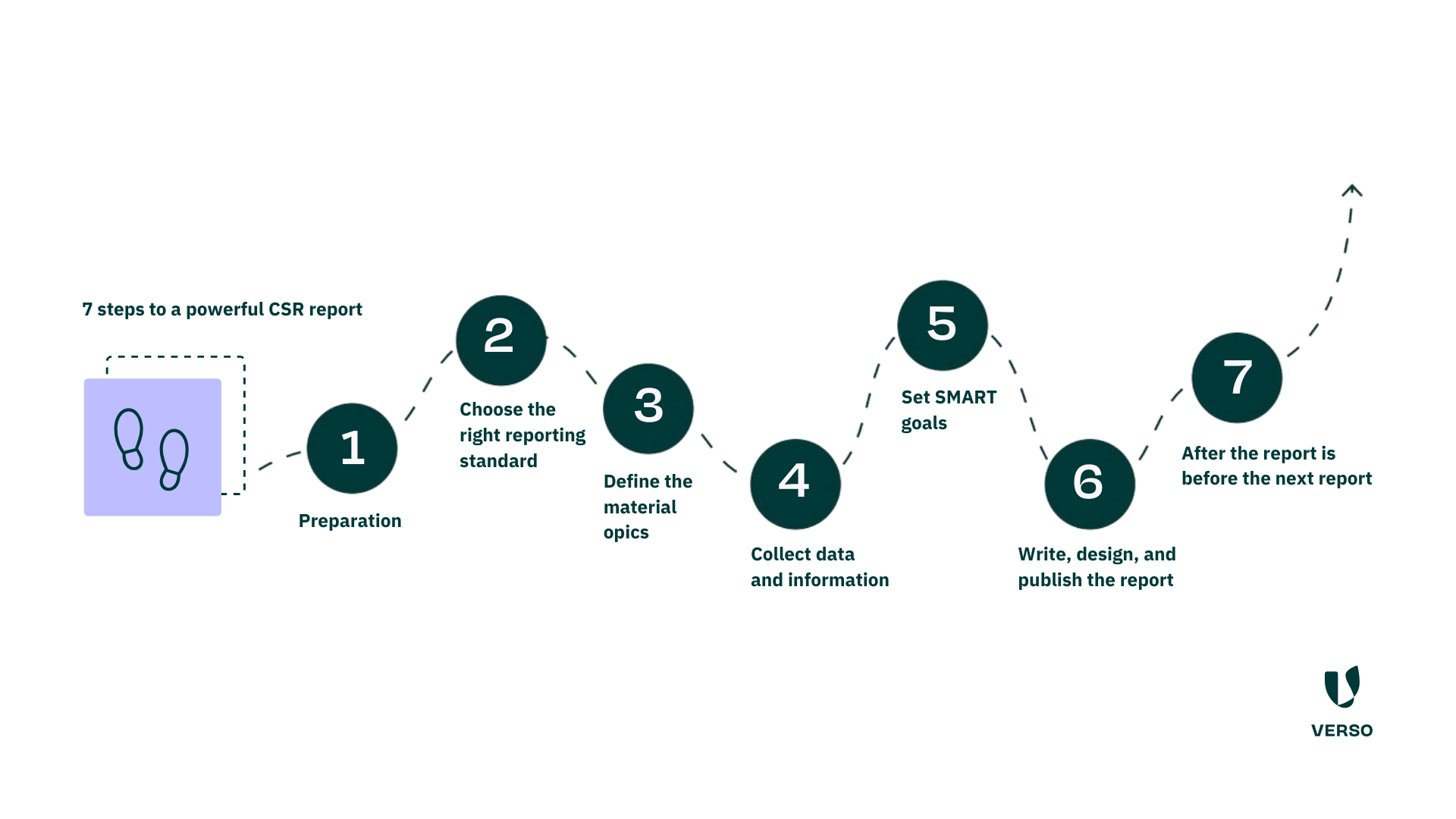
 

7-step process showing the key stages of creating a sustainability report, from preparation and materiality analysis to data collection, goal setting, publication, and continuous improvement.

I’m new to the role of ESG Manager…

How do I establish sustainability management in my company?

If you’re just starting to work with ESG, this may sound familiar: You have a lot of ideas and initiatives in mind, but you need to align them within a clear, goal-oriented sustainability strategy. You’re also thinking about which targets are realistic and make sense for your business. On top of that, you still need the right processes and metrics to monitor progress.

And above all, three key questions arise:

  1. What does all of this mean for my company?
  2. How do I tackle such a huge topic?
  3. How do I justify my efforts and the necessary resources to management?

Our introductory blog articles on sustainability management are a great starting point. You’ll gain valuable insights into your role and responsibilities as a sustainability manager and get tips on how to communicate effectively with management – showing why sustainability matters for your business.

CSRD, SFDR, EU Taxonomy – What are they, and what’s the background?

With so many regulations, you’ve probably come across terms like CSRD, SFDR, EU Taxonomy, and ESRS. They are all part of the European Green Deal and closely interconnected. The EU aims to strengthen sustainability across the economy through these directives and regulations.

To comply with the CSRD, companies are required to report according to the ESRS—the European standards set by the EU. But how exactly do you apply these standards? Do frameworks like GRI or DNK also meet these requirements? You’ll find the answers in our ESRS Whitepaper.

The SFDR is a sustainability-related disclosure regulation for the financial sector. If you’re unsure whether it applies to your business and what steps to take, our SFDR Factsheet provides the guidance you need.

The EU Taxonomy is a classification system applied within CSRD and SFDR. It defines when an economic activity is considered green, sustainable, or environmentally friendly—creating clarity around sustainability claims. What this classification means for your business and your sustainability work is explained in our EU Taxonomy Whitepaper.

How can I make my company more sustainable?

Start taking action now! The more you can showcase (implemented) measures in your report, the more meaningful your sustainability report will be. Here are a few tips for effective sustainability initiatives in your company.

Communicate your sustainability journey right from the start—and be transparent about areas where action is still needed. This makes your ambitions credible and easier to understand. But be careful not to fall into common greenwashing traps when communicating your efforts. Not only could this damage your reputation, but the EU is also introducing specific anti-greenwashing regulations, such as the Green Claims Directive.


We support you in creating your sustainability report!

Preparing a sustainability report is especially challenging the first time. But with the right tools and solid knowledge, you can save both time and costs. We offer the perfect solution for both: Our training programs (available in german) provide fresh insights and help you become a sustainability expert. And with our ESG management software, you can quickly and efficiently collect all relevant sustainability data in one place.

* This information is summarized editorial content and should not be considered legal advice. VERSO assumes no liability. 

Subscribe to our newsletter!

Sign up and receive regular news about:

  • Pragmatic all-in-one solution for ESG reporting, climate and supply chain management
  • Best practices in the areas of ESG and sustainable supply chains
  • Developed with expertise from 12+ years of sustainability management
  • Sustainability events and much more.

Get to know the software!

Sonnenstrahlen brechen durch Wolken hindurch – Symbolbild für die Chancen, die die CSRD bringt, auch wenn sie erst einmal wie belastende Bürokratie wirkt
07.08.2024

Why the CSRD is more than bureaucracy

Despite the many requirements, working on the CSRD report creates a profound awareness of genuine sustainability. Even if the CSRD is primarily a bureaucratic obligation, it also conceals valuable opportunities for business. Read this article to find out what these are.

The first companies have already published their CSRD report, and many more have yet to do so. In Germany alone, around 15,000 companies are affected by the new EU directive on sustainability reporting. And if we look a little further: Across Europe, a total of around 50,000 companies will have to report in accordance with the CSRD in the coming years.

What is the aim of the CSRD?

The CSRD is primarily intended to improve the transparency and comparability of sustainability reports, but also to close gaps in previous reporting obligations. To understand this, it helps to look back at the past of sustainability reporting. Sustainability reporting used to be voluntary for companies, was subject to no or only a few rules and often ended up as a kind of marketing brochure.

The first EU directives then put a stop to this. However, the CSRD now goes one step further. On the one hand, a whole host of companies are affected by the new reporting obligation, from small and medium-sized enterprises to large corporations. Across Europe. And in some cases even beyond the EU.

On the other hand, there are stricter rules: All disclosures must now be verifiable and signed off by auditors. The CSRD also requires significantly more and more in-depth quantitative and qualitative data. This should make the reports more comparable.

In this way, the EU wants to drive forward the sustainable transformation of the economy.
At the same time, the CSRD is a sensible response to the growing expectations of investors, customers and society as a whole. Companies are increasingly being held accountable for their sustainability performance – and more and more often, sustainability efforts also form the basis for economic success.

In a nutshell: CSRD makes sustainability transparent and comparable, creating the basis for us to steer our economy towards a more sustainable future in a targeted manner. “That sounds all well and good,” you may be thinking, “but what’s the point of all the pink clouds if I’m sitting here at my desk and can’t see sustainability for all the data?”

Overwhelmed by the CSRD?

Make CSRD as easy as possible: Our new CSRD Suite provides tools and support for every stage of CSRD compliance.

Awareness arises from bureaucracy

PwC recently published a study according to which the majority of the companies surveyed were confident: Yes, we will be ready for our new reporting obligations by the deadline. The respondents were mainly listed companies with an annual turnover of over one billion. However, we know from our own experience that small and medium-sized enterprises in particular are groaning in the face of the work involved in preparing and implementing the CSRD.

They tend to have mixed feelings about the CSRD. “The CSRD is just another useless bureaucracy that will create a burden, stress and work and tie up considerable resources, but ultimately won’t change anything at all.” This and similar criticism of the new directive is often voiced. And yes – of course there is a lot of bureaucracy behind the new laws and reporting obligations relating to sustainability.

A lot of data has to be collected, a lot of time is spent on preparation and implementation and a lot of employees are involved. However, in our work with our customers, we see time and again that anyone who writes sustainability reports and takes an in-depth look at the topic of sustainability also recognizes the potential of CSRD.

More than just a bureaucracy monster: 6 potentials of CSRD for your company

Despite (or perhaps because of!) the many requirements, working on the CSRD report creates a profound awareness of genuine sustainability. So even if the CSRD is primarily a bureaucratic obligation, it conceals valuable insights and potential. And let’s take a look at them now.

1. the CSRD promotes a better understanding of one’s own risks and opportunities

Before the actual CSRD report is prepared, the double materiality analysis is carried out. Here you determine:

  • How do sustainability aspects influence your company?
  • What impact does my company have on the environment and society?

Background: The ESRS, the CSRD framework, lists over 1,000 possible data points for the report. In the end, however, only selected data points such as ESRS 2 and those whose associated impacts, risks and opportunities (IROs) you have determined to be material are required to be reported. On the one hand, the double materiality analysis gives you clarity as to what belongs in your CSRD report. On the other hand, it also gives you a very helpful picture of how your company relates to the environment and society. You also get a crystal-clear overview of the risks your company could still face – where undiscovered opportunities for the future of your company lie dormant – and how your company is developing. Find out more in our article “The double materiality analysis in 7 steps”.

The ESRS standards at a glance

With the CSRD, the EU is also introducing uniform European standards.
The European Sustainability Reporting Standards (ESRS) are intended to make sustainability reports more meaningful and comparable.
All information can be found in the whitepaper.

2. the CSRD brings economic benefits, supports innovation …

The majority of decision-makers surveyed in a Noerr study assume that ESG will bring about change in the company. However, the transformation of business models in turn requires comprehensive adjustments to product development, internal processes and management.

This is where the wealth of data you collect and analyze for CSRD provides useful insights. Where are resources still being wasted without this being noticed? Which processes that “we’ve always done this way” could be optimized – and thus promote not only sustainability but also efficiency? Where do we need to rethink in order for the sustainable transformation to succeed? These are just a few situations in which ESG data management lays the foundation for a sustainable future.

In the best case scenario, you don’t just write your CSRD report for the sake of it, but take something away from it for the success of your company.

3. … and strengthens the resilience of your company

Let’s take a concrete example: ESRS E1, the “climate change standard”. Here you have to report, among other things,

  • how your company has a positive and negative impact on the climate,
  • which climate protection measures you implement,
  • what risks and opportunities arise from climate change,
  • and how to adapt your company to climate change.

The smaller the company, the greater the likelihood that the issue of climate change will not necessarily be a high priority due to time constraints – i.e. it will be postponed for the time being without the CSRD. However, the first consequences of climate change are already making themselves felt. And will occur more frequently in the future. Heavy rain, floods, heatwaves, droughts and fires can paralyze production facilities, lead to staff absences, cause supply chain delays or destroy transport routes. 55% of managers surveyed in Germany in a Capgemini study estimate that climate change will cause the majority of operational disruptions in the coming years. So it only makes sense to look at what climate change means for your company and how you can counteract it. And in the course of CSRD, you approach such and similar considerations in a very structured way.

CSRD: 10 tips for successful data collection

CSRD presents companies with new challenges – and this starts with data collection. Our article gives you 10 tips for efficient processes.

4. solid sustainability reports create trust

Investors and other stakeholders are now looking very closely at what is happening in your company in terms of sustainability. Sustainability reports are a great way to communicate your status quo and your ambitions in this area. The best way to do this, however, is with a reporting standard that specifies uniform requirements for all companies concerned in order to ensure maximum comparability. As we wrote at the beginning, CSRD transforms sustainability reports into transparent and, above all, verifiable documentation of your sustainability journey.

And if we want to look at things from a negative perspective: Intentional and grossly negligent errors in the CSRD report are punishable by, among other things, “naming and shaming” – i.e. public disclosure. If your company violates its CSRD reporting obligations or attempts to falsify data, this can ruin its reputation and trust. In this respect too, it is therefore worth seeing the CSRD as an opportunity and implementing it conscientiously. You can find more information on the possible sanctions in our article “The cost of mistakes in reporting and implementing sustainability.”

5 The CSRD report as a repository for fact-based sustainability communication

Once you have identified stakeholders, determined opportunities and risks, set up strategies and collected ESG data from all possible areas as part of your CSRD obligation, you have one thing in addition to the report: a very useful repository of information. This, in turn, is ideal for any sustainability communication outside of the report.

After all, this is also becoming increasingly important. Here we would like to quote a Capgemini survey once again: 77% of consumers surveyed are changing their purchasing behavior in favor of more sustainability. 66% are even specifically looking for sustainable products. Conversely, 36% of the companies surveyed also stated that Our customers are not interested in sustainability! This shows a major perception gap that needs to be closed.

The best way to do this is with comparable reports that are checked by a third party (you guessed it: the CSRD…). This is what 34% of consumers surveyed in a Deloitte study would like. Fact-based sustainability communication is also beneficial when it comes to recruiting talent and employee satisfaction. According to the EIB Climate Survey 2023, 56% of people surveyed value an employer that thinks and acts sustainably. According to a Gartner survey, a strong ESG culture even boosts employee engagement by up to 43%.

6 ESG data facilitates access to credit

It’s not just investors and the public who are demanding ESG measures, but also banks and credit institutions. Just as a disability insurer is interested in whether you prefer to solve crossword puzzles or skydive in your free time when taking out insurance, financial institutions are now increasingly looking at ESG risks when granting loans. The list of questions is based on the CSRD, among other things. This means that if you are already collecting ESG data for the CSRD anyway, you will have it to hand more quickly when applying for financing. Read more about this in our article “ESG in financing: This data decides on loans”.

Conclusion: CSRD is worthwhile in many respects – and it doesn’t have to be complicated at all

Let’s summarize once again. CSRD helps you to identify risks and opportunities for your company in a targeted manner. It provides your company with economic advantages and can even become a driver of innovation. Furthermore, it strengthens your company’s resilience in the long term if you take a close look at sustainability.

Externally, CSRD promotes the trust of your stakeholders and serves as a basis for general sustainability communication, which in turn appeals to customers and employees. Last but not least, the data once collected will help in future when granting loans. It’s exciting to see the wide-ranging effects of this report, which seems so dry at first, isn’t it?

And the best thing is that CSRD doesn’t necessarily have to be a nerve-wracking challenge.
With software and advice at eye level, VERSO will guide you step by step through the CSRD process. For example, with our new AI-supported module for audit-proof double materiality analysis. Or with our all-in-one solution for ESG management and ESG reporting – including carbon footprint and supply chain transparency.

Feel free to contact us!

* This information is summarized editorial content and should not be construed as legal advice. VERSO accepts no liability.

Subscribe to our newsletter!

Register now to arrange a free demo appointment and get to know our solutions at first hand.

  • Pragmatic all-in-one solution for ESG reporting, climate and supply chain management
  • Individual advice from the VERSO experts
  • Developed with expertise from 12+ years of sustainability management
  • Trusted by 250+ customers
Nuvia Maslo im neuen Kurs der VERSO Academy, Fit for Sustainability
09.07.2024

What specialists and managers should know about sustainability

ESG regulations, sanctions and real environmental threats are putting companies under increasing pressure. This means that sustainability must now be implemented in companies.

And in such a way that it does not become a bureaucratic monster. Because sustainability is not a spoilsport, but can create real business value. Read here to find out how this works and what you need to know as a specialist or manager.

Sustainability starts with specialists and managers

Sustainability ambitions must come from the management level.
Then it can create real business value with competitive advantages, cost savings and resilience.
At management level, the importance of the topic must be understood, priorities set and strategic decisions made for sustainability.
For specialists and managers, this means getting to grips with the topic of sustainability, acquiring knowledge and at least understanding the basics.
We give you 4 tips to help you successfully drive forward the sustainable transformation in your company.

Training tip: The new ESG course “Fit for Sustainability”

Learn everything that specialists and managers need to know about sustainability in our “Fit for Sustainability” online course.
The early bird phase is currently still running – register here for a 25% voucher!

4 tips for starting the sustainable transformation

1. find out about the role of companies in sustainability

Climate change is real.
The first effects are already being felt.
Extreme weather events are more extreme and occur more frequently.
There is a lot to be done to ensure that this planet remains liveable for future generations.
But what role do companies play in this?
Where are the most serious problems and how can we solve them?
You should be clear about this before you put sustainability on the agenda.
Because only then will you be able to win over your employees to the issue and only then will you have the know-how to implement measures with real impact.

2. familiarize yourself with the most important ESG regulations

With the Green Deal, the EU is bringing many laws and directives to the table that oblige companies to be more sustainable.
These include the CSRD reporting obligation, the CSDDD supply chain law and special regulations such as the EU Taxonomy, the SFDR regulation for the financial sector, the CBAM carbon border adjustment mechanism and the EUDR deforestation regulation.
In addition, there are also laws in Germany that require companies to deal with sustainability at all ESG levels, such as the German Supply Chain Act LkSG.
Of course, you don’t need to know all the directives and laws in detail.
However, an overview of the implementation deadlines, what needs to be done and which roles are required in the company is essential.

3. communicate sustainability transparently and without greenwashing

Regardless of whether you have to publish a sustainability report due to the CSRD obligation or would like to report on your sustainability activities voluntarily: Communicating sustainability is a fine line between correct and misleading.
What is communicated can quickly verge on greenwashing, and the CSRD also requires very comprehensive statements that have to be watertight.
Successful and legally compliant communication requires a good understanding of sustainability, of the company’s own activities, of sustainability communication and of the regulatory framework.

4. develop a sustainability strategy and use it to leverage potential for your company

The topic of sustainability and the associated laws and guidelines are often referred to as a “bureaucracy monster”.
But that doesn’t have to be the case: take a strategic approach to the topic and integrate sustainability firmly into your corporate strategy.
This will open up real opportunities for your company.
Because sustainable management makes your company resilient and fit for the future and opens up new business models and competitive advantages.

How do you get started? With knowledge building!

Now it’s time to get started!
At the VERSO Academy, we have the ideal course for you to gain knowledge on all these topics: You will efficiently learn everything important that specialists and managers should know about sustainability in the shortest possible time – tailored to your needs and potential.
After the training course, you can get started with the sustainable transformation straight away. Sounds good?
Get the
25 % Early bird discount – redeemable as soon as the course is bookable:

* This information is summarized editorial content and should not be construed as legal advice. VERSO accepts no liability.

Subscribe to our newsletter!

Sign up and receive regular news about:

  • Pragmatic all-in-one solution for ESG reporting, climate and supply chain management
  • Individual advice from the VERSO experts
  • Developed with expertise from 12+ years of sustainability management
  • Trusted by 250+ customers

Get to know the software!

Stakeholder-Anforderungen von ESG-Informationen an KMU
12.02.2024

5 reasons why a sustainability report is also worthwhile for SMEs

Many companies – large and small – are affected by sustainability regulations such as the CSRD, the LkSG or the European supply chain law CSDDD. But what about those that are not subject to these regulations? Are they exempt from reporting?

Watch out: Not being directly affected does not mean that you do not have to deal with sustainability! We explain here why SMEs also have to provide sustainability data and what information is required.

Which stakeholders request ESG data from SMEs

1. business partners create transparency in the supply chain

Are you a supplier to another company? Many SMEs supply larger companies that fall under the LkSG (Lieferkettensorgfaltspflichtengesetz) and are or will be affected by the EU CSRD (Corporate Sustainability Reporting Directive) and CSDDD (Corporate Sustainability Due Diligence Directive).

Large companies not only have to make their own ESG information transparent, but also that of their suppliers.

This means that you are also affected by the requirements of the regulations and will be asked by your customers for comprehensive sustainability information.

As a result, you have to undergo extensive due diligence checks, such as the EcoVadis sustainability assessment, which identifies potential risks for people and the environment in the supply chain.

Incidentally, it is not only you as a supplier who must provide evidence, but often also sub-suppliers.

Your customers are also bound by industry-specific guidelines and laws.
Sustainability information from the supply chain is also required from this side.
Examples of this include the Agricultural Organizations and Supply Chain Act (AgrarOLkG), the chemical industry standard or the industry-specific guidelines of the OEC.

2. financial sector pays more attention to sustainable investments

SMEs that are supported by investors or have received project-related investments should definitely be prepared for ESG inquiries.
The reasons for this:

  • Due to the SFDR (Sustainable Finance Disclosure Regulation), financial market players and financial advisors are obliged to provide ESG information on financial products and services.
  • Investors are themselves capital market participants and must report on sustainability goals and positioning within the financial sector.
  • Rating agencies now also include ESG criteria in their investment ratings.
  • Prior to the final M&A transaction, the sustainability strategy is reviewed – if not already requested in advance, measurable sustainability indicators are required from you by then at the latest.

All information about the SFDR

The Sustainable Finance Disclosure Regulation (SFDR) is one of the EU’s levers for promoting a sustainable economy. Get an overview of the SFDR, the categorization of financial products and the disclosure requirements.

3. banks require ESG disclosures in loan and funding procedures

If you want to apply for a loan or a grant from the bank, you will need a number of documents.
In the past, it was mainly about creditworthiness, business concept, collateral and the like.
Today, the issue of sustainability also plays a decisive role.

This is because banks need sustainability information from you when granting loans in order to meet the requirements of the European Banking Authority (EBA) and the German Federal Financial Supervisory Authority (BaFin).

In addition, banks are increasingly adhering to self-imposed frameworks and sustainable finance targets.

In practice, this means that lending costs are directly influenced by your ESG rating: better rating, cheaper loan.

This data decides on loans

Read this article to find out how ESG data affects financing and what data companies need to provide now to ensure their loan applications continue to be approved.

4. insurance companies also include ESG risks in their financial statements

Insurance companies also rely on and request ESG data from customers. Two perspectives need to be understood here: Firstly, (re)insurers also fall under the CSRD reporting obligation.

They must therefore report on the status quo of their sustainability ambitions themselves.
This also includes the customer area, for which your insurer naturally needs information from you as a customer.

The second perspective is about the insurance risk when you want to take out a new insurance policy.

It is common practice here to first assess the risk potential of an insured person. Sustainability risks are now also taken into account. Anyone who does not have this issue on their radar may be classified as having a higher insurance risk and lower insurance benefits.


5. customers and partners expect proof of ESG efforts

New partnerships, collaborations and tenders are increasingly demanding certifications that prove a company’s sustainability ambitions.

When you enter into negotiations, you need to be well prepared:

  • No Open Doors without ESG certifications: In addition to known information security standards, for example, certifications from the ESG sector are increasingly a prerequisite for a serious discussion.
    Go through the assessments at an early stage – they are often lengthy and cannot be “handed in quickly”.
  • Sustainability and ESG criteria in the tendering process: If there is a tender, your company could fall out of the selection process due to a missing or unsound sustainability strategy.
    You can prove this with recognized ESG certificates, among other things.
    With sustainability and ESG criteria in tendering processes, companies want to ensure that ecological and social standards are adhered to in the supply chain right from the start.

In addition to special ESG certifications, ESG criteria are also asked for in other quality standards that have a high priority in the industry and are actually “only” concerned with corporate processes:

  • Fairtrade
  • Organic certifications
  • Employer rankings
  • ISO standards

CSRD compliance made easy

From the CSRD basics to the finished report: Our practical software package guides you step by step to CSRD compliance!

How do SMEs best prepare for sustainability requirements from stakeholders?

As you can see, sustainability issues come from every corner. You not only have to collect and communicate ESG data to fulfill legal requirements – keyword: LkSG, CSDDD and CSRD-compliant.

Your stakeholders also ask for this data for a variety of reasons. The problem with these queries is that if SMEs are affected by one or more of these scenarios and are not prepared for them, this usually means a lot of work. This is because very different information is required from different stakeholders. They are confronted with different reporting standards and find themselves in a flood of questionnaires.

However, you can avoid these problems with a voluntary sustainability report.
It is best to report in accordance with a recognized standard that is suitable for your company, such as the DNK, the GRI Standards or the ESRS – the latter will enable you to meet the regulatory requirements of the CSRD in the future. Frameworks such as the SDGs or the UN Global Compact also form a good basis for the sustainability report.

EFRAG is currently also working on its own voluntary standards(VSME) for SMEs, which are adapted to the size, resources and needs of these companies.
The advantages of a voluntary report in a nutshell:

  • As a rule, you already collect all the important data that you also need for other purposes.
    In the best case even in a single tool, in which you can also control measures and write the report.
  • In the case of inquiries, the report already contains most of the required information, giving you more time for detailed questions.
  • If you do have to report later, you are already optimally prepared for CSRD, LkSG and CSDDD!
  • Although this may sound like a lot of effort at first, the introduction of ESG structures brings with it great opportunities: innovation and long-term growth are promoted, risks are minimized and, not to forget, you also consolidate and strengthen relationships with your customers.

Step-by-step to the sustainability report

A meaningful sustainability report can be quite a challenge. Where do you start? What data is important? And how should the CSR report be published? Our practice-oriented playbook answers your questions.

Do you want to be prepared for the next request?

The voluntary sustainability report puts you ahead of the game!
If you have any questions about the sustainability report or the legal requirements, we are here for you – with over 12 years of experience in sustainability management.

* This information is summarized editorial content and should not be construed as legal advice. VERSO accepts no liability.

Subscribe to our newsletter!

Sign up and receive regular news about:

  • Pragmatic all-in-one solution for ESG reporting, climate and supply chain management
  • Individual advice from the VERSO experts
  • Developed with expertise from 12+ years of sustainability management
  • Trusted by 250+ customers

Get to know the software!