
Phase-in-Regelung ESRS
02.12.2024

Phase-in regulations of the ESRS: All about the transition periods for the CSRD report

Companies that have to prepare a CSRD sustainability report are given some relief with the phase-in regulations of the ESRS. The transitional periods make it possible to address certain topics at a later date. In this article, you will find out which phase-in regulations and deadlines are available.

The European Sustainability Reporting Standards (ESRS) are the basis for a legally compliant sustainability report. However, the framework entails a large number of disclosure obligations. Companies must provide comprehensive qualitative and quantitative data on their material topics and data points. The path to a CSRD report is not easy! In order to provide some relief for companies subject to reporting requirements, the ESRS offer so-called phase-in regulations. The transitional periods allow you to process certain topics later or in a simplified form, even if you have identified them as material.

Why are there phase-in rules in the ESRS?

Plain and simple: for many companies, the data for some data points is simply not yet available. As data collection will still take some time, phase-in rules have been integrated into the ESRS. The transitional periods are intended to make the start of reporting a little easier. During this “acclimatization period”, companies can omit specific disclosure obligations, particularly in the first few years of mandatory reporting. The transition periods give you the opportunity to gradually build up the processes for data collection and CSRD reporting. Our tip is: start the reporting process as early as possible! And before your company is obliged to do so! This will allow you to establish and optimize important structures and processes before time runs out or it is even too late. Then you will be prepared when it comes to mandatory reporting or when the transition periods end and you have to provide all data on key topics.

CSRD compliance made easy

From the CSRD basics to the finished report: Our practical software package guides you step by step to CSRD compliance!

What phase-in rules are there for the ESRS?

The ESRS offer companies numerous phase-in regulations. They are listed in Appendix C of ESRS 1. The scope varies greatly: sometimes they only relate to a few data points, sometimes to all disclosure requirements of a standard. When using the VERSO ESG Hub, the specific phase-in rules of the individual standards are displayed directly. You can therefore see at a glance whether you can omit a standard or have to report on it directly. In this list you will find the disclosure requirements that have been gradually introduced. The effective date refers to the mandatory reporting in each case.

ESRS Disclosure obligation Transition period for companies
under 750 employees
Transition period for companies
over 750 employees
ESRS 2 SBM-1: Strategy, business model and value chain The data points SBM-1, 40 b (Breakdown of total revenue by material ESRS sectors) and SBM-1, 40 c (List of additional relevant ESRS sectors) do not have to be reported until the delegated acts of the corresponding sector standards enter into force.
SBM-3: Significant impacts, risks and opportunities and their interaction with strategy and business model The data point SBM-3, 48 e (expected financial impact) can be omitted in the first year. In addition, qualitative data is sufficient in the first three years if it is not feasible to prepare quantitative data.
ESRS Disclosure obligation Transition period for companies
under 750 employees
Transition period for companies
over 750 employees
ESRS E1 E1-6: Gross greenhouse gas emissions (Scope 1, 2, 3 and total greenhouse gas emissions) Information on Scope 3 and total emissions can be omitted in the first year if the company has fewer than 750 employees on average.
E1-9: Expected financial impact of significant physical and transition risks and potential climate-related opportunities The information can be omitted in the first year. In addition, qualitative data is sufficient in the first three years if it is not feasible to prepare quantitative data.
ESRS E2 E2-6: Expected financial impact due to pollution-related impacts, risks and opportunities The information can be omitted in the first year. In addition, qualitative information is sufficient in the first three years. An exception to this second simplification is data point E2, 40 b on operating and capital expenditure incurred in the reporting period in connection with major incidents and deposits.
ESRS E3 E3-5: Expected financial implications of impacts, risks and opportunities related to water and marine resources The information can be omitted in the first year. In addition, qualitative information is sufficient in the first three years.
ESRS E4 E4: All disclosure requirements The disclosures can be omitted in the first two years if the company has an average of less than 750 employees.
E4-6: Expected financial implications of impacts, risks and opportunities related to biodiversity and ecosystems The information can be omitted in the first year. In addition, qualitative information is sufficient in the first three years.
ESRS E5 E5-6: Expected financial implications related to resource use and circular economy impacts, risks and opportunities The information can be omitted in the first year. In addition, qualitative information is sufficient in the first three years.
ESRS Disclosure obligation Transition period for companies
under 750 employees
Transition period for companies
over 750 employees
ESRS S1 S1: All disclosure requirements The disclosures can be omitted in the first year if the company has an average of less than 750 employees.
S1-7: Characteristics of the company’s external workforce The information can be omitted in the first year.
S1-8: Collective bargaining coverage and social dialog The disclosure requirement in relation to own workforce in non-EEA countries can be omitted in the first year.
S1-11: Social security The information can be omitted in the first year.
S1-12: Percentage of people with disabilities The data can be omitted in the first year.
S1-13: Continuing education and skills development The information can be omitted in the first year.
S1-14: Health and safety Information on the data points on work-related illnesses and the number of days lost due to injuries, accidents, fatalities and work-related illnesses can be omitted in the first year. In addition, reporting on external workers may be omitted.
S1-15: Work-life balance The information can be omitted in the first year.
ESRS S2 S2: All disclosure requirements The disclosures can be omitted in the first two years if the company has an average of less than 750 employees.
ESRS S3 S3: All disclosure requirements The disclosures can be omitted in the first two years if the company has an average of less than 750 employees.
ESRS S4 S4: All disclosure requirements The disclosures can be omitted in the first two years if the company has an average of less than 750 employees.

Phase-in rules: The key to successful ESRS reporting

The ESRS phase-in rules are a useful relief for companies preparing for CSRD reporting. However, they should not be a free ride, but a strategic opportunity to prepare for the new requirements. Companies should use the transition periods to set up internal processes and create the data basis for future reports. The sooner you start, the better prepared you will be for the full implementation of the CSRD requirements. Although reporting in accordance with the ESRS is challenging, it is also an opportunity to embed sustainable business practices deep within the company. In the long term, this not only pays off in terms of regulatory compliance, but also creates valuable opportunities for your business. In a blog post, we show 6 potentials of CSRD for your company.

Get to know the VERSO ESG Hub right away

The VERSO ESG Hub simplifies and accelerates the entire CSRD reporting process. Would you like to get to know the software solution right away? Then arrange a demo appointment directly.

* This information is summarized editorial content and should not be construed as legal advice. VERSO accepts no liability.

Subscribe to our newsletter!

Sign up and receive regular news about:

  • Current ESG topics and legislative changes
  • Individual advice from the VERSO experts
  • News about VERSO
  • Trusted by 250+ customers

Der Aufbau der ESRS: SO berichten Sie CSRD-konform.
28.11.2024

Structuring an ESRS report: How to ensure CSRD compliance

Tens of thousands of companies are required to publish a CSRD compliant sustainability report for the first time. Many are now faced with over 1,000 data points and wondering: How do we turn this into a structured sustainability report? What is the structure of an ESRS report?

This article will guide you through the process and provide you with a checklist to help identify the key data points for your report.

Creating an ESRS report – What needs to be done?

For most companies, preparing a CSRD-compliant sustainability report is uncharted territory. So far, only a few have completed this process, meaning you are not alone. To understand the structure of an ESRS report, it is helpful to first familiarize yourself with the individual ESRS standards. The next step is to focus on the disclosure requirements and data points that are most relevant to your company. To support you in this process, we have prepared a practical checklist.

What do CSRD and ESRS require?

Being affected by the CSRD means that a company is required to publish a sustainability report as part of its management report. This sustainability report is not meant to be a marketing brochure but a comprehensive document covering environmental, social, and governance (ESG) topics.

A key aspect: Companies do not have the freedom to choose their reporting framework – the ESRS are the mandatory standards they must follow. Additionally, just like the management report, the sustainability report must be audited by external auditors. This makes it even more crucial to understand the framework, be familiar with the structure of the report, and ensure that you report on the correct, material data points.

How should I approach the double Materiality Assessment?

Speaking of key data points: The double materiality assessment is the core of the ESRS report.

Download the full blog post now and gain access to:

  • Tips for conducting the double materiality assessment,
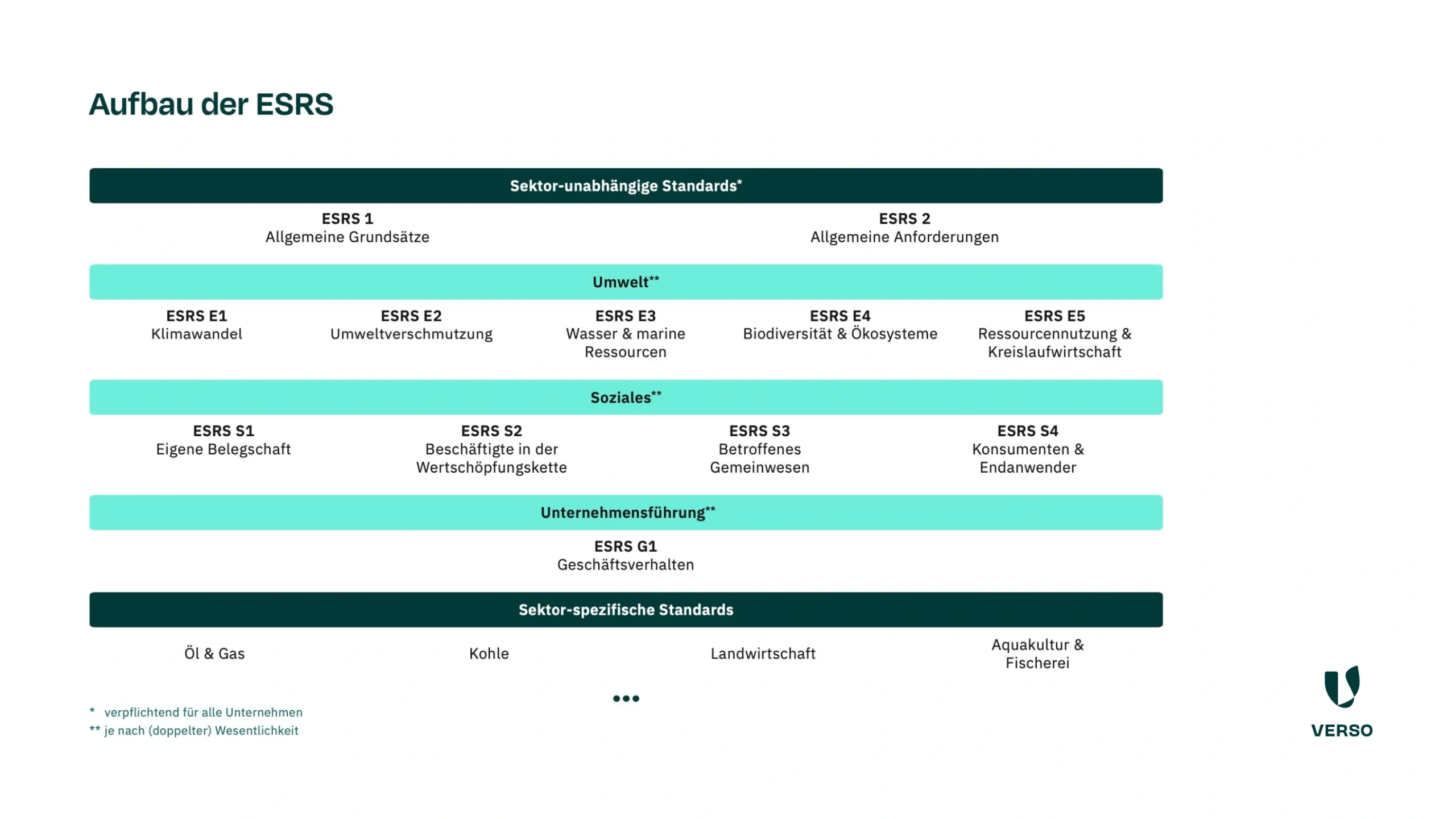
  • An overview of the ESRS structure,
  • In-depth insights into the content of the ESRS standards, and
  • A checklist for identifying the key material data points.

Before we continue

The content on this website is the result of the work of people who immerse themselves in the world of ESG with much passion and care. We take the time to present complex topics in an understandable way and provide practical tips. To prevent our work from being copied or used as AI training material, we ask you to leave us your e-mail address for particularly extensive and detailed content such as this. You will then receive the article as a PDF directly in your mailbox.

Subscribe to our newsletter!

Sign up and receive regular news about:

  • Current ESG topics and legislative changes
  • Individual advice from the VERSO experts
  • News about VERSO
  • Trusted by 250+ customers
Sign up now!

Doppelte Wesentlichkeitsanalyse
27.11.2024

Mastering CSRD challenges: The double materiality analysis in seven steps

Which topics are relevant for the CSRD report?
The answer is provided by the double materiality analysis. In this article, you will learn how to efficiently master the analysis step by step with the support of our AI-based software solution.

The goal of double materiality

With the introduction of the CSR reporting obligation CSRD, the European Union wants to increase the scope of sustainability disclosures. This will make CSR reports more meaningful and comparable.

The impact of the sustainability report will also be increased because the dual materiality contributes to a shift from a shareholder perspective to a stakeholder perspective. The CSR report is aimed at investors, but also at employees, customers and society.

Definition: What is double materiality?

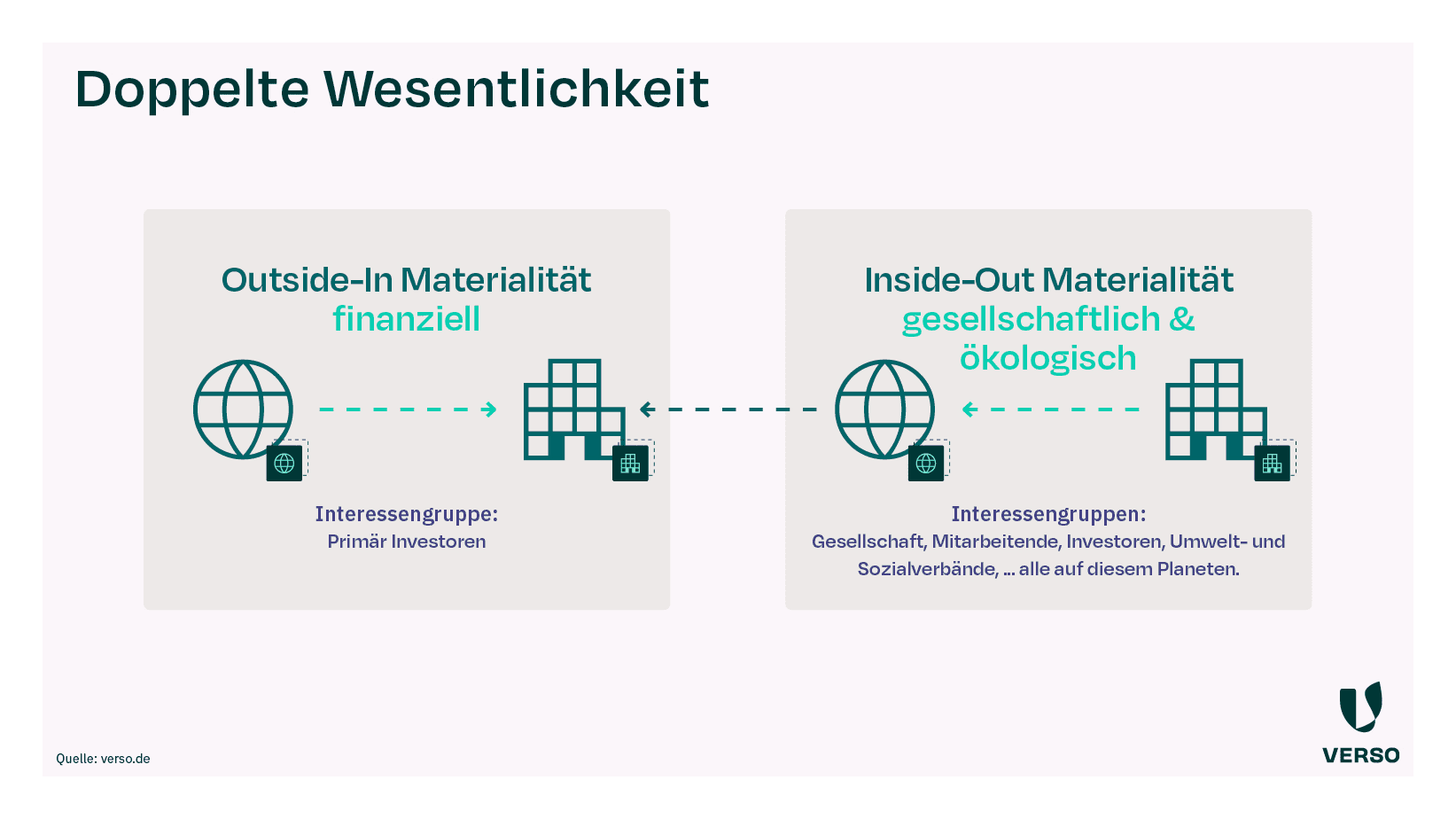
Double materiality means: it must be stated
how sustainability aspects affect the company (outside-in perspective)
AND
how the company affects society and the environment (inside-out perspective). The dual materiality will change the materiality principle used in Germany in particular and lead to significantly more information being relevant to reporting and CSR reports becoming more meaningful as a result. In future, companies will have to state both perspectives – independently of each other – in the sustainability report.

Previously, both aspects had to be fulfilled at the same time. In the case of the outside-in perspective (“financial materiality”), disclosures must be made that are necessary for an understanding of the company’s business performance, results or position. Particularly in the world of finance, this perspective is often the only one considered today and referred to as “ESG” or “ESG-related risks” – in other words, only the risk perspective is considered from a sustainability perspective.

With the inside-out perspective (“environmental and social materiality”), information must be provided that is necessary for an understanding of the impact of business activities on sustainability aspects. In short, it must be explained: What impact does my company have on the planet and society?

Infografik: Erklärung doppelte Wesentlichkeit der CSRD

What is the outside-in perspective in double materiality?

Many companies have so far focused on the outside-in perspective, as it represents a form of risk management. This field will also be covered in the future. The information is primarily aimed at investors. From the outside-in perspective, companies must disclose the following information:

  • How do external developments affect the business model, strategy and sales, among other things? External developments include unexpected weather events, for example, but also stricter regulatory requirements.
  • Industry-specific topics also play a role: Are there sustainability aspects that have already been identified by competitors, customers or suppliers?
  • What are the main risks for the company, a product or a service? And how are they managed or mitigated?

What is the inside-out perspective?

The inside-out perspective significantly broadens the view. Contact persons are not only investors, but also employees, consumers and environmental and social organizations. From the inside-out perspective, companies must disclose how their activities affect society and the environment. The impact of products, services and business relationships (including the supply chain) should also be mentioned here. Information is required on, among other things

Environmental issues:

  • Climate impact
  • Prevention and reduction of environmental pollution
  • Environmental impact of energy use
  • Biodiversity

Social:

  • Health and safety in the workplace
  • Diversity and equal treatment
  • Human rights
  • Social commitment

Governance:

  • Management and control processes
  • Combating corruption and bribery

In 7 steps through the double materiality analysis

1. Create an understanding of dual materiality

In the dual materiality analysis, you determine how sustainability aspects affect your company and how its activities impact the environment and society. The double materiality analysis forms the start and basis for your sustainability reports in the coming years. A high-quality process and a well-founded result are therefore a must.

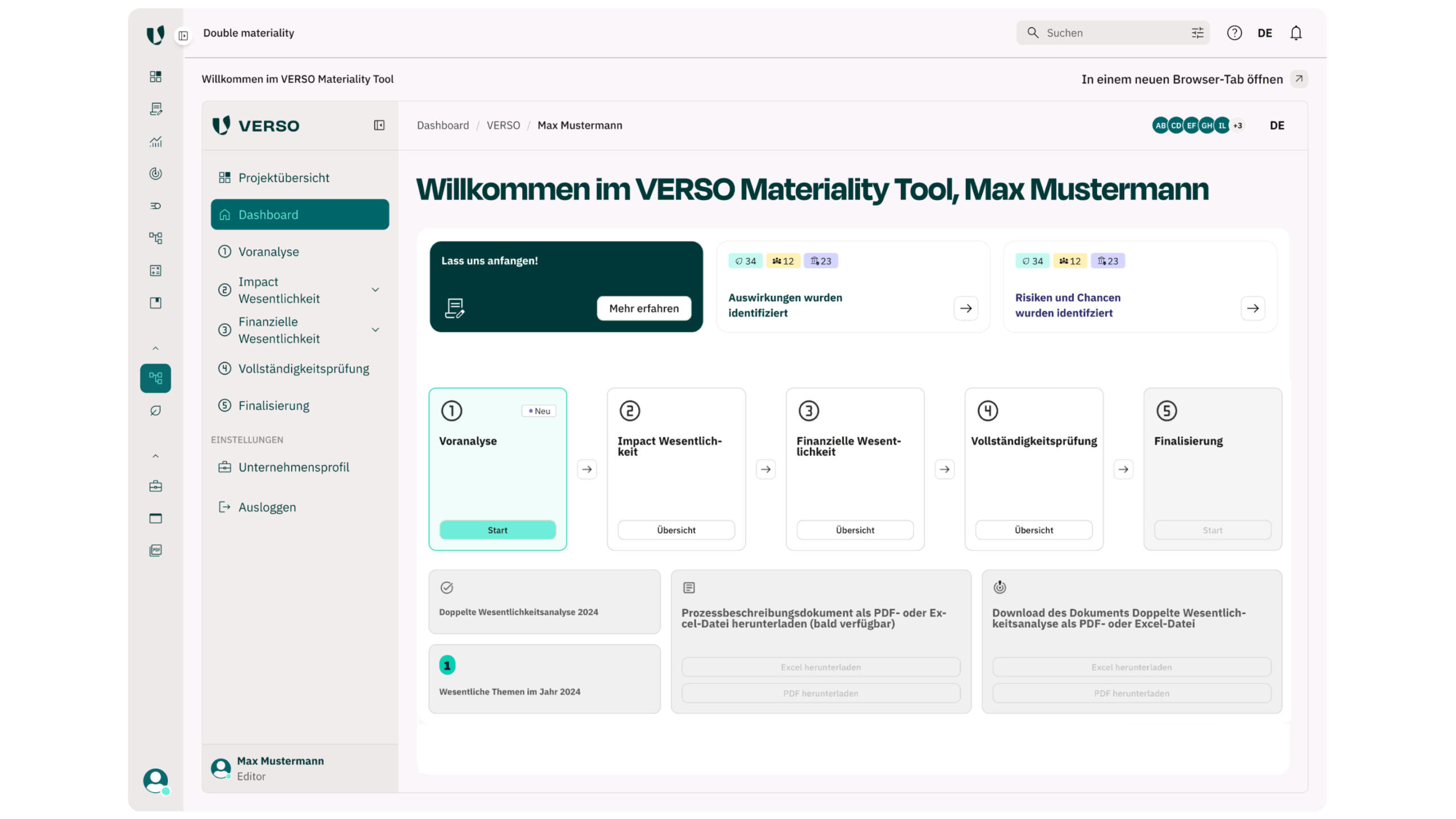
In addition, auditors will audit the materiality analysis process and the finished CSRD report in the future. It is therefore worth going through the analysis in a tool that is recognized by auditors. VERSO’s AI-supported software solution for dual materiality guides you through the process step by step; the auditor can check directly in the tool. First, it is important for you and your sustainability team to take a closer look at the concept of double materiality. Here are some questions that are helpful in this first phase:

  • Are we familiar with the concept of dual materiality? Does everyone in the team understand which perspectives (financial and impact materiality; impacts, risks and opportunities) need to be considered?
  • What are the general conditions of our company, which topics could be relevant from the outset due to the environment, industry and products?
  • Which upstream and downstream economic activities, from raw material extraction to consumption and disposal, are part of the value chain?
  • Do we all understand what the dual materiality analysis process should look like, what our goal is, how we will proceed?
  • Who are important stakeholders (e.g. those affected by impacts; groups with an interest in information) with whom we work and to whom we turn?
  • Have we brought the management team on board and kept them sufficiently informed? Can we count on their commitment?

AI-supported materiality analysis from the industry pioneer

As a sustainability software pioneer, we also have your back when it comes to CSRD reporting: save time, money and nerves with the market-leading solution for double materiality.

2. Create a roadmap for the dual materiality analysis

Once everyone is familiar with the topic and has gained an overview, the next step is to plan the analysis. Fundamental decisions should be made in three areas:

Responsibilities: Clarify who in your team is responsible for what. You can define these responsibilities in the VERSO software. This allows you to assign different levels of authorization and keep track of who is working on which topics at all times.

Time and resource plan: Analyzing dual materiality takes time. Create a schedule and consider what human and financial resources you need. Plan in such a way that you can talk to all affected stakeholders, involve management in the process and also coordinate the results well at the end. Think about all of this in the context of the sustainability report: have you considered the double materiality analysis when preparing the report or do you need to adjust the project plan?

Sources and stakeholders: Consider which methods and with which stakeholders and colleagues you want to carry out the materiality analysis. The ESRS and other frameworks as well as industry standards and findings from the corporate environment provide you with starting points for possible relevant topics.

Einblick in das KI-gestützte Modul zur Wesentlichkeitsanalyse von VERSO

At VERSO, we have already supported many customers throughout the entire process – from the double materiality analysis to reporting. This includes, for example, the Deutsche Automobil Treuhand GmbH (DAT)which also uses the AI-supported VERSO software.

3. Identifying impacts, risks and opportunities (IROs)

A sustainability aspect of the ESRS is material and reportable if the associated impacts, risks or opportunities (IROs) are considered material. Example: If the pollution of wastewater by substances used is a material impact, this must be reported on the data points in the associated standard E2 “Environmental pollution”.

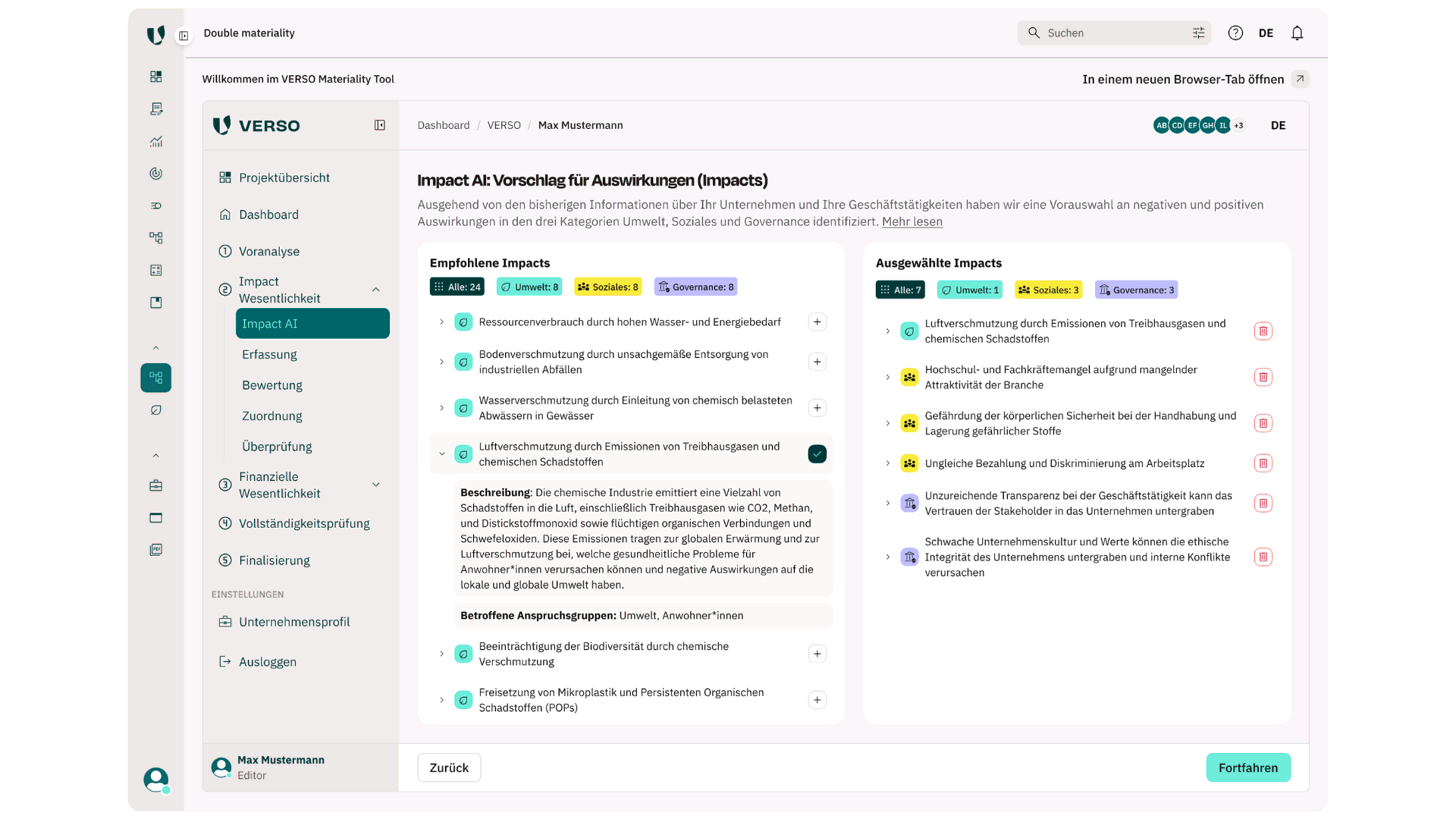
Identifikation der Auswirkungen, Risiken und Chancen (IROs) in der VERSO Software

But how do you get to the IROs?

The IROs can arise from a wide variety of sources, such as industry or company specifics and discussions with various stakeholder groups. Sparring with the VERSO consultants is helpful here. In addition, internal data from whistleblower systems, occupational health and safety information or discrimination cases can provide you with information on relevant ESG issues in your company.

VERSO makes it easier for you to determine the IROs: Based on your information on company activities, NACE codes, locations, industries, etc., our AI module suggests possible material topics. So you don’t start with a blank sheet of paper. You can start directly with individual effects and assign them to the respective topics. Anyone with a little knowledge of the subject will have noticed that our AI-supported materiality analysis module takes a bottom-up approach to IRO identification.

Here, you first identify and evaluate the IROs so that the material topics of the ESRS emerge at the end. You could also do it the other way around – but in our experience, important topics often fall through the cracks.

The bottom-up approach in detail:

  • Identify all actual and potential impacts that your company or your economic activities have or could have on stakeholders along the entire value chain(impact materiality or inside-out perspective).
  • Define which financial opportunities and risks could arise for your company from sustainability issues(financial materiality or outside-in perspective). Here you can build on the results of the impact assessment.
  • Sharpen the IROs to make them as specific as possible. You have clearly listed your collected impacts in the VERSO module. For a CSRD-compliant ESRS report, you must also specify the information and interests of your stakeholders. You must roughly describe which of your material IROs the stakeholders influence or experience impacts on. VERSO’s materiality module saves you time here too: you can enter the affected stakeholders when specifying the material topics and also describe these groups and their impacts in more detail.

Get to know our materiality analysis module

Would you like to try out our AI-supported software solution for analyzing double materiality? Then arrange a demo for the VERSO ESG Hub now and we will answer your questions!

4. Coordinating and sharpening of the IROs with the management

Now it is time to coordinate the preliminary results with your company’s management. The management level has a different view of the company and also knows other perspectives, such as those of investors.

And finally, the dual materiality analysis should be supported by the entire company and form the basis for strategy development – management must be on board for this. It is best to present the results to management directly in our software. The data is clearly presented in the module, but can of course also be exported in the desired format and incorporated into presentations.

5. Definition of the main topics

In order to classify the IROs as material in accordance with the CSRD, they must be assessed according to the ESRS criteria. Among other things, you evaluate the IROs according to

  • Extent,
  • Scope,
  • Immutability and
  • Probability of occurrence.

Attention:
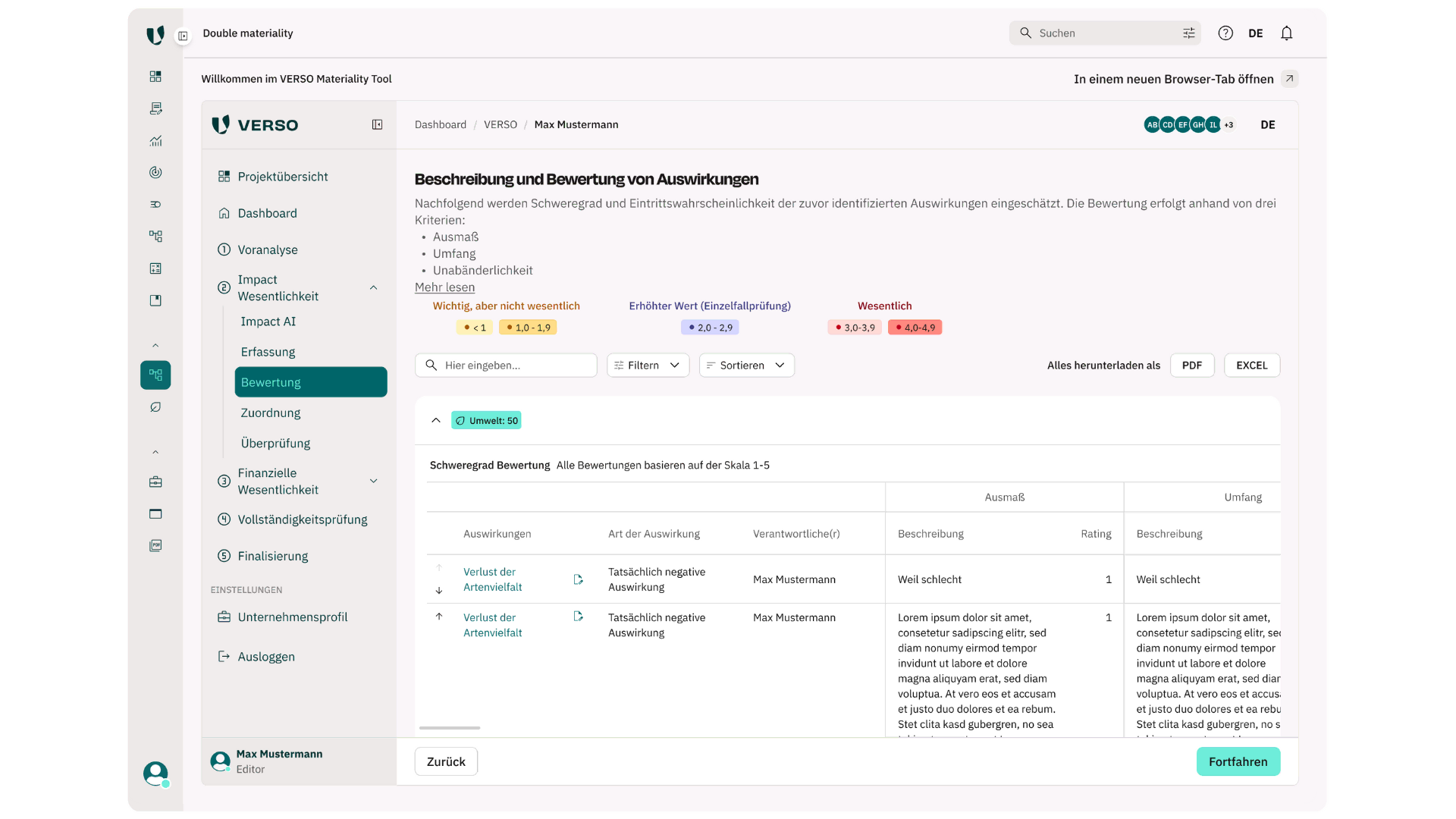
Depending on the type or category of IROs (e.g. actual or potential impact), different assessment criteria must be used. These categories are already stored in the VERSO software. You can select these for your IROs and assess the scope, extent and probability of occurrence with just a few clicks. Suitable threshold values are also already stored in the software solution. They help you to determine the IROs that are actually material for your sustainability report. The software automatically calculates the severity of the respective IRO. At the end, you can see at a glance which IROs are classified as material.

Festlegung und Bewertung der wesentlichen IROs im VERSO Tool

You can easily assign the identified IROs to the ESRS-compliant subtopics in the module. This results in the relevant topics for your report. IROs that do not fit any of the predefined topics can of course still be included and assigned to your own topics in the software.

There is also a completeness check in the VERSO module to check whether you have evaluated and assigned all topics. You will see those ESRS topics and subtopics for which you have not entered any IROs. If such a topic seems important to you, you can refine it in the IROs.

This way, no IRO will slip through. Topics for which you have not identified any material IROs are not included in the reporting obligation. At the end, you have all topics that have been assessed as material from either a financial or an impact perspective. You can present the results graphically in a materiality matrix or in a classic table. According to the CSRD, a graphical representation of the materiality analysis is not mandatory. And that’s it for the analysis itself: with our software, you can save your information in the final step and lock it for editing. The auditor can then check your analysis directly in the module.

This last step is immensely important so that you can guarantee that the materiality analysis process has been carried out in accordance with the CSRD and checked by an auditor. With our software, you can also be sure that your double materiality analysis is ESRS-compliant and audit-proof in accordance with the requirements of the Institute of Public Auditors in Germany (Institut der Wirtschaftsprüfer – IDW). Once the materiality analysis has been completed, the material topics, standards and data points are transferred to the VERSO ESG Hub reporting module so that you can continue directly with your reporting.

6. Definition of measures

The double materiality analysis does not stand for itself: The material IROs serve as the basis for your sustainability report. This shows the status quo and, over the years, the development of your company in the area of sustainability. In addition, the materiality analysis is the basis for your sustainability strategy, in which you define targets and measures.Incidentally, the ESRS already provides you with valuable input for the definition of targets and measures. And you can find out how to approach the CSRD report in the CSRD practical guide.

7. Stick with it, adapt, repeat

A final tip from us: don’t see the double materiality analysis as a one-off project, but as an analysis tool that will accompany you in your sustainability work.

If there are significant changes in the company, you will have to repeat the double materiality analysis. You usually revise individual parts and adapt the analysis annually. This keeps the key IROs up to date and makes your company’s developments measurable.

Get to know the AI-supported materiality analysis directly

The dual materiality analysis is the basis of your CSRD report. We make this process easier and faster for you: with our AI-supported software solution for the dual materiality analysis, you can be sure that your analysis is CSRD-compliant. Try it out for yourself and book a demo where we will show you all the functions.

* This information is summarized editorial content and should not be construed as legal advice. VERSO accepts no liability.

Subscribe to our newsletter!

Sign up and receive regular news about:

  • Current ESG topics and legislative changes
  • Individual advice from the VERSO experts
  • News about VERSO
  • Trusted by 250+ customers

Sign up now!

CSRD-Bericht 10 wertvolle Tipps zur erfolgreichen Datensammlung
04.11.2024

CSRD: 10 valuable tips for successful data collection

CSRD presents companies with new challenges – and this starts with data collection. Processes and responsibilities are often not yet established, and the data must also comply with regulatory requirements. In this article, you will find 10 valuable tips for efficient data collection.

CSRD reporting with its ESRS standards is complex. You have probably already heard this or are perhaps experiencing it yourself. And this complexity is particularly evident when it comes to collecting data for the sustainability report.

A number of questions quickly arise: What data do we need? How detailed does it need to be? Who supplies the data? Who ensures that it is correct? And so on. The European Financial Reporting Advisory Group (EFRAG) is the perfect address to answer all questions relating to data collection. The organization has developed the ESRS, which specify the form and content of a CSRD report. And in its guidelines, it has repeatedly emphasized the importance of comprehensive and structured data collection.

Collecting all the essential information requires well thought-out planning, clear processes and close cooperation between the various departments in your company. The following 10 tips will help you to establish efficient data collection and optimize the preparation of a CSRD-compliant sustainability report.

Stress-free CSRD compliance

Our practical software package supports you every step of the way – right through to the finished CSRD report.

1. start early: set up processes and avoid bottlenecks

The first tip is very obvious, yet it is often forgotten: Start as early as possible!

It is important to set up efficient processes before mandatory CSRD reporting begins. Well-defined and proven processes lead to faster data collection and reduce the risk of errors. Regularly reviewing and adapting these processes ensures that they remain in place even as requirements increase. Those who invest in clean processes at an early stage can therefore meet their regulatory obligations much more efficiently and quickly in the long term.

You must also be aware of this: Data collection is a real time waster. People often underestimate how long it takes to retrieve the essential information. You must not forget: For many departments in your company, your request comes on top of their actual tasks. You should also allow some time for responses from business partners and suppliers.

Various sources and departments are involved, especially when it comes to complex data sets such as the carbon footprint. While consumption data is usually available quickly, it takes much longer to carry out a commuter survey or to collect cross-location information. The information on the ESRS S1 standard (company’s own workforce) also usually takes longer, as a lot of quantitative data is requested here.

Another tip here: Calculate the deadline from the back”! First determine when the sustainability report should be published – in the case of the CSRD, together with the management report. Then go through the individual steps, such as text creation, data collection and analysis of double materiality, right up to the beginning. Allow a little buffer for each task and then you will know when you should start at the latest.

Practical guide: Fit for the first CSRD report

Our practical guide with checklist makes it easier for you to get started and prepare for reporting in accordance with CSRD and the ESRS.

2. double materiality analysis: the foundation for your CSRD report

A central component of CSRD reporting is the dual materiality analysis. This enables you to find out what impact your business activities have on the environment and society and what opportunities and risks exist for your company due to external aspects. These impacts, opportunities and risks (IROs) define which topics are material for your company. The double materiality analysis therefore forms the basis for your data collection, your CSRD sustainability report and your ESG management. You should therefore pay particular attention to this. Errors can lead to missing or inaccurate data. An analysis with substance, on the other hand, will guide you purposefully through the reporting process. Our AI-supported software solution offers valuable support, including time savings in the double materiality analysis.

3. gap analysis: identifying and closing data gaps

Has your company already produced a sustainability report? Is it based on a standard such as GRI or DNK? Then you already have a good template here that you can compare with the CSRD requirements. Carry out a gap analysis and find out what data you have reported in previous years, whether it corresponds to the ESRS formulas and what data is still missing. This will help you determine which processes are already in place and which data collection processes still need to be established or adapted. However, you can also carry out a gap analysis without a previous report. In this case, you first check which data you already have and then determine where there is still room for improvement.

4. identify data sources and define responsibilities

When collecting data, it is not only important what information is required according to CSRD, but also who or wor which department can provide it. You should therefore processes and communication channels up and define responsibilities. In this way, you create clarity, avoid delays and set yourself up for success. hethat data collection will continue continues to run efficiently and smoothly in the future.

5. promote teamwork and a shared awareness

CSRD reporting is a team effort. As you have seen from the previous points, many departments are involved – so teamwork is a must! When preparing reports, you are in close coordination with HR, IT, Finance, Purchasing, Risk Management and other departments. Encourage good and efficient collaboration. In the VERSO ESG Hub, for example, you can define responsibilities for each topic. Every year, when data collection starts again, each person responsible can enter their data directly into the tool. Regular training courses and workshops also raise awareness of sustainability. Involve other departments and inform everyone involved about the latest requirements.

6. set focus and define priorities

Focus on material topics. The double materiality analysis shows you the way here. Please note: The report should concentrate on your efforts in the area of your material topics and fulfill the regulatory requirements. To make the start of reporting a little easier, you should initially refrain from voluntary data points. You should also take advantage of transition periods that have been introduced to ease the burden on companies. You do not have to report on all material topics right from the start. Instead, there are topics for which you are given a settling-in period. Make use of the phase-in regulations that cover many standards. They allow you to skip the disclosures in the first few years or exempt smaller companies from disclosure requirements.

7 Learning from mistakes: The first report doesn’t have to be perfect

The first report does not have to be perfect – you have to understand and accept that. The first step is to establish efficient data collection as part of the CSRD and to set up or improve processes. Do not try to write by hook or by crook about concepts and measures that you have not yet introduced. Instead, set yourself a target for when you want to publish the relevant data – and communicate this openly in your report.

8. ensure granularity of the data

Ensure the right granularity of your data to guarantee the necessary transparency and traceability. Data should be collected in as much detail as possible to enable precise analysis and informed decision-making. Instead of general information on greenhouse gas emissions or energy consumption, it is necessary to collect data down to the level of individual business units, production processes or locations. Overly aggregated information can lead to important details being overlooked. In order to define your goals, you should take sufficient time and, if necessary, hold workshops. The focus should be on what is realistic and sensible for your company in the long term. Choose your goals and measures consciously and avoid adjusting them too frequently. This ensures sustainable and consistent reporting.

The ESRS standards at a glance

The European Sustainability Reporting Standards (ESRS) are intended to make sustainability reports more meaningful and comparable. All information can be found in the whitepaper.

9. quality assurance: check data for reliability

High data quality is the key to a CSRD-compliant sustainability report. It is therefore important that you set up internal control systems that work in a similar way to financial reporting. These controls ensure that the ESG data is accurate, complete and reliable. Data quality plays a key role, particularly with regard to the external assurance required under the CSRD. To ensure high data quality, you should prepare well and read the information in the standards carefully. There you will find the Application Requirements (AR) with detailed instructions. They specify how certain information must be disclosed or measured.

10. use technology: Digital tools optimize data collection

Manual data collection is error-prone and time-consuming. Excel tables quickly become confusing – especially with CSRD with over 1000 data points. You spend a lot of time scrolling back and forth between the individual data points. This is something that costs nerves and that you should save yourself. Software-supported reporting is simpler, more effective and more data-based. And we are not just writing this from our own experience, EFRAG also points this out. Digital tools, especially with AI support, help you to standardize processes and ensure that all essential data is recorded and processed correctly.


Effective data collection: how VERSO supports you

VERSO simplifies and accelerates your entire reporting process – from dual materiality analysis to data collection and reporting. You identify the material topics with the help of our AI-supported software solution. In the VERSO ESG Hub, you collect all material data and create a CSRD-compliant report directly in the tool.

* This information is summarized editorial content and should not be construed as legal advice. VERSO accepts no liability.

Subscribe to our newsletter!

Register now to arrange a free demo appointment and get to know our solutions at first hand.

  • Pragmatic all-in-one solution for ESG reporting, climate and supply chain management
  • Individual advice from the VERSO experts
  • Developed with expertise from 12+ years of sustainability management
  • Trusted by 250+ customers
Tipps & Learnings aus der EFRAG-Studie zu den ersten CSRD-Berichten
04.10.2024

EFRAG study: Learnings and tips for your CSRD report

EFRAG has analyzed some of the first ESRS sustainability reports and published the results in a comprehensive study. Here you can find the lessons learned from the study and our tips for CSRD implementation.

In 2024, some companies published their first voluntary report in accordance with the ESRS (European Sustainability Reporting Standards). EFRAG has analyzed some of these first ESRS reports in a study.

The European Financial Reporting Advisory Group (EFRAG) is an independent EU advisory body that promotes the development of reporting standards, particularly in the area of sustainability. She helped develop the ESRS, the standards for implementing the CSRD. The study provides companies that are dealing with sustainability reporting for the first time with learnings, best practice approaches and assistance. We have taken a look at the comprehensive document and prepared a clear overview for you.

In this article you will receive:

  • Practical approaches to ESRS implementation and their advantages and disadvantages
  • Dos & don’ts for your CSRD report
  • Our 5 top tips for a CSRD-compliant report

Practical approaches to ESRS implementation and their advantages and disadvantages

EFRAG has looked at the previous reports from four perspectives:

  • How did the companies approach the double materiality analysis?
  • How were the data points selected and what was the quality of the response?
  • How detailed was the value chain depicted in the reports?
  • How were the responsibilities in ESG reporting management regulated?

The organization has observed different approaches for these four perspectives, all of which have their advantages and disadvantages. Depending on experience, data situation and organization, different approaches make sense for companies. This overview will provide you with inspiration for implementation in your company:

Topic Preliminary observed approaches Advantages Disadvantages
Double materiality analysis Based on data collection, additional involvement of stakeholders and experts Objective, evidence-based assessment of material topics Quality and efficiency can suffer if little or imprecise data is available and experts are not sufficiently involved
Based mainly on input from external stakeholders and internal participants Broader range of potentially material topics can broaden the horizon Variety of topics can be overwhelming; assessments could be subjective
Data points Evaluation of materiality at the level of individual data points (bottom-up) Preventive sorting out of immaterial data points saves work and streamlines the report to the essentials The concept of materiality at data point level (“Is this data point material for the company?”) is rarely fully understood
Use of phase-in options (omission of data points in the first or second reporting year) Companies can focus better on building the database, the correctness of the report and the structure of processes Comparability (base years etc.) not consistent and possibly misleading; concern about overlooking reporting obligations
Disclosure of all data points without using the phase-in options Ensure that no reporting obligation is overlooked High effort; not all data points may be relevant; lower data quality due to larger reporting scope
Value chain Highly segmented mapping (e.g. according to production stages) Very detailed reporting with a high level of transparency Difficult to find the balance between aggregation and granularity; industry-specific guidelines would be helpful
Rough aggregation (e.g. to total levels of upstream, downstream and own operations) Streamlines the report; an overview without detail is often sufficient for readers Can limit the assessment of IROs at the right level of detail and potentially miss nuances of complex value chains
Go beyond direct business relationships (Tier 1) High transparency; full ESRS compliance Limited data availability, especially for financial institutions; difficulties in application beyond Tier 1 relationships
Focus only on direct business relationships (Tier 1) Data is more available in this area; for some companies only Tier 1 is material Not compliant with ESRS requirements; information distortions and insufficient consideration of material effects in connection with indirect business relationships
ESG report management One person has primary responsibility; often from the sustainability or finance department There is a clear point of contact within the company Training is required to provide managers with comprehensive knowledge of ESG content management and data management
Shared responsibility between departments (e.g. finance and sustainability) Allows responsibility to be shared; skills can be pooled Requires clear governance and regular forums for updates, coordination and decision-making between the departments involved

Dos & don’ts for your CSRD report

Dos:

Structure sustainability reporting clearly: Define clear responsibilities for reporting processes, data delivery, verification, communication, etc. – similar to financial reporting. Involve internal and external experts: Conduct workshops and interviews to obtain in-depth input – especially for your material topics. Communicate the scope, objective and purpose of the report internally and externally: A common understanding of the CSRD reporting obligation promotes consistent data quality and a uniform, readable report.

Don’ts:

Avoid over-aggregating the data: If you make data, processes and descriptions too general or brief, relevant information may be lost. No purely subjective assessments: Greenwashing was yesterday – the CSRD demands evidence for your statements. Always supplement qualitative information with data-based evidence. Do not report superfluous data points: Avoid including more data points than necessary as this can distract from relevant information.

Practical guide: Fit for the first CSRD report

Our practical guide with checklist makes it easier for you to get started and prepare for the CSRD and ESRS.

Our 5 top tips for a CSRD-compliant report

  1. Establish clearly defined processes: Develop clear processes for data collection and reporting – this is the only way to ensure consistency and reliability.
  2. Organize reporting well: Establish clear responsibilities and promote cross-departmental cooperation. All departments must be involved in the implementation of the CSRD.
  3. Carry out a data gap analysis: Use the EFRAG Implementation Guidance 3 to find your gaps in data collection and close them.
  4. Consider the supply chain now: Despite the transition periods, we advise you to start working on the transparency of your supply chains now – because even with a top tool such as the Supply Chain Hub, obtaining supplier data will not happen overnight.
  5. IT integration: Get rid of the clutter of Excel lists and implement software like the VERSO ESG Hub, which is designed to collect and report on over 1,000 data points.

Overwhelmed by the CSRD?

Meet CSRD requirements with ease – with our modular CSRD Suite.

Conclusion

Our conclusion on the EFRAG study: There are different approaches to implementing the CSRD reporting obligation. However, it is becoming apparent that the requirements can only be met if

  • high data quality is available,
  • the focus is on the key topics, disclosure requirements and data points, and
  • the reportable data points are reported in a fact-based and detailed manner.

Centralized data collection and clear communication of requirements are essential for this. Sufficient time and resources should be planned for the materiality analysis. And extensive knowledge (internal and/or external) of the individual requirements is necessary for correct reporting. Do you need support with this? VERSO offers everything from a single source: software, consulting and training.

* This information is summarized editorial content and should not be construed as legal advice. VERSO accepts no liability.
Mann schiebt sein Fahrrad durch Hochwasser. Symbolbild für den Klimawandel, auf den sich ESRS E1 fokussiert
24.09.2024

CSRD and climate: tips on reporting in accordance with ESRS E1

Anyone facing CSRD reporting cannot avoid ESRS E1. Read this article to find out what makes the first environmental standard so important and how you can meet the requirements efficiently!

ESRS E1 – the standard to which (almost) everyone must report

The work on each CSRD report starts with a double materiality analysis. This determines which of the more than 1000 data points of the CSRD your company actually has to report on. The first environmental standard ESRS E1 is an exception. Regardless of the result of the double materiality analysis, every company must basically report on the 230 or so data points required by this standard. Why? Because every company causes emissions and therefore has an impact on climate change. Conversely, every company is likely to be affected by climate change. In short: no company can avoid ESRS E1. At the same time, reporting according to this standard is complex. So let’s go through step by step how to master ESRS E1.

The ESRS standards at a glance

The European Sustainability Reporting Standards (ESRS) are intended to make sustainability reports more meaningful and comparable. All information can be found in the whitepaper.

What is ESRS E1 about?

Data collection and reporting are easier if you know the “why” behind it. ESRS E1 is designed to show you why,

  • … how your company affects climate change (positively and negatively, real and potential).
  • … what risks and opportunities climate change holds for your company and how your company deals with them.
  • … how your company is working to protect the climate – this includes previous and current measures, but also future ones.
  • … the financial consequences of the climate crisis for your company.

The requirements of ESRS E1 can be divided into two subject areas:

  • Mitigation of climate change (“Climate Change Mitigation”): Strategies and measures to limit global warming
  • Adaptation to climate change (“Climate Change Adaptation”): Approaches to strengthen resilience to current and expected consequences of climate change

The data points at a glance

As already mentioned, ESRS E1 is relevant for almost all companies. In total, E1 comprises nine disclosure requirements – but not all of them are immediately relevant or important for every company. Here is a brief overview:

  • E1-1 – Transition plan for climate protection
  • E1-2 – Concepts related to climate change mitigation and adaptation
  • E1-3 – Measures and resources in connection with the climate strategies
  • E1-4 – Goals related to climate change mitigation and adaptation
  • E1-5 – Energy consumption and energy mix
  • E1-6 – Gross GHG emissions in Scope 1, 2 and 3 categories and total emissions
  • E1-7 – Greenhouse gas abatement and greenhouse gas reduction projects financed throughcarbon credits
  • E1-8 – InternalCO2 pricing
  • E1-9 – Expected financial impact of significant physical and transition risks and potential climate-related opportunities

There are also three requirements from the overarching ESRS 2 standard:

  • ESRS 2 GOV-3 – Inclusion of sustainability-related performance in incentive systems
  • ESRS 2 IRO-1 – Description of procedures for the identification and assessment of significant climate-related impacts, risks and opportunities
  • ESRS 2 SBM-3 – Significant impacts, risks and opportunities and their interaction with strategy and business model

Good to know: There are some exceptions to ESRS E1 reporting. In principle, any company can use internalcarbon pricing(ESRS E1-8), but in practice it only makes sense for large companies. ESRS E1-8 is therefore not a mandatory part of every CSRD report. You only have to report on E1-9 from the second reporting year onwards. And Scope 3 data is only mandatory in the first reporting year for companies with more than 750 employees. Nevertheless, a lot of information is requested here. To make matters worse, most of the required data points are not simply available, but must first be determined. This raises the question: What is the best way to approach ESRS E1? Here is your guide to ESRS E1.

Guide for your climate strategy

A holistic climate strategy is more than helpful for climate targets, transition plans and CO2 balances. You can find tips on this in this guide.

Step by step through ESRS E1

The ESRS E1 disclosure requirements make sense in the order just mentioned when reading and reporting/writing. However, if you stick to this order when collecting data, you will be missing important data at the beginning. We therefore recommend the following procedure for data collection instead. During the actual reporting, you then present your results in the actual order: E1-1, E1-2, …

Step 1: ESRS E1-6 and ESRS E1-5

ESRS 1 stands and falls with the GHG balance for Scopes 1 to 3, which serves as a baseline for all further disclosure requirements. Determine your energy balance directly here so that you have all the data to hand in the next steps.

Step 2: ESRS E1-4

Based on your balance sheet baseline, develop or name your short and medium-term climate targets as well as your long-term net zero target. Make sure that your targets are science-based and in line with the goals of the Paris Climate Agreement. Don’t have any targets yet? Then you can also indicate when you will set your targets.

Step 3: ESRS E1-3

Now identify your decarbonization levers. Describe which measures you want to use to achieve the stated targets and which measures have already been implemented. Alternatively, you can specify here by when you want to have developed your measures – similar to the targets.

Step 4: ESRS E1-7

Does your company offset unavoidable residual emissions viaCO2 credits or compensation projects? Then of course you must also report on this. Caution: Be careful here to avoid falling into the greenwashing trap.

Step 5: ESRS E1-1

Now comes your transition plan. Here you describe in detail how your company is working to protect the climate, how you are preparing your company for the climate crisis and its consequences and how your company is making a concrete contribution to limiting global warming. There is a transition period for ESRS E1-1 in the first reporting years.

Step 6: ESRS E1-2

You then name concepts in connection with climate protection and adaptation to climate change – and how you implement these strategies. This includes, for example, internal control elements such as the internalCO2 price according to ESRS E1-8, but also IT and software strategies. Here, too, you can alternatively specify by when you will develop your concept.

Step 7: Reporting

Once the data has been collected, targets set and measures defined to achieve these targets, the next step is reporting.

Practical guide CSRD

Special features, practical examples and stumbling blocks: Our guide makes it easier for you to get started and prepare for the CSRD and the ESRS standard. Including checklist!

Practical tips for implementation

Not all companies manage to report on all disclosure requirements in their first report. Nevertheless, we would like to conclude by giving you a few basic tips on what you should pay particular attention to when reporting on ESRS E1.

Never underestimate the carbon footprint

The carbon footprint must be based on a stable foundation of data. You should therefore carefully consider all of your company’s sources of emissions. From employees’ commute to work to logistics. Even if this means a lot of work, don’t take any shortcuts in the wrong places. The results run like a red thread through the entire standard. All further measures are derived from the carbon footprint. At the same time, you can only achieve your climate targets if they are reflected in the carbon footprint. Thirdly, inaccuracies and errors lead to false claims in climate statements – something that is now sanctioned under the Green Claims Directive. So approach ESRS E1-6 with a keen eye and the necessary level of detail to ensure that the next steps are also successful.

Customize your processes

The enormous amounts of data that need to be collected from a wide variety of sources for ESRS E1 require a high level of transparency about what is going on in your company and your supply chains. Depending on how your company is already set up, new processes and structures may be needed to effectively map the requirements.

Allow sufficient time

CSRD reporting is already very extensive. ESRS E1 in particular takes a lot of time. The carbon footprint alone can take six months – and the climate strategy based on it is also time-consuming. So plan enough time and a buffer!

From carbon footprint to reporting: VERSO supports you!

Probably the most important tip: don’t waste any time. And don’t hesitate to seek support. VERSO helps you with software and advice to meet the requirements of ESRS E1 – from thecarbon footprint and transparent, truthful climate communication to the finished sustainability report.

Stress-free CSRD compliance

Our practical software package supports you every step of the way – right through to the finished CSRD report.

* This information is summarized editorial content and should not be construed as legal advice. VERSO accepts no liability.

Subscribe to our newsletter!

Register now to arrange a free demo appointment and get to know our solutions at first hand.

  • Pragmatic all-in-one solution for ESG reporting, climate and supply chain management
  • Individual advice from the VERSO experts
  • Developed with expertise from 12+ years of sustainability management
  • Trusted by 250+ customers

Get to know the software!

10 CSRD-Tipps
23.09.2024

10 CSRD tips for
ESG managers

“CSRD – what exactly do we need to do?” Many companies are faced with this question. The scope of the reporting obligation and the associated ESRS standards is very challenging. Don’t lose your nerve right away – these 10 CSRD tips will help you get started.

The first glance at the requirements of the Corporate Sustainability Reporting Directive (CSRD) and the European Sustainability Reporting Standards (ESRS) can set the pulse of sustainability managers racing. The CSRD may be challenging, but that’s no reason to panic! Here are 10 CSRD tips for you if you are dealing with the European reporting obligation for the first time.

CSRD tip 1: Clarify whether ESG regulations are affected

Get an overview of the CSRD and whether your company is affected and when you have to report for the first time. Clarify whether you are or will be affected by other ESG regulations. This is because these regulations may or must be covered or taken into account in the CSRD report. The EU Taxonomy, the German Supply Chain Act (LkSG) and the European Supply Chain Directive (CSDDD) are important in this context. An overview of the CSRD can be found in the CSRD factsheet.

CSRD tip 2: Take a closer look at the ESRS reporting standard

In order to understand the scope and requirements of the CSRD for your sustainability report, it is important that you have at least a rough overview of the framework, the ESRS. Don’t worry, you don’t have to read and understand all 1000+ data points: It’s best to take a look at the structure of the ESRS report here. And if you do want to take a closer look, you can download the original version of all ESRS standards from the EFRAG website.

CSRD tip 3: Link theory with practice

There are some companies that have published a CSRD report this year. You can learn from them and get a feel for what your report could look like. However, each company is so individual that you can’t follow one of these reports exactly. Each report has done different things well. But a spoiler first: the CSRD report will probably be closer to the financial report than most previous reports according to GRI or DNK. There is currently a lot of discussion about which direction the sustainability report will take. Here you can find a study by EFRAG on some initial reports.

CSRD tip 4: Understanding the double materiality methodology

The basis of the CSRD report is the dual materiality analysis. The materiality analysis has been around for some time, but the principle of dual materiality to identify sustainability issues relevant to reporting has only become mandatory with the CSRD. The ESRS prescribe a specific process for this, which must be documented. It is important to critically question: What is our knowledge and capacity for materiality analysis? Can we do this internally or do we need external help? Our experience shows: Bringing in external consultants is definitely helpful – if only to be able to draw on their experience when evaluating and selecting topics. Details on analyzing double materiality can be found in our 7-step guide. You can also get a good overview of the method in EFRAG’s Implementation Guideline and in the DNK’s supporting documents.

The challenge of the first sustainability report

A company’s first ESG report is always particularly time-consuming.
We have created a practical guide for your first sustainability report.
You will be guided step by step through the process of creating a meaningful sustainability report.

CSRD tip 5: Create resources and expertise for the CSRD project

CSRD is a major challenge and not a one-off project. One sustainability manager alone is often not enough. Take a realistic look at the to-dos: What resources do we need for implementation? Are additional skills or training necessary? Do we need to hire someone? In the event that know-how is not enough, you are sure to find the right training course at the VERSO Academy.

CSRD tip 6: Plan the process in detail

There are some steps in CSRD reporting that require either a lot of time, a lot of coordination with internal stakeholders or both. It is therefore important that the process is realistic and forward-looking. You should also allow for buffers and plan a little more generously. You should keep the following milestones in mind:

  • When do we want to publish the report?
  • Are there any time constraints that we need to consider (vacations, other projects?)
  • When do we write the report?
  • Who needs to be involved in the process and when?
  • When do we collect the data?
  • When do we do the dual materiality analysis?
  • When do we have to start?

CSRD tip 7: Determine contact persons

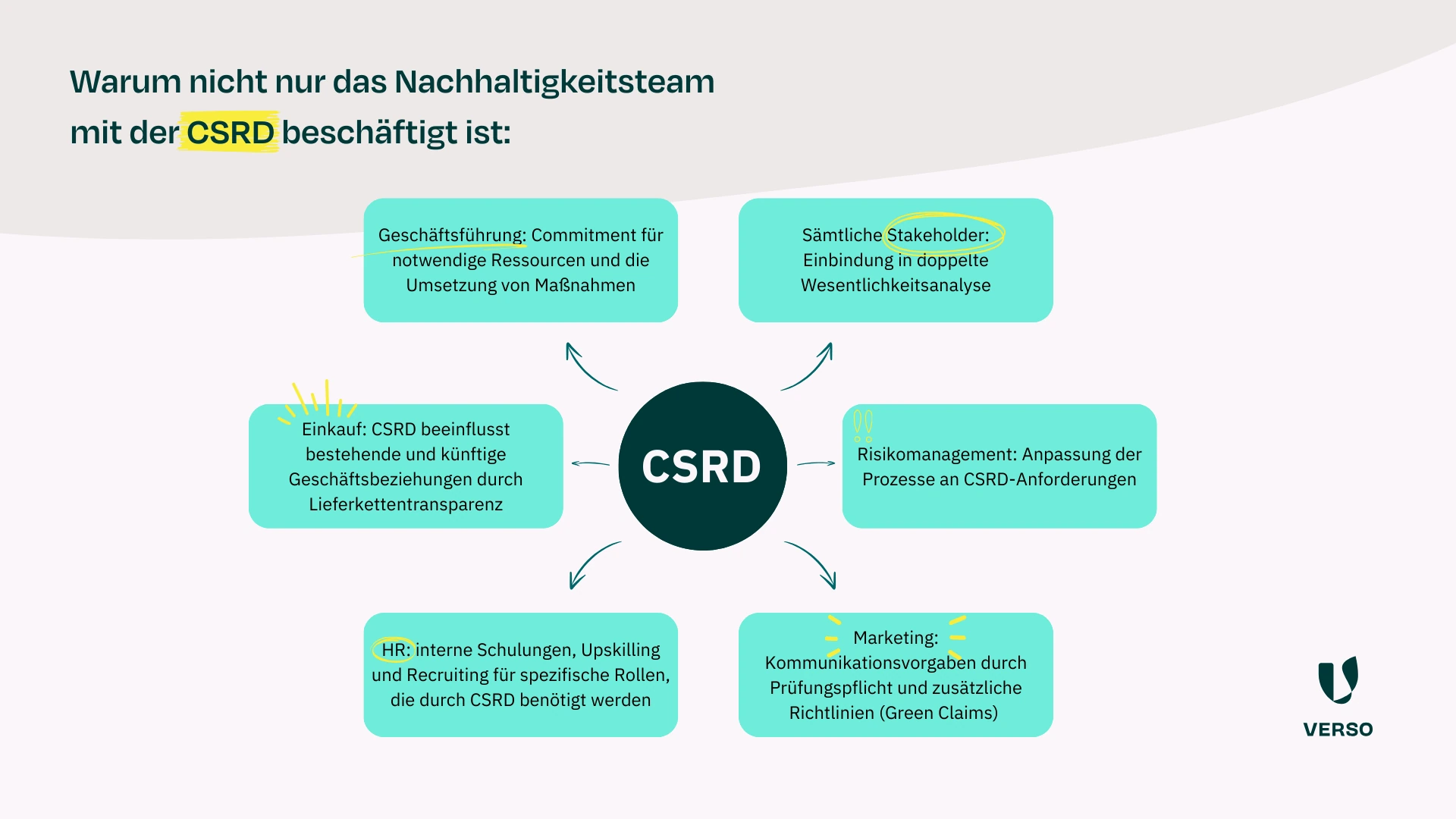
Reporting is a team effort: in addition to the sustainability managers, the implementation of CSRD requires the involvement of a wide range of departments within a company. Determine your contact persons from the teams at an early stage, get them on board and clarify responsibilities. We have summarized which teams are involved in CSRD, why and how in a graphic.

CSRD betrifft das ganze Unternehmen – Geschäftsführung, Stakeholder, Risikomanagement, Marketing, HR, Einkauf.

CSRD tip 8: Develop a process for data collection

You will need lots and lots of data for your CSRD-compliant sustainability report. This quickly raises the question: How do we collect the data? Establish a process that is as seamless as possible. And then: Where do we collect the data? Yes, this can be an Excel list, but experience has shown that this quickly becomes confusing. Our recommendation: use sustainability software for this.

CSRD tip 9: Take a strategic view of sustainability

The CSRD actively asks for a sustainability strategy – you need a concept for each individual key sustainability aspect. You also need to show how sustainability is anchored in the corporate strategy. Here are tips for developing a sustainability strategy.

CSRD tip 10: Don’t forget the supply chain

Although you can extend the transition period here, sooner or later you will need the data from the supply chain. And experience shows that you can’t achieve supply chain transparency overnight – it’s a longer process. Therefore: send out questionnaires now, carry out assessments and get an overview of the supply chain – preferably directly via a central tool such as the VERSO Supply Chain Hub.

Overwhelmed by the CSRD?

Make CSRD as easy as possible: Our new CSRD Suite provides tools and support for every stage of CSRD compliance.

Our bonus tips:

Finally, we have two bonus tips for you: How should the process of creating a sustainability report be optimized? The guide with 7 steps to the sustainability report will help you. And if you want to delve deeper into CSRD reporting, we have a comprehensive guide for you: CSRD practice guide.

* This information is summarized editorial content and should not be construed as legal advice. VERSO accepts no liability.

Subscribe to our newsletter!

Sign up and receive regular news about:

  • Pragmatic all-in-one solution for ESG reporting, climate and supply chain management
  • Individual advice from the VERSO experts
  • Developed with expertise from 12+ years of sustainability management
  • Trusted by 250+ customers

Sonnenstrahlen brechen durch Wolken hindurch – Symbolbild für die Chancen, die die CSRD bringt, auch wenn sie erst einmal wie belastende Bürokratie wirkt
07.08.2024

Why the CSRD is more than bureaucracy

Despite the many requirements, working on the CSRD report creates a profound awareness of genuine sustainability. Even if the CSRD is primarily a bureaucratic obligation, it also conceals valuable opportunities for business. Read this article to find out what these are.

The first companies have already published their CSRD report, and many more have yet to do so. In Germany alone, around 15,000 companies are affected by the new EU directive on sustainability reporting. And if we look a little further: Across Europe, a total of around 50,000 companies will have to report in accordance with the CSRD in the coming years.

What is the aim of the CSRD?

The CSRD is primarily intended to improve the transparency and comparability of sustainability reports, but also to close gaps in previous reporting obligations. To understand this, it helps to look back at the past of sustainability reporting. Sustainability reporting used to be voluntary for companies, was subject to no or only a few rules and often ended up as a kind of marketing brochure.

The first EU directives then put a stop to this. However, the CSRD now goes one step further. On the one hand, a whole host of companies are affected by the new reporting obligation, from small and medium-sized enterprises to large corporations. Across Europe. And in some cases even beyond the EU.

On the other hand, there are stricter rules: All disclosures must now be verifiable and signed off by auditors. The CSRD also requires significantly more and more in-depth quantitative and qualitative data. This should make the reports more comparable.

In this way, the EU wants to drive forward the sustainable transformation of the economy.
At the same time, the CSRD is a sensible response to the growing expectations of investors, customers and society as a whole. Companies are increasingly being held accountable for their sustainability performance – and more and more often, sustainability efforts also form the basis for economic success.

In a nutshell: CSRD makes sustainability transparent and comparable, creating the basis for us to steer our economy towards a more sustainable future in a targeted manner. “That sounds all well and good,” you may be thinking, “but what’s the point of all the pink clouds if I’m sitting here at my desk and can’t see sustainability for all the data?”

Overwhelmed by the CSRD?

Make CSRD as easy as possible: Our new CSRD Suite provides tools and support for every stage of CSRD compliance.

Awareness arises from bureaucracy

PwC recently published a study according to which the majority of the companies surveyed were confident: Yes, we will be ready for our new reporting obligations by the deadline. The respondents were mainly listed companies with an annual turnover of over one billion. However, we know from our own experience that small and medium-sized enterprises in particular are groaning in the face of the work involved in preparing and implementing the CSRD.

They tend to have mixed feelings about the CSRD. “The CSRD is just another useless bureaucracy that will create a burden, stress and work and tie up considerable resources, but ultimately won’t change anything at all.” This and similar criticism of the new directive is often voiced. And yes – of course there is a lot of bureaucracy behind the new laws and reporting obligations relating to sustainability.

A lot of data has to be collected, a lot of time is spent on preparation and implementation and a lot of employees are involved. However, in our work with our customers, we see time and again that anyone who writes sustainability reports and takes an in-depth look at the topic of sustainability also recognizes the potential of CSRD.

Practical guide: Fit for the first CSRD report

Our practical guide with checklist makes it easier for you to get started and prepare for the CSRD and ESRS.

More than just a bureaucracy monster: 6 potentials of CSRD for your company

Despite (or perhaps because of!) the many requirements, working on the CSRD report creates a profound awareness of genuine sustainability. So even if the CSRD is primarily a bureaucratic obligation, it conceals valuable insights and potential. And let’s take a look at them now.

1. the CSRD promotes a better understanding of one’s own risks and opportunities

Before the actual CSRD report is prepared, the double materiality analysis is carried out. Here you determine:

  • How do sustainability aspects influence your company?
  • What impact does my company have on the environment and society?

Background: The ESRS, the CSRD framework, lists over 1,000 possible data points for the report. In the end, however, only selected data points such as ESRS 2 and those whose associated impacts, risks and opportunities (IROs) you have determined to be material are required to be reported. On the one hand, the double materiality analysis gives you clarity as to what belongs in your CSRD report. On the other hand, it also gives you a very helpful picture of how your company relates to the environment and society. You also get a crystal-clear overview of the risks your company could still face – where undiscovered opportunities for the future of your company lie dormant – and how your company is developing. Find out more in our article “The double materiality analysis in 7 steps”.

The ESRS standards at a glance

With the CSRD, the EU is also introducing uniform European standards.
The European Sustainability Reporting Standards (ESRS) are intended to make sustainability reports more meaningful and comparable.
All information can be found in the whitepaper.

2. the CSRD brings economic benefits, supports innovation …

The majority of decision-makers surveyed in a Noerr study assume that ESG will bring about change in the company. However, the transformation of business models in turn requires comprehensive adjustments to product development, internal processes and management.

This is where the wealth of data you collect and analyze for CSRD provides useful insights. Where are resources still being wasted without this being noticed? Which processes that “we’ve always done this way” could be optimized – and thus promote not only sustainability but also efficiency? Where do we need to rethink in order for the sustainable transformation to succeed? These are just a few situations in which ESG data management lays the foundation for a sustainable future.

In the best case scenario, you don’t just write your CSRD report for the sake of it, but take something away from it for the success of your company.

3. … and strengthens the resilience of your company

Let’s take a concrete example: ESRS E1, the “climate change standard”. Here you have to report, among other things,

  • how your company has a positive and negative impact on the climate,
  • which climate protection measures you implement,
  • what risks and opportunities arise from climate change,
  • and how to adapt your company to climate change.

The smaller the company, the greater the likelihood that the issue of climate change will not necessarily be a high priority due to time constraints – i.e. it will be postponed for the time being without the CSRD. However, the first consequences of climate change are already making themselves felt. And will occur more frequently in the future. Heavy rain, floods, heatwaves, droughts and fires can paralyze production facilities, lead to staff absences, cause supply chain delays or destroy transport routes. 55% of managers surveyed in Germany in a Capgemini study estimate that climate change will cause the majority of operational disruptions in the coming years. So it only makes sense to look at what climate change means for your company and how you can counteract it. And in the course of CSRD, you approach such and similar considerations in a very structured way.

CSRD: 10 tips for successful data collection

CSRD presents companies with new challenges – and this starts with data collection. Our article gives you 10 tips for efficient processes.

4. solid sustainability reports create trust

Investors and other stakeholders are now looking very closely at what is happening in your company in terms of sustainability. Sustainability reports are a great way to communicate your status quo and your ambitions in this area. The best way to do this, however, is with a reporting standard that specifies uniform requirements for all companies concerned in order to ensure maximum comparability. As we wrote at the beginning, CSRD transforms sustainability reports into transparent and, above all, verifiable documentation of your sustainability journey.

And if we want to look at things from a negative perspective: Intentional and grossly negligent errors in the CSRD report are punishable by, among other things, “naming and shaming” – i.e. public disclosure. If your company violates its CSRD reporting obligations or attempts to falsify data, this can ruin its reputation and trust. In this respect too, it is therefore worth seeing the CSRD as an opportunity and implementing it conscientiously. You can find more information on the possible sanctions in our article “The cost of mistakes in reporting and implementing sustainability.”

5 The CSRD report as a repository for fact-based sustainability communication

Once you have identified stakeholders, determined opportunities and risks, set up strategies and collected ESG data from all possible areas as part of your CSRD obligation, you have one thing in addition to the report: a very useful repository of information. This, in turn, is ideal for any sustainability communication outside of the report.

After all, this is also becoming increasingly important. Here we would like to quote a Capgemini survey once again: 77% of consumers surveyed are changing their purchasing behavior in favor of more sustainability. 66% are even specifically looking for sustainable products. Conversely, 36% of the companies surveyed also stated that Our customers are not interested in sustainability! This shows a major perception gap that needs to be closed.

The best way to do this is with comparable reports that are checked by a third party (you guessed it: the CSRD…). This is what 34% of consumers surveyed in a Deloitte study would like. Fact-based sustainability communication is also beneficial when it comes to recruiting talent and employee satisfaction. According to the EIB Climate Survey 2023, 56% of people surveyed value an employer that thinks and acts sustainably. According to a Gartner survey, a strong ESG culture even boosts employee engagement by up to 43%.

6 ESG data facilitates access to credit

It’s not just investors and the public who are demanding ESG measures, but also banks and credit institutions. Just as a disability insurer is interested in whether you prefer to solve crossword puzzles or skydive in your free time when taking out insurance, financial institutions are now increasingly looking at ESG risks when granting loans. The list of questions is based on the CSRD, among other things. This means that if you are already collecting ESG data for the CSRD anyway, you will have it to hand more quickly when applying for financing. Read more about this in our article “ESG in financing: This data decides on loans”.

Conclusion: CSRD is worthwhile in many respects – and it doesn’t have to be complicated at all

Let’s summarize once again. CSRD helps you to identify risks and opportunities for your company in a targeted manner. It provides your company with economic advantages and can even become a driver of innovation. Furthermore, it strengthens your company’s resilience in the long term if you take a close look at sustainability.

Externally, CSRD promotes the trust of your stakeholders and serves as a basis for general sustainability communication, which in turn appeals to customers and employees. Last but not least, the data once collected will help in future when granting loans. It’s exciting to see the wide-ranging effects of this report, which seems so dry at first, isn’t it?

And the best thing is that CSRD doesn’t necessarily have to be a nerve-wracking challenge.
With software and advice at eye level, VERSO will guide you step by step through the CSRD process. For example, with our new AI-supported module for audit-proof double materiality analysis. Or with our all-in-one solution for ESG management and ESG reporting – including carbon footprint and supply chain transparency.

Feel free to contact us!

* This information is summarized editorial content and should not be construed as legal advice. VERSO accepts no liability.

Subscribe to our newsletter!

Register now to arrange a free demo appointment and get to know our solutions at first hand.

  • Pragmatic all-in-one solution for ESG reporting, climate and supply chain management
  • Individual advice from the VERSO experts
  • Developed with expertise from 12+ years of sustainability management
  • Trusted by 250+ customers

CSRD und Lieferkette - Was der Einkauf beachten muss
17.06.2024

CSRD and supply chain: What procurement needs to consider

The CSRD with its ESRS standards is not only a lot of work, it also has a major impact on companies: This is because you have to make extensive ESG disclosures – and not only look at your own company, but also at the supply chain. Read here what purchasing departments need to consider and what opportunities and risks arise from the EU directive.

The CSRD (Corporate Sustainability Reporting Directive) has applied to the first companies since January 2024, and others are gradually being added. Ultimately, around 50,000 companies in Europe will be obliged to publish a report with comprehensive information on ESG (environmental, social and governance) issues.

The ESRS, the European Sustainability Reporting Standards, were also introduced with the CSRD. For the first time in the EU, they provide a standardized framework for the preparation of a sustainability report – in simple terms: which ESG information is required and in what form it must be reported.

It is important to note that the reporting obligation not only relates to the company itself, but also extends to the entire value chain. In this blog post, we look at the upstream value chain – i.e. the supply chain. And this is where companies subject to CSRD reporting requirements can quickly run into problems: they need a lot of information from their suppliers and the data situation is often inadequate – according to the Bertelsmann Stiftung’s Sustainability Transformation Monitor 2024. With VERSO, you can master this challenge. Our Supply Chain Hub creates transparency in the supply chain and enables you to analyze risks, develop targeted measures and comply with reporting obligations. We will now take a closer look at these disclosure requirements within the framework of the CSRD and the impact on purchasing.

CSRD and supply chain: What needs to be reported?

The CSRD demands a lot from companies: the ESRS comprises around 1150 data points and over 100 of these relate to the supply chain. Purchasing is therefore an important player in the reporting process.

The information involved can be roughly summarized as follows: The ESG report must contain information on environmental and social IROs (impacts, risks and opportunities) in the supply chain as well as measures related to the IROs. If your company is affected by the LkSG, you will probably recognize some disclosure requirements and can realize synergies: This is because some BAFA requirements overlap with the ESRS.

Bei den ESRS gibt es sektorunabhängige Standards und sektorspezifische Standards. Die Sektorunabhängigen Standards teilen sich in die Bereiche Allgemeines, Umwelt, Soziales und Unternehmensführung. Die Allgemeinen Standards sind verpflcihtend für alle Unternehmen, die Themenstandards sind je nach doppelter Wesentlichkeit berichtspflichtig oder nicht.

But what does this mean in detail? To answer this question, let’s take a closer look at some ESRS standards and clarify how they relate to the supply chain.

ESRS E1 – the climate protection standard

The name says it all: ESRS E1 is about climate protection – in your company and in your supply chain. Your company must therefore not only disclose its own greenhouse gas emissions, but also the CO2 emissions in the upstream and downstream value chain – i.e. in Scope 3. Incidentally, the majority of companies generate the most emissions in this category.
E1 also requires companies to set themselves climate targets. Transparency about the targets and measures of their own suppliers is crucial in this respect.

ESRS E5 – Resource utilization and circular economy

The supply chain naturally plays an important role in ESRS E5, as many resources are obtained or processed here. For example, the CSRD asks for:

  • Measures to avoid the generation of waste
  • Resource utilization
  • Measures to promote the circular economy
  • Cooperation or initiatives to improve the recyclability of products and materials


ESRS S2 – Workforce in the value chain

The fact that the ESRS S2 also relates to the supply chain and entails disclosure obligations is already in the name, so to speak. Among other things, the CSRD is concerned here with how your company fulfills the due diligence obligations. This means How do you Ensure compliance with human rights, labor standards andgood working conditions at suppliers? The CSRD does not require much more than the LkSG. You should also show whether there is a complaints management or whistleblower system for workers in the supply chain, how you handle complaints and resolve any problems raised.

ESRS S3 – Affected communities

The ESRS S3 addresses the impacts that your company’s operations, products or services, and upstream and downstream value chains have on “affected communities”. This refers to people and groups who live or work in the same area as a company. The standard also explicitly refers to impacts on indigenous peoples. Impacts can arise, for example, from truck transportation, the extraction of raw materials or controversial land use.

ESRS G1 – Company policy

With regard to the supply chain, your company must disclose the following:

  • Management of relationships with suppliers, payment practices, in particular with regard to late payments to small and medium-sized enterprises
  • Strategies for detecting and preventing corruption and bribery, including training for suppliers

However, you do not have to provide information on every standard in your CSRD report. This depends on whether a topic is material for your company. VERSO offers you an AI-supported materiality analysis here. In our white paper “All information on the ESRS” you will also find further detailed information on the European standards, in particular on the transition periods.

Is your purchasing department ready for the ESG requirements?

Companies are now affected by a large number of sustainability requirements – and purchasing is no exception.
Use our checklist to find out whether your purchasing organization is optimally prepared for ESG requirements.

CSRD and the supply chain: opportunities and risks for procurement

The CSRD is a major challenge – we can’t hide that and we don’t want to. With almost 1200 data points, ESRS reporting is a mammoth task. It is complex and resource-intensive. But with the right support, you can manage it – we will be happy to assist you with the sustainable transformation. What’s more, the CSRD doesn’t just end with a sustainability report.

The fact that your company is systematically addressing the issue of sustainability opens up great opportunities. The double materiality analysis and reporting will make opportunities and risks in the supply chain more visible. This enables your company to address these in a targeted manner. Sustainability requirements can trigger innovations, such as the use of environmentally friendly materials or the optimization of logistics processes.

Many customers also tell us that the reporting process has enabled them to get to know their suppliers even better. The increased transparency ensures better and more sustainable supply chain practices. By working closely together, you strengthen long-term partnerships and thus improve the stability and efficiency of the supply chain. The reporting process promotes digital development. Software specialized in CSRD, LkSG and CBAM requirements helps monitor the supply chain and ensures compliance with legal requirements. It can collect and process the necessary large volumes of data.

Risk management for sustainability in the supply chain

In our white paper, you will learn how to implement the requirements of the German Supply Chain Act (LkSG) in a future-proof manner through digitalization and collaboration.

How does CSRD influence purchasing and the supply chain?

CSRD has a major impact on purchasing and requires a high degree of transparency and responsibility. Your company must collect and provide detailed information and comply with legal due diligence obligations in relation to environmental and social standards. This includes a new assessment in the purchasing process to ensure that suppliers comply with sustainability requirements.

So you need to be even more careful about who your company does business with.
Teamwork is also required when it comes to climate change. Climate change and extreme weather will affect us all. That’s why we need to act together to slow down climate change and reduce its impact.

Climate protection measures must not stop at the gates of your own company: Together with your suppliers, you can implement initiatives that help reduce greenhouse gas emissions.
You can find specific tips for decarbonizing your supply chain in the blog post “Why is climate protection in the supply chain relevant?”.

How VERSO supports you in implementing the CSRD

VERSO offers you the all-in-one package for implementing the CSRD. The EU directive makes the topic of sustainability in the supply chain even more relevant, as companies must now also report robustly on sustainability activities in the supply chain. The VERSO Supply Chain Hub helps procurement to record the necessary data in the supply chain, monitor suppliers and provide the required reporting key figures with minimal effort.

We round off the package for implementing your CSRD obligations with additional software solutions and consulting services. With VERSO, you can carry out an AI-supported materiality analysis. In the ESG Hub, you collect all relevant data and create a meaningful sustainability report. The Climate Hub supports you with your carbon footprint and decarbonization strategy. And in the VERSO Academy, you will acquire the necessary knowledge about CSRD and ESRS.

* This information is summarized editorial content and should not be construed as legal advice. VERSO accepts no liability.

Subscribe to our newsletter!

Sign up and receive regular news about:

  • Pragmatic all-in-one solution for ESG reporting, climate and supply chain management
  • Individual advice from the VERSO experts
  • Developed with expertise from 12+ years of sustainability management
  • Trusted by 250+ customers

Get to know the software!

Ältere Frau arbeitet am Laptop und guckt sehr konzentriert
15.05.2024

Sanctions at a glance: The cost of mistakes in reporting and implementing sustainability

A slap on the wrist and, if it becomes public, a brief outcry from the public: until a few years ago, companies didn’t have to worry too much if they put sustainability on the back burner or engaged in greenwashing. This is now a thing of the past. Read here about the consequences if the new requirements are not implemented correctly – and get tips on how to do it right!

Some simply lack an overview of their own data. Others are overwhelmed by the numerous requirements of the new ESG regulations. Still others underestimate the effort involved and start far too late. And then, of course, there are companies that try to cover up their lack of commitment to sustainability with falsified information. The possible reasons for inadequate implementation of the new regulations in sustainability, climate and supply chain management are as varied as the people who implement them for their companies.

Until a few years ago, there were hardly any consequences. There might have been a shitstorm and a few calls for a boycott, but over time – or a lot of PR work – these soon petered out. However, with the introduction of the new regulations and guidelines for sustainable business practices, which are being rolled out across Europe as part of the Green Deal, this is now a thing of the past. Errors and misrepresentations can be expensive. How expensive exactly? We have summarized this for you in this article – including recommended reading to help you get it right!

This information is editorial content that should not be construed as legal advice. VERSO accepts no liability.

Stress-free CSRD compliance

Make CSRD as easy as possible: Our new CSRD Suite provides tools and support for every stage of CSRD compliance.

Sanctions for EU taxonomy, CSRD and SFDR

As far as uniform sanctions are concerned, the trio is unfortunately still rather incomplete. This is because the three directives have yet to be transposed into national law. Each EU member state must independently determine the extent to which it wishes to sanction errors in financial and non-financial reporting. In line with the CSR-RUG – the predecessor of the CSRD – errors in reporting in accordance with the CSRD, SFDR and EU taxonomy will presumably also be penalized in accordance with §331 and §334 HGB. In figures, this means

  • Prison sentences of up to 3 years
  • For members of authorized representative bodies or supervisory boards of a corporation: prison sentences of up to 3 years; companies face fines of up to 2 million euros or twice the economic benefit they have derived from the incorrect report – whichever is higher.
  • For capital market-oriented companies: Fines of up to 10 million euros, 5 percent of annual turnover or twice the economic benefit – the highest amount is also chosen here.

On top of this – as the fermented icing on the cake, so to speak – there may also be legal action for breach of competition law, exclusion from public procurement procedures and “naming and shaming”, i.e. publicity including loss of reputation.

Important to know: Only intentional errors and errors due to gross negligence are punishable. Incidentally, the Auditors’ Association wants to relax the CSRD for auditors: With a cap on the amount of liability and limited liability for gross negligence. However, this demand has been heavily criticized – so there is still some way to go here. From 2025, the first court proceedings will show the exact direction of sanctions for breaches of the EU taxonomy, CSRD and SFDR.

Read more:

Practical guide to CSRD

Our practical guide, including a checklist, will help you prepare for CSRD reporting.
Find out what challenges there are and how you can overcome them.

Sanctions for LkSG and CSDDD

CSDDD

After a long back and forth, an agreement was reached in March 2024 on the CSDDD; the European supply chain law. Here, too, there is still some time before it is transposed into national law. However, the liability and sanction framework in the event of a breach of the due diligence obligations for people and the environment enshrined in the CSDDD is already clear. Affected companies are liable for all damages that occur along the upstream supply chain due to inadequate or missing risk prevention or remedial measures – unless these are caused by a business partner. In other words:

  • If your company knows about irregularities and ignores them, supervisory authorities can impose fines of up to 5% of global turnover.
  • Civil liability will also be introduced.
    Those affected can therefore assert claims against your company with the help of NGOs or trade unions, for example.
  • There is also the threat of naming and shaming and exclusion from public procurement.

LkSG

In contrast to the CSDDD, there is no civil liability under the German Supply Chain Act. However, there are expensive fines if the legal obligations are not complied with. Under the LKSG, these include environmental and human rights due diligence obligations towards indirect suppliers and, if known, also towards direct suppliers. Under the LkSG, risks must also be identified, documented and then eliminated or at least minimized. Otherwise there is a risk of fines of up to 8 million euros. For companies with an annual turnover of more than 400 million euros, the fine increases to up to 2% of global annual turnover. And: companies can be excluded from public procurement.

Read more:

EU ETS and CBAM sanctions

EU ETS

With the EU Emissions Trading System (EU ETS), the EU aims to cap the emissions of the member states. Companies only have a certain amount of freedom to emit emissions – otherwise certificates must be purchased. Non-compliance could result in fines:

  • 100 euros per metric ton of CO2 equivalents emitted without a certificate

In order to avoid certificate prices on the one hand and sanctions on the other, some companies relocated their production to non-EU countries (“carbon leakage”). The CBAM was therefore also introduced as part of the EU ETS reform.

CBAM

Since January 2024, the CBAM reporting obligation has applied to all companies that import certain emission-intensive goods from non-EU countries. The so-called “climate tariff” supplements the EU ETS – and entails a whole range of possible sanctions:

  • Transitional phase: If the CBAM report is incomplete, contains incorrect information or is not submitted at all, or is not corrected after being requested to do so, a penalty of 10 to 50 euros per ton of unreported emissions will be imposed.
  • Implementation phase: In accordance with the EU ETS, fines of EUR 100 per tonne of CO2 equivalent are imposed for missing certificates.
  • Anyone importing CBAM goods without the status of authorized user must expect even higher penalties.
  • In addition to the financial sanctions, it is also possible that the “Authorized Declarant” status will be withdrawn – the company concerned would then no longer be allowed to import CBAM goods from 2026.

Good to know: As a CBAM applicant, you will have noticed that there was a delay in activating the registration options. As a result, the first CBAM reports could not be submitted on time. According to the Federal Environment Agency, however, this delay will not be penalized.

Read more:

Is your purchasing department ready for the ESG requirements?

Companies are now affected by a large number of sustainability requirements – and purchasing is no exception. Use our checklist to find out whether your purchasing organization is optimally prepared for ESG requirements.

Sanctions with the EUDR

Supply chain officers and buyers must prepare themselves for even more sanctions. If you place products on the EU internal market that have been produced without deforestation, you could face the following penalties under the directive:

  • Skimming off profits unlawfully made as a result of non-compliance with the EUDR
  • Fines in proportion to forest damage and value of goods, but at least 4 % of annual turnover
  • Seizure of goods or products
  • Temporary import bans
  • Exclusion from public funds and public tenders
  • Inclusion in a public list incl.
    Information on the violation

Also important: If you do not have the relevant geo-information and proof of origin for your goods, you will no longer be allowed to import them into the EU once the EUDR comes into force. Keep this in mind now if you are ordering goods that you want to import into the EU single market from 2026.

Read more:

Sanctions under the Green Claims Directive

There is already a whole range of regulations on environmental claims and environmental labeling systems on the market. The Green Claims Directive will be added shortly. It is specifically aimed at advertising claims that make a product or company appear more sustainable than it actually is. False green claims are punished as follows:

  • Fines of at least 4% of the annual turnover
  • Exclusion from public procurement
  • Recovery of the revenue that your company has generated through the false statements.

Read more:

Save money and nerves with VERSO

To ensure that companies do not approach the sustainable transformation too carelessly, the EU provides for “effective, proportionate and dissuasive” measures in any case.

In view of the possible sanctions, we are happy to believe this – and help you to correctly implement the guidelines and regulations that apply to you. Not only our top software, but also our experienced consultants and our specialized partners are at your side. Feel free to get in touch with us!

Subscribe to our newsletter!

Register now to arrange a free demo appointment and get to know our solutions at first hand.

  • Pragmatic all-in-one solution for ESG reporting, climate and supply chain management
  • Individual advice from the VERSO experts
  • Developed with expertise from 12+ years of sustainability management
  • Trusted by 250+ customers

Get to know the software!