
 Login
Login Contact us
 Become a partner
5 Advantages of A Decarbonization Strategy: Why it Is Important for Companies
Carbon footprint, climate targets, net zero: behind all these terms lies the decarbonization strategy or the climate strategy of companies. The holistic development of such a strategy has many advantages. You can read about the opportunities behind it here.
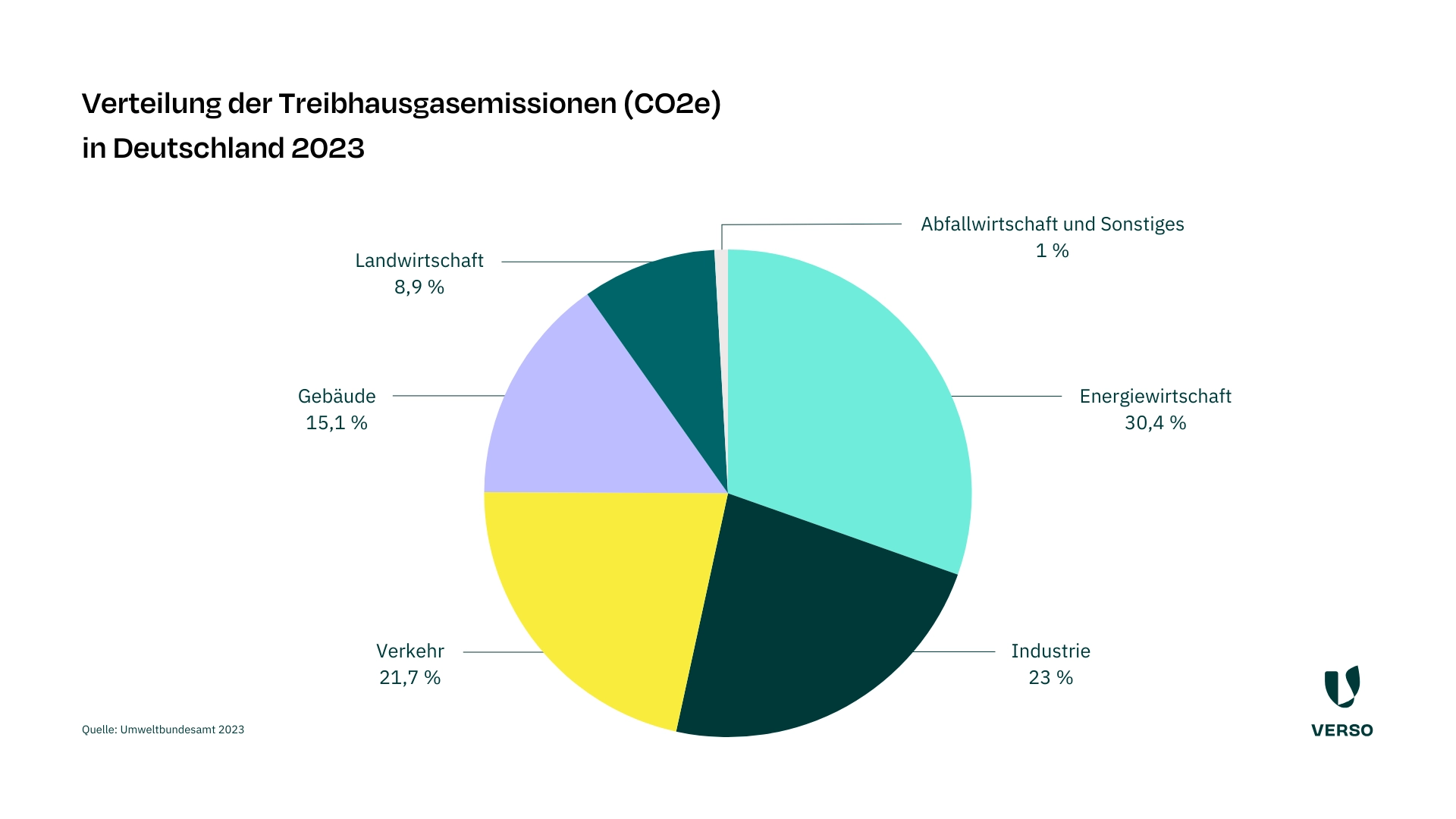
Despite the Paris Climate Agreement, the Green Deal and national laws: The amount of greenhouse gases (GHG) in the atmosphere continues to rise.
And industry is the second largest contributor to these emissions after the energy sector.
As a result, the pressure on companies to focus on their environmental performance, invest in climate protection and reduce their GHG emissions continues to grow.
You may already be facing requirements such as carbon footprinting, meeting climate targets or, more recently, a climate transition plan required by the CSRD.
All of these topics are part of the holistic climate strategy that we are talking about here.
What is a decarbonization strategy?
A decarbonization strategy can be thought of as a cycle: It comprises six steps that you go through in sequence.
After the sixth step, you start again at number one.
With each step, you look at your challenges in more detail and continue to optimize your processes.
You can manage your goals, adapt measures, reduce emissions further and further – and get closer and closer to your Net Zero goal.
These are the 6 steps of the decarbonization strategy:
- Development and recognition of challenges
- Preparation of a greenhouse gas balance sheet to determine the status quo
- Definition of measurable climate targets and measures
- Reducing GHG emissions as far as possible
- Offsetting residual emissions through certified projects from e.g. Climate Grid
- Transparent communication of successes and potential for improvement
Before you go through the process for the first time, we recommend that you introduce a data and process management tool such as VERSO’s Climate Hub into your company.
Important for the decarbonization plan: The software should not only cover the calculation of the carbon footprint, but also enable proper climate management including KPI tracking, target tracking, creation of measures as well as internal and external collaboration options.
The 5 advantages of a decarbonization strategy
In 2023, the opinion research institute Forsa asked German SMEs that will fall under the new CSRD about their status quo with regard to sustainability and climate reporting: 52% are currently working on a climate strategy, 40% have already formulated a concrete strategy and 9% do not yet see a need for one.
We have here Five advantages that a climate strategy entails for your company:
1. be prepared for regulatory pressure
In Germany and the EU, the laws resulting from the European Green Deal in particular are calling on companies to decarbonize and operate in a more environmentally conscious manner.
Examples of legal requirements:
- The CSRD’s ESRS E1 reporting standard alone requires an entire climate transition plan – in addition to the carbon footprint and disclosure of specific climate targets.
- The CSRD is also linked to the EU taxonomy, which requires companies to disclose how sustainable their business activities are according to strict criteria.
- The CBAM will be of interest to companies that import goods from non-EU countries, as the CO2 border adjustment mechanism will in future oblige companies that import emission-intensive goods to purchase certificates to offset the emissions emitted.
At the latest when your company is affected by these regulations, you should have a decarbonization plan up your sleeve – otherwise legal consequences are possible.
However, there are also advantages to starting the project before the law takes effect.
You can then pay attention to limit values and risks as early as the target setting stage, collect the data required for legal compliance during data collection and have the relevant disclosure requirements ready in the right form.
This will save you stress and you will not be surprised by requirements that you cannot fulfill.
2. avoid the risk of greenwashing accusations
Simply calling yourself “green” is a thing of the past.
With the Green Claims Directive the EU is specifying what is greenwashing and what is not.
Soon, companies will have to prove the accuracy of their environmental claims in a scientifically verified manner.
If they fail to do so, they will not only face damage to their image, but also real legal and financial consequences.
They are certainly not deliberately greenwashing – but it can easily happen unknowingly, as many greenwashing accusations originate from marketing activities that portray the company in too good a light.
This happens above all when the company’s sustainability data is not transparent.
However, transparent sustainability communication can succeed with a climate strategy: The number-based strategy, KPI tracking and carbon footprint allow you to communicate comprehensible facts, figures and targets.
3. identify the risks and potential of climate issues
A decarbonization strategy can make a significant contribution to the future viability of your company.
It reveals risks and potential. Risks By collecting detailed data, you can identify risks that often go unnoticed in day-to-day business.
How much electricity do we actually consume?
Which bottlenecks in our production lead to increased CO2 consumption?
You receive figures and comparative values for areas where there was often little clarity before.
Identifying climate risks makes your overall risk management more meaningful.
It helps you to plan more reliably and calculate costs correctly. Potentials In addition, your potentials become visible, such as the environmental commitment of your suppliers, energy savings or the use of renewable energies.
You can measure progress and see which measures may have less impact than expected and where you can actually make a difference.
Ultimately, you can also save costs and increase your efficiency.
4. advantages with stakeholders for loans, investments and tenders
If you have a decarbonization plan ready, you will make yourself popular with your stakeholders.
After all, they are increasingly asking about a company’s commitment to climate protection.
Which stakeholders are you talking about in particular?
- Business partners in tenders: Other companies – especially OEMs – are also affected by statutory ESG requirements.
As a result, they naturally do not want to take on any additional risk and also pay attention to ESG criteria in tenders.
If you already have a solid decarbonization plan in place, this puts you in a better position in the tendering process. - Banks for loans: Banks also face ESG requirements.
In practice, this means that your borrowing costs also depend on your ESG rating: Better rating, cheaper loan.
And your strategy naturally has an impact on your rating. - Investors: The same applies here – investors also include ESG criteria in their investment ratings.
With a decarbonization strategy, a lot of things can be ticked off the list.
And not to forget: The strategy gives investors insights into your company’s potential and options for action.
You can authentically demonstrate how you want to ensure the future viability of your company in harmony with the environment. - Customers: 79% of consumers change their purchasing behavior based on sustainability considerations(study by Capgemini).
This means that you have a competitive advantage if you can make transparent how your company is committed to climate protection and decarbonization.
Consumers now look closely at sustainability communication and are quickly suspicious of general sustainability claims.
You score points with your climate strategy because you can also back up your communication with figures and transparently show your improvement potential and strategy.
5. strengthen supply and business relationships
Companies with which you have a business or supply relationship may also be affected by the CSRD or the German Supply Chain Act, the LkSG.
You now need ESG transparency throughout your supply chain – including climate and CO2 data.
With your climate strategy, you are already prepared for the questionnaires from your business partners.
If you have nothing to show, business relationships may be on the brink of collapse.
How VERSO supports you with your decarbonization strategy
If you want to take a strategic approach to decarbonization, we will be happy to support you: The VERSO Climate Hub, combined with the VERSO ESG Hub, enables you to achieve holistic climate management.
We are also happy to support you with our consulting team: many questions arise, especially in the first year of balancing or strategy development, and it takes some time to familiarize yourself with the topic.
We support you in integrating the processes in your company, in correctly preparing the first carbon footprint and in developing sensible targets, measures and strategies to reduce your emissions.
With this support, we enable you to subsequently implement your climate strategy on your own responsibility.
Does that sound like what you’re looking for?
Please feel free to contact us.
* This information is summarized editorial content and should not be construed as legal advice. VERSO accepts no liability.
This could also be of interest to you:


Subscribe to our newsletter!
Sign up and receive regular news about:
- Pragmatic all-in-one solution for ESG reporting, climate and supply chain management
- Individual advice from the VERSO experts
- Developed with expertise from 12+ years of sustainability management
- Trusted by 250+ customers